It depends on the test. Softeners handle hardness and can tolerate small amounts of iron, but higher iron fouls the resin. Those wells need an iron filter ahead of the softener. See iron filter vs water softener.
24/7 · Weatherford & Parker County
Well Water Filtration & Treatment for Parker County Homes
Iron stains, hard-water scale and rotten-egg smell are common in Trinity aquifer wells. The fix depends on the numbers, so we test before we sell anything.
(817) 382-3840 · Open 24 hours, 7 days a week
Call if you see
- Orange or brown staining in sinks and toilets
- Rotten-egg smell, especially from hot water
- White scale on fixtures and in the water heater
- Cloudy water or grit in aerators
- Positive bacteria test after the well was repaired
Last updated
Water Well Drilling Weatherford designs well water filtration for Parker County homes starting from a lab result. The three complaints we hear most here all have chemical causes: orange stains, scale and a sulfur smell. Each one has a different fix, and the wrong equipment can make another one worse.
Parker County water, in plain terms
- Iron and manganese. Common in Trinity outcrop water. Iron leaves orange-brown stains, manganese leaves black ones, and both feed iron bacteria that leave slime in toilet tanks.
- Hardness. Calcium and magnesium from the limestone. It forms scale in water heaters and fixtures and makes soap harder to rinse off.
- Hydrogen sulfide. The rotten-egg smell, more common in deeper Trinity and Paluxy wells. It corrodes copper and silver and makes water unpleasant to drink.
- TDS and chloride. Higher in some Cross Timbers wells in far-west Parker County. Reverse osmosis at the kitchen tap handles drinking water; whole-house RO rarely makes sense.
Building the treatment train
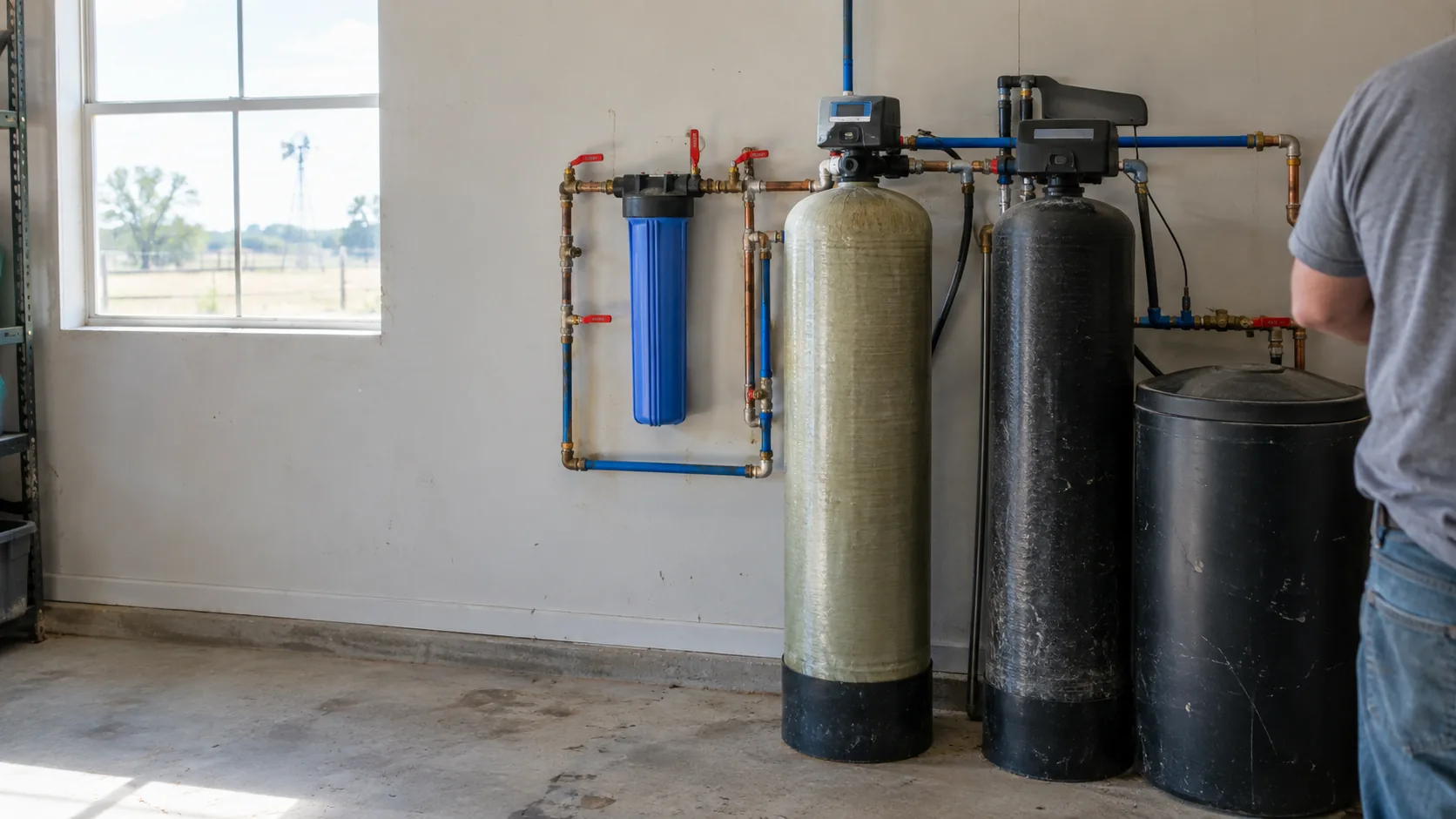
Equipment goes in a fixed order. Sediment comes off first, so grit doesn’t foul everything downstream. Iron and sulfur come next: air injection or chlorine oxidizes them, and a media filter catches what’s left. A softener follows, to handle hardness without iron coating the resin. UV goes last, when bacteria is a concern, because it only works on clear water. Skip a step or change the order and the system stops working, usually within a year.
Sizing to the well, not just the house
Backwashing filters need a burst of flow to clean themselves. On a strong Trinity well that’s no problem. On a 3–5 gpm Cross Timbers well, it can drain the pressure tank and starve the backwash. We measure the well’s delivered flow before choosing media, and on low-yield wells we pair treatment with a storage tank so backwash doesn’t compete with the house.
Test before you buy
Every system starts with well water testing: iron, manganese, hardness, pH, sulfide and TDS, plus bacteria. After installation we test again, so you have numbers showing the equipment works.
Typical cost
$1,500–$6,500 for a whole-house system
A single softener runs about $1,500–$3,000 installed. An iron or sulfur system about $2,000–$4,000. UV about $700–$2,500. Most Parker County homes need two or three stages.
What's included on every well water filtration & treatment call
- Lab results reviewed: iron, manganese, hardness, pH, sulfide, TDS
- Flow rate of the well and house measured for equipment sizing
- Sediment prefilter sized to the pump output
- Iron and sulfur removal by air injection, oxidizing media or catalytic carbon
- Water softener sized to hardness and household use
- UV disinfection where bacteria is a concern
- Bypass valves and a raw-water sample tap before treatment
- Follow-up test to confirm the system is doing its job
Related resources for well water filtration & treatment
Well Water Filtration & Treatment: three ways it gets done
| Item | Cartridge filter only | Softener for everything | Tested treatment train |
|---|---|---|---|
| Iron | Clogs in days | Fouls the resin at high levels | Oxidized and filtered before it reaches the softener |
| Rotten-egg smell | No change | No change | Removed by air injection, chlorination or catalytic carbon |
| Hardness | No change | Softened | Softened, with the softener sized to hardness and use |
| Backwash | N/A | Often more than a low-yield well can deliver | Set to the well's measured flow rate |
How well water filtration & treatment works, start to finish
-
Test the water
No equipment is recommended without a lab panel. If you have a recent result, we start from that.
-
Design the train
Each problem gets the right stage, in the right order. Sediment first, iron and sulfur next, then softening, then UV if needed.
-
Install and set
Equipment is installed with bypasses and a raw-water tap, and backwash is set to what the well can actually deliver.
-
Verify
We retest after installation to confirm iron, hardness and odor are where they should be.
Need well water filtration & treatment in Weatherford or Parker County?
A person answers 24/7 and prices the job before work starts.
Well Water Filtration & Treatment questions
Do I need a water softener or an iron filter?
How do I get rid of the rotten-egg smell in my well water?
The smell is hydrogen sulfide gas. Low levels can be handled with catalytic carbon. Higher levels need air injection or chlorination followed by filtration. If the smell is only in hot water, the water heater's anode rod may be the cause. Our rotten-egg smell guide explains how to tell.
How much does well water treatment cost?
Most whole-house systems cost $1,500 to $6,500 installed, depending on how many stages you need. Hardness plus moderate iron, common in Parker County, typically lands at $2,000–$5,000. See well water filtration system cost.
Can a low-yield well run a backwashing filter?
Only if the backwash rate fits what the well can deliver. Backwashing media filters can need 5–10 gpm for several minutes, which some Cross Timbers wells can't supply. We measure the well first and pick media or a design that fits.
Do you answer after hours and on weekends?
Yes. The phone is answered 24 hours a day, 7 days a week. After-hours work is priced before we roll, and if the fix can safely wait until morning we will tell you so.
Sources
Related well services
-
Well Water Testing
Bacteria, nitrate, iron, hardness, sulfide and methane screening for Parker County wells, with the sample drawn and handled the way the lab requires.
-
Well Rehabilitation
Cleaning, shock chlorination and redevelopment for wells losing yield to iron bacteria, scale or sand.
-
Water Well Service & Repair
Flow tests, well caps, wiring, casing and chlorination for existing wells, plus one number to call when anything on the system acts up.
Request well water filtration & treatment
Tell us what the well is doing and where it is. Not urgent? We'll call back first thing.
Faster by phone, any hour: (817) 382-3840