Once a year for bacteria, nitrate and total dissolved solids, as the Texas Well Owner Network recommends. Test again after flooding, after any repair that opens the well, or whenever the taste, smell or color changes.
24/7 · Weatherford & Parker County
Well Water Testing for Parker County Wells
Clear water isn't necessarily safe water. A lab panel matched to Parker County's known issues tells you what's actually in your well, and what to do about it.
(817) 382-3840 · Open 24 hours, 7 days a week
Call if you see
- New well, new house or first test in over a year
- Rotten-egg smell, metallic taste or orange staining
- Flooding over or near the wellhead
- Someone in the house has a weak immune system or a new baby
- Lender or buyer requires a water test
Last updated
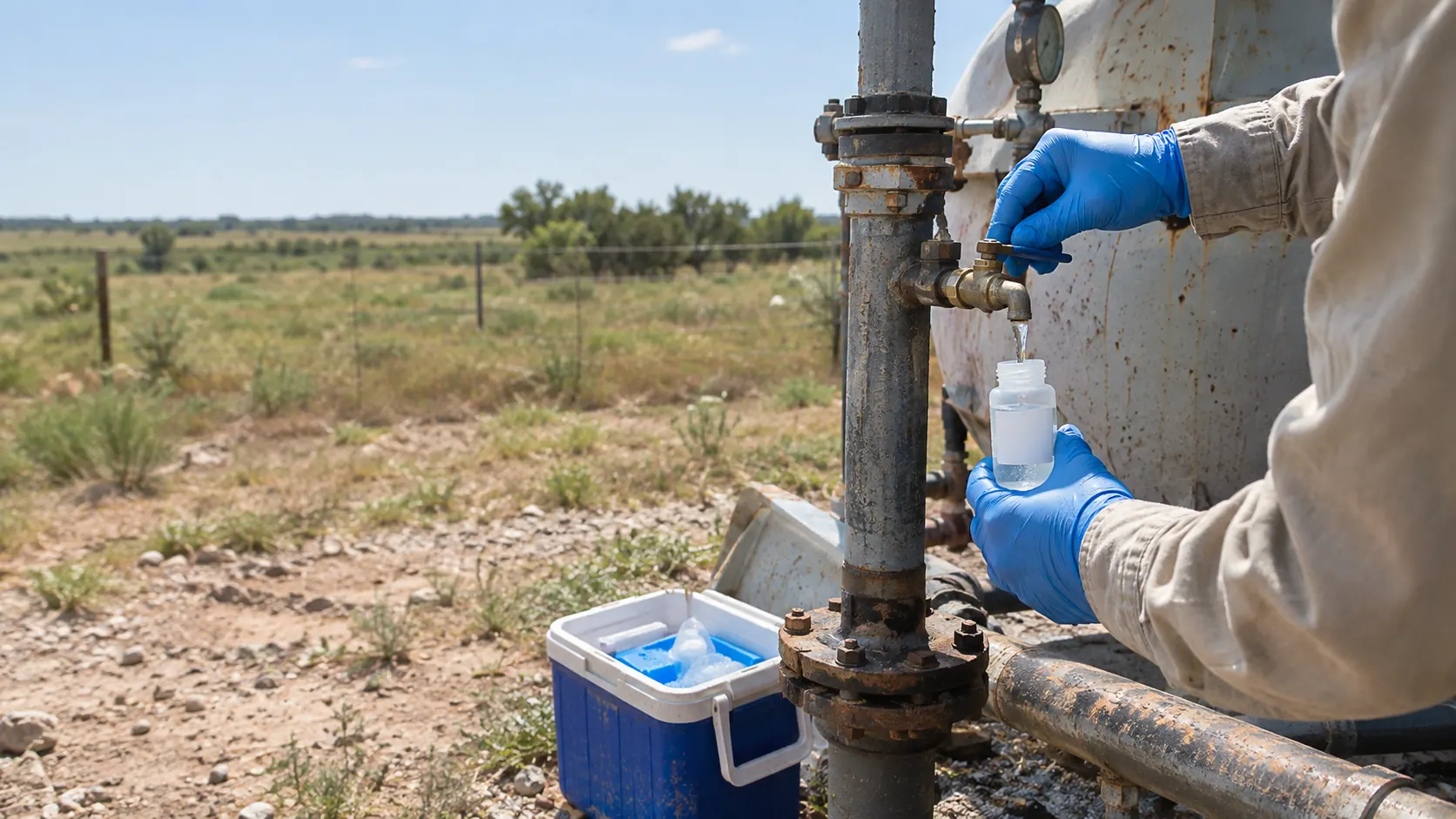
Water Well Drilling Weatherford arranges well water testing for private wells across Parker County, and we sample the way the lab requires, because most bad results come from bad sampling. A private well isn’t a public water system. Nobody tests it unless you do. The Texas Well Owner Network, run through Texas A&M AgriLife, recommends testing every year for bacteria, nitrate and total dissolved solids.
What the basic panel tells you
- Total coliform and E. coli. Coliform means surface water or soil is getting in. E. coli means fecal contamination. Either one points to a cap, seal or casing problem as much as a water problem.
- Nitrate. Drinking water above 10 ppm nitrate-nitrogen is considered unsafe, especially for infants. Septic systems, fertilizer and livestock areas near a shallow well are the usual sources.
- Total dissolved solids. A measure of how much mineral the water carries. High TDS tastes salty and leaves deposits.
Parker County extras
Trinity aquifer water in the outcrop areas is typically hard and high in iron. That shows up as orange staining, a metallic taste and scale in water heaters. Deeper Trinity and Paluxy wells can carry hydrogen sulfide, the rotten-egg smell. In far west Parker County, Cross Timbers wells can run higher in chloride and TDS. And in parts of south Parker and Hood counties, methane has been documented in some wells. We add iron, manganese, hardness, pH and sulfide to the panel before anyone sizes treatment equipment. A softener sized without those numbers is a guess.
Testing for a home sale
Buyers, lenders and inspectors usually want a recent bacteria and nitrate result. FHA guidelines, for example, require a water test when the well sits closer than 100 ft to a septic system. The sample should come from the tap closest to the well and before any softener or filter, unless the treatment is permanently installed and needed to make the water safe. We handle the sample for pre-purchase well inspections the same way.
After a positive result
A positive bacteria test is fixable. We find the likely entry point (a damaged cap, a missing seal, a cracked casing, or a pitless adapter below grade), repair it, shock chlorinate the well and plumbing, then resample. Never treat a positive result with chlorine alone. If the entry point stays open, the bacteria come back.
Typical cost
$100–$350 in lab fees, plus the sampling visit
A basic bacteria and nitrate test is at the low end. A full panel with metals, hardness and sulfide for treatment sizing costs more. Some Texas AgriLife county offices run low-cost screening days for bacteria and nitrate.
Source: Angi, cost of a well inspection and water testing (2026)
What's included on every well water testing call
- Sample drawn at the tap closest to the well, before treatment equipment
- Sterile bottles and chain of custody handled per the lab's method
- Total coliform and E. coli bacteria
- Nitrate and total dissolved solids
- Iron, manganese and hardness for treatment sizing
- Hydrogen sulfide and pH when odor or corrosion is reported
- Methane screening available where gas is suspected
- Results explained, with treatment options only if the numbers call for them
Related resources for well water testing
Well Water Testing: three ways it gets done
| Item | Test strips | Mail-in kit | Lab panel, sampled on site |
|---|---|---|---|
| Bacteria | Not reliable | Often past hold time | Sterile sample, delivered to the lab on time |
| Nitrate | Rough color range | Measured | Measured and compared with the 10 ppm limit |
| Treatment sizing | No | Partial | Iron, manganese, hardness and pH to size equipment correctly |
| Sampling point | Kitchen tap after the softener | Wherever is convenient | Tap closest to the well, before any treatment |
How well water testing works, start to finish
-
Pick the panel
We match the tests to your reason: routine safety, a home sale, a smell or stain, or a problem with treatment equipment.
-
Sample correctly
Bacteria samples come from a disinfected tap before any filter, in sterile bottles, and go to the lab inside the required hold time.
-
Read the results
We go through each number against the drinking-water limit and tell you what, if anything, needs doing.
-
Fix and retest
Bacteria gets shock chlorination and a follow-up sample. Iron, hardness or sulfide gets treatment sized to the results.
Need well water testing in Weatherford or Parker County?
A person answers 24/7 and prices the job before work starts.
Well Water Testing questions
How often should I test my well water?
What should Parker County well owners test for?
Start with coliform and E. coli bacteria, nitrate and TDS. Trinity aquifer water is often hard and can carry iron, and deeper wells can carry hydrogen sulfide, so add iron, manganese, hardness and sulfide before buying treatment. Where gas is suspected, as in parts of south Parker and Hood counties, add a methane screen.
What does it mean if my well tests positive for coliform?
Coliform means surface water or soil is reaching the water. E. coli means fecal contamination and the water should not be drunk untreated. The usual fix is to find the entry point, such as a cracked cap or a missing seal, then shock chlorinate and retest.
Is there methane in Parker County well water?
It has been found in some wells, notably in far south Parker County. Researchers disagree on how much comes from natural shallow gas and how much from drilling. If you smell gas, see bubbling or have sputtering taps, get a methane screen. Our methane guide explains the history and the test.
Do you answer after hours and on weekends?
Yes. The phone is answered 24 hours a day, 7 days a week. After-hours work is priced before we roll, and if the fix can safely wait until morning we will tell you so.
Sources
Related well services
-
Well Water Filtration & Treatment
Iron filters, softeners, sulfur removal, sediment and UV systems chosen from a lab result, not a sales sheet.
-
Water Well Inspection
Pre-purchase well inspections for Parker County property: flow and pressure test, equipment condition, records check and a bacteria sample.
-
Well Rehabilitation
Cleaning, shock chlorination and redevelopment for wells losing yield to iron bacteria, scale or sand.
Request well water testing
Tell us what the well is doing and where it is. Not urgent? We'll call back first thing.
Faster by phone, any hour: (817) 382-3840