Around Weatherford, most new household wells finish between 200 and 340 ft, with a median of 240 ft. Near Aledo the median is 320 ft, and around Granbury 360 ft. We pull the state driller reports for wells near your lot before quoting, so the estimate reflects your neighbors' actual wells.
24/7 · Weatherford & Parker County
Residential Well Drilling for Parker County Homesites
A new household well done in the right order: check the lot and the rules first, then register, drill, case, grout and set a pump sized to what the hole actually produces.
(817) 382-3840 · Open 24 hours, 7 days a week
Call if you see
- Building on raw acreage with no water service
- Old well too shallow or failing
- Adding a second home or shop on the property
- Buying land and need to know if a well is possible
Last updated
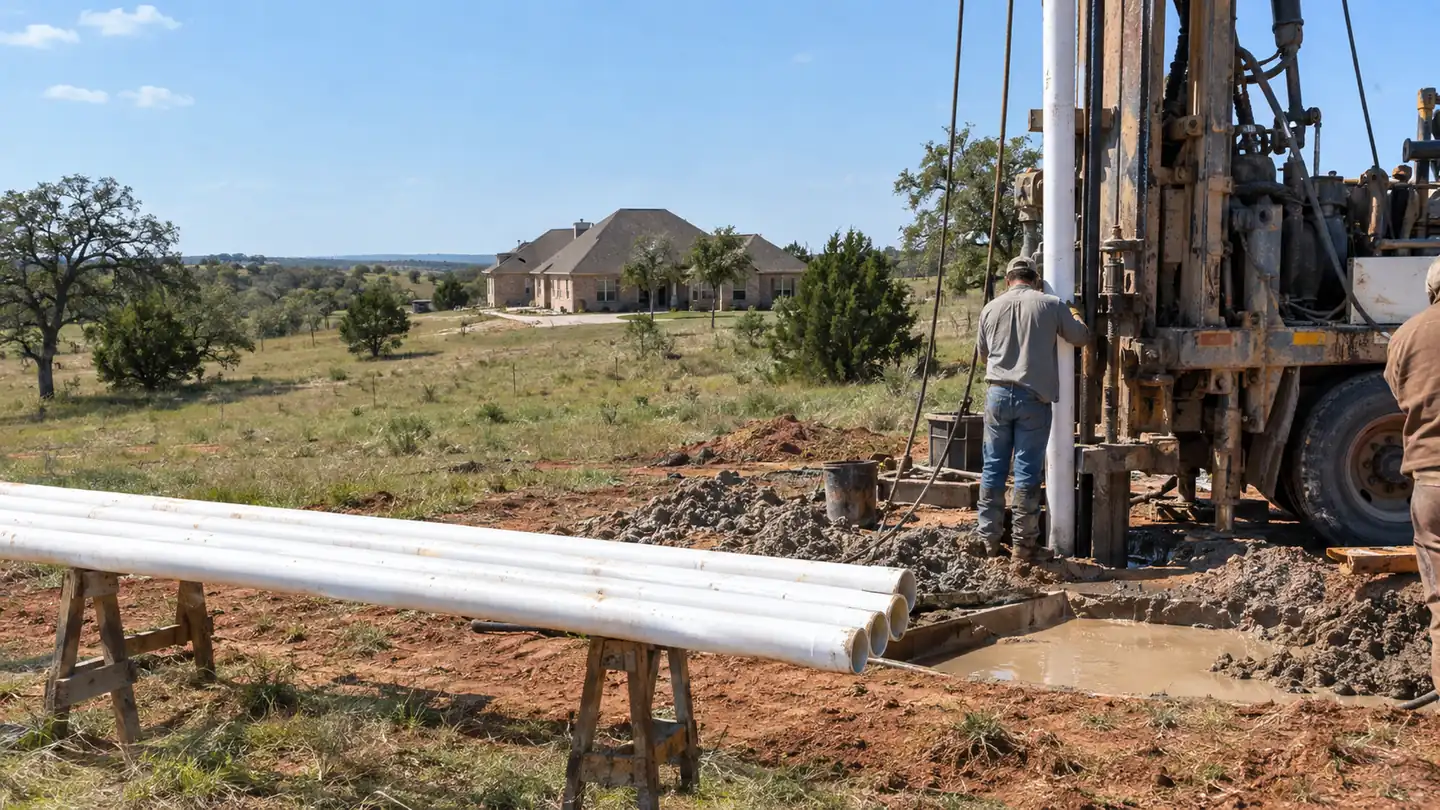
Water Well Drilling Weatherford handles residential well drilling for new homes, rebuilds and acreage across Parker County. The job starts well before the rig shows up. Parker County sees more new household wells than almost anywhere in Texas: drillers filed 4,746 reports for new household wells in the county between January 2021 and September 2026, and 1,287 of them in 2022 alone. That volume is why the Upper Trinity Groundwater Conservation District enforces tract sizes and spacing, and why the siting step matters.
Step one: can a well go here?
Before we price anything, we check four things:
- Tract size. At least 2 acres today. From January 1, 2027, new subdivisions in western Parker County, where the Trinity aquifer is 60 ft thick or less, need 5 acres.
- District spacing. 50 ft from property lines and 150 ft from other registered wells today. Household-class wells move to 100 ft and 300 ft in 2027.
- State setbacks. 50 ft from a septic tank, 100 ft from an absorption field or spray area, and 150 ft from livestock pens and feedlots.
- Access. Firm ground where a rig and support truck can set up.
On smaller lots these rules can leave little room, so it’s worth checking before you close on land. See the Parker County well permit steps.
What’s under your lot
East of Weatherford, the Trinity aquifer’s sands sit under a limestone cap, so wells run deeper: about 320 ft around Aledo. Around Weatherford itself the median is 240 ft. North and west, around Peaster, Poolville and Brock, most wells finish between 200 and 260 ft. In far-west Parker County the Trinity thins out and wells tap the Cross Timbers rock instead. Yields there are often lower and more variable. See how deep wells run across the county.
How the well is built
The borehole is drilled to the producing zone, and casing is set with a screen or open section where the water enters. The space between casing and borehole is sealed with cement from the surface to at least 10 ft down. The surface gets a concrete slab at least 4 inches thick and 2 feet wide around the casing, and the casing stands at least 12 inches above ground under a sanitary cap. Those details are state requirements, and they are also what keeps a new well from being contaminated by its own yard.
Pump, tank and first water
Once the well is finished, we measure how much it produces and where the water stands. The pump is sized to those numbers, not to a catalog default. The tank is sized so the pump runs at least a minute every time it starts, which is what motor makers call for. The well is disinfected, a bacteria sample goes to a lab, and you get a copy of the State Well Report. Want to price your own lot first? Try the well cost calculator.
Typical cost
$12,000–$25,000 all-in for a typical 240-ft well
About $10,000–$17,000 for the drilled, cased well with pump and tank, plus $2,000–$8,000 to trench and connect to the house. East-side and Hood County wells run deeper.
Source: Our Weatherford cost guide (line-item sources listed there)
What's included on every residential well drilling call
- Lot review: tract size, septic layout, property lines and nearby registered wells
- Upper Trinity GCD registration filed before the rig moves in
- Depth estimate from state driller reports for wells near your site
- Drilling, casing and annular cement seal to state standards
- Concrete surface slab and sanitary well cap
- Submersible pump, drop pipe and wire sized to the finished well
- Pressure tank and switch set so the pump runs at least a minute per start
- Disinfection, bacteria sample and State Well Report copy for your records
Related resources for residential well drilling
- How Much Does Water Well Drilling Cost in Weatherford, TX?Cost Guide
- Do You Need a Permit to Drill a Water Well in Parker County?Permit & Code
- How Many Acres Do You Need for a Water Well in Parker County?Permit & Code
- How Deep Are Water Wells in Parker County?Learn
- What Are the Water Well Setback Requirements in Texas?Permit & Code
- Well Water vs City Water in Weatherford: Which Costs Less?Decision Guide
Residential Well Drilling: three ways it gets done
| Item | Do it yourself | Cheapest bid | Done to standard |
|---|---|---|---|
| Siting | Wherever the truck can reach | Closest point to the house | Measured against septic, property lines, livestock areas and registered wells |
| District registration | Skipped | Filed after drilling | Filed and accepted before the rig arrives |
| Surface seal | No grout | Minimal grout, no slab | Cement seal to at least 10 ft, 4-in. slab 2 ft out from casing |
| Pump sizing | Largest pump available | Standard pump regardless of yield | Sized to the measured yield, water level and household demand |
| Records | None | Report filed, copy never sent | State Well Report, pump data and bacteria result handed over |
How residential well drilling works, start to finish
-
Check the lot
We confirm the tract meets district minimums and find a site that clears septic, property-line and neighboring-well setbacks.
-
Register and schedule
The well is registered with the Upper Trinity district ($600 plus a $100 refundable deposit) before drilling, then the rig is scheduled.
-
Drill, case, seal
Drilling usually takes one to three days. The casing is set and cemented, and the slab and cap are finished to state standards.
-
Pump, test, report
The pump and tank go in, the well is disinfected and sampled, and you get the State Well Report the driller files within 60 days.
Need residential well drilling in Weatherford or Parker County?
A person answers 24/7 and prices the job before work starts.
Residential Well Drilling questions
How deep will my new well be?
Can I drill a well on my lot?
Under current Upper Trinity district rules, the tract must be at least 2 acres, and the well must sit 50 ft from property lines and 150 ft from other registered wells. From January 1, 2027, household-class wells need 100 ft and 300 ft, and new subdivisions in western Parker County need 5 acres. See minimum acreage for a water well.
How long does it take to get a new well?
Drilling takes one to three days for most household wells. With registration, pump installation, trenching to the house and the bacteria test, most projects take one to three weeks from signed quote to water in the house.
What if the well doesn't produce enough water?
Some parts of the county, especially the Cross Timbers rock in far-west Parker County, produce only a few gallons a minute. A storage tank with a booster pump lets a low-yield well supply a household by filling the tank slowly around the clock.
Do you answer after hours and on weekends?
Yes. The phone is answered 24 hours a day, 7 days a week. After-hours work is priced before we roll, and if the fix can safely wait until morning we will tell you so.
Sources
Related well services
-
Well Water Testing
Bacteria, nitrate, iron, hardness, sulfide and methane screening for Parker County wells, with the sample drawn and handled the way the lab requires.
-
Well Water Storage Tanks
Storage tank and booster systems that let a low-yield well keep up with a household.
-
Livestock & Ranch Wells
Stock-tank and pasture wells for cattle, horses and small ranches, sized to head count and summer demand.
Request residential well drilling
Tell us what the well is doing and where it is. Not urgent? We'll call back first thing.
Faster by phone, any hour: (817) 382-3840