Texas A&M AgriLife puts peak needs at roughly 7–16 gallons per day for cattle and 8–12 for horses. Hot weather pushes it higher: a 1,000-lb heifer can drink about 20 gallons a day in heat, and lactating cows need much more. We size the well and storage to your worst August day.
24/7 · Weatherford & Parker County
Livestock Well Drilling for Parker County Ranches
A pasture well sized to your herd's August demand, sited to meet the livestock setbacks, and pumped by solar or grid power, whichever fits the fence line.
(817) 382-3840 · Open 24 hours, 7 days a week
Call if you see
- Stock tank or pond drying up in summer
- Hauling water to a back pasture
- Adding cattle or horses to new acreage
- Old windmill well no longer producing
Last updated
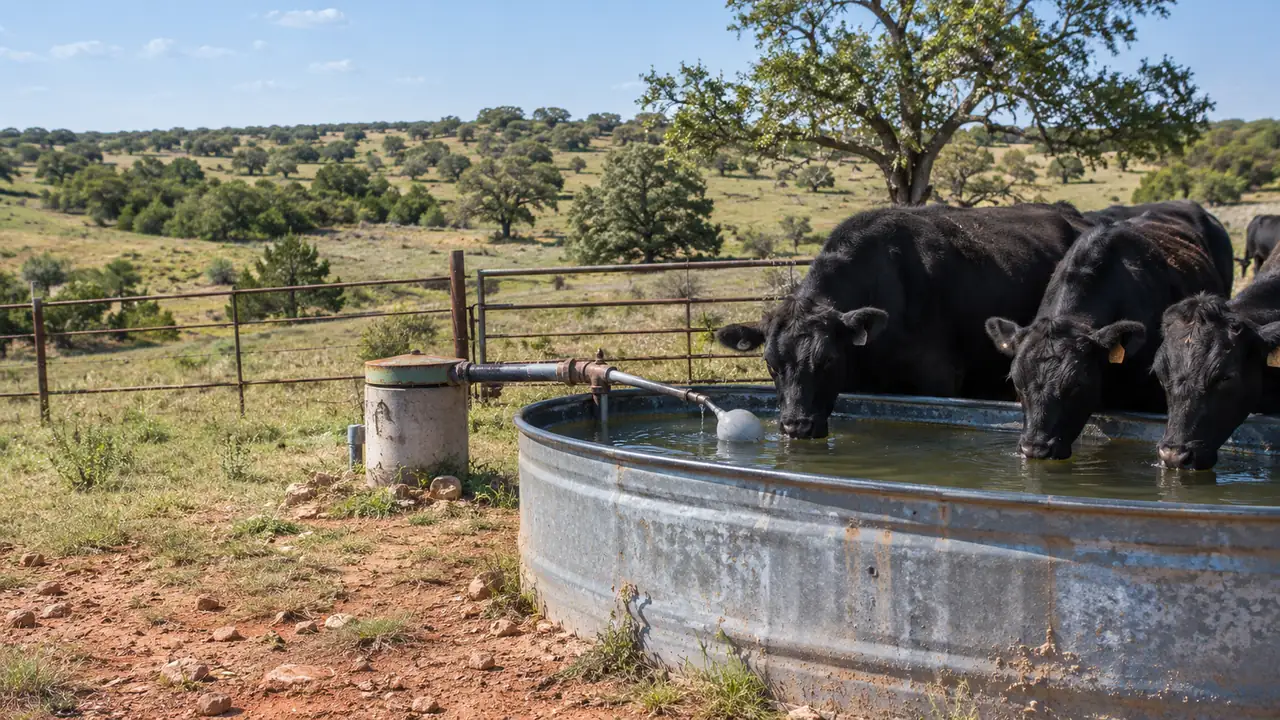
Water Well Drilling Weatherford handles livestock well drilling for cattle, horse and small-acreage ranches across Parker County. Here, pasture water is usually the difference between a stock tank that holds through August and hauling water every other day. A dedicated livestock well gives the herd clean groundwater and takes the pond out of the equation in a drought.
Sizing starts with the herd
Texas A&M AgriLife puts peak daily water needs at about 7–16 gallons per head for cattle and 8–12 for horses. Cattle drink about a gallon more per day for every 10°F above 40°F, so a July afternoon in Parker County sits at the top of that range. Twenty cows and four horses can need roughly 350–450 gallons on a hot day. A modest well can supply that. The pump, storage and trough just need to match.
Siting around the pens
State rules keep a new well at least 150 ft from livestock pens and feedlots, as well as 100 ft from septic absorption fields and 50 ft from property lines. District spacing adds its own distances from other registered wells. On a working ranch, we site the well upslope of the pens where possible and run pipe to the troughs, not the other way around.
Power: grid or solar
Near an existing service, a standard submersible pump on a float-controlled tank is the simplest setup. In a back pasture a long way from power, a solar well pump with enough storage for two or three cloudy days usually costs less than trenching power out.
Storage and freeze protection
A storage tank lets the well pump steadily at the rate it can sustain while the herd drinks in bursts. Float valves stop overflow, and overflow is routed away from the wellhead so the slab doesn’t turn into a mud hole. Exposed piping and valves get freeze protection. February 2021 showed how fast North Texas pasture plumbing can fail.
What's included on every livestock & ranch wells call
- Daily demand worked out from head count, species and season
- Site chosen for access, setbacks and trough placement
- District registration filed before drilling
- Well drilled, cased and sealed to state standards
- Pump sized to yield and demand, grid or solar powered
- Storage tank sized for hot days and cloudy spells
- Float valves and overflow routed away from the wellhead
- Freeze protection on exposed piping
Related resources for livestock & ranch wells
Livestock & Ranch Wells: three ways it gets done
| Item | Hauling water | Pond or tank only | Dedicated well and storage |
|---|---|---|---|
| Summer reliability | Only as reliable as your trailer and time | Fails in drought | Groundwater plus storage sized for peak demand |
| Water quality | Varies | Algae and mud in late summer | Clean groundwater at the trough |
| Labor | Daily | Low until it dries up | Float-controlled; checked weekly |
| Aquifer protection | N/A | N/A | Sealed well sited 150 ft from pens |
How livestock & ranch wells works, start to finish
-
Count the demand
Head count and species set the gallons per day. AgriLife puts peak needs at about 7–16 gallons per head for cattle and 8–12 for horses.
-
Pick the site
The well goes where it meets the livestock setbacks and district spacing and can reach the troughs without long exposed pipe runs.
-
Drill and equip
The well is drilled and sealed, then fitted with a pump and storage that cover peak demand without over-pumping the well.
-
Set the controls
Float valves, a level switch or solar controller keep the tank full without running the well dry or flooding the pen.
Need livestock & ranch wells in Weatherford or Parker County?
A person answers 24/7 and prices the job before work starts.
Livestock & Ranch Wells questions
How much water do cattle and horses need per day?
Does a livestock well need to be registered?
Yes. Every new well in Parker County, including stock wells, must be registered with the Upper Trinity Groundwater Conservation District before drilling. The tract, spacing and setback rules apply the same way they do to household wells.
Solar or electric pump for a back pasture?
If the power line is far away, solar usually wins, because running power a quarter mile can cost more than the solar kit. Solar pumps deliver lower flow and only in daylight, so they're paired with a storage tank that carries the herd through the night and cloudy days. See solar well pumps.
Can I use my house well for livestock?
Often, if the well produces enough and the pump and tank can handle the combined demand. Heavy livestock use on a low-yield well can starve the house, so we measure yield first and may add a storage tank.
Do you answer after hours and on weekends?
Yes. The phone is answered 24 hours a day, 7 days a week. After-hours work is priced before we roll, and if the fix can safely wait until morning we will tell you so.
Sources
Related well services
-
Solar Well Pumps
DC solar pumps for pastures without power, with a storage tank sized for cloudy days.
-
Well Water Storage Tanks
Storage tank and booster systems that let a low-yield well keep up with a household.
-
Residential Well Drilling
New household wells for Parker County acreage: siting, district registration, drilling, casing, grout and a pump sized to the hole.
Request livestock & ranch wells
Tell us what the well is doing and where it is. Not urgent? We'll call back first thing.
Faster by phone, any hour: (817) 382-3840