For livestock and off-grid use, yes, if the system is sized honestly. A solar pump delivers less flow than a grid pump and only in daylight, so it has to be paired with storage. Sized for winter sun and your herd's peak demand, it runs for years with little attention.
24/7 · Weatherford & Parker County
Solar Well Pump Installation for Pastures and Off-Grid Wells
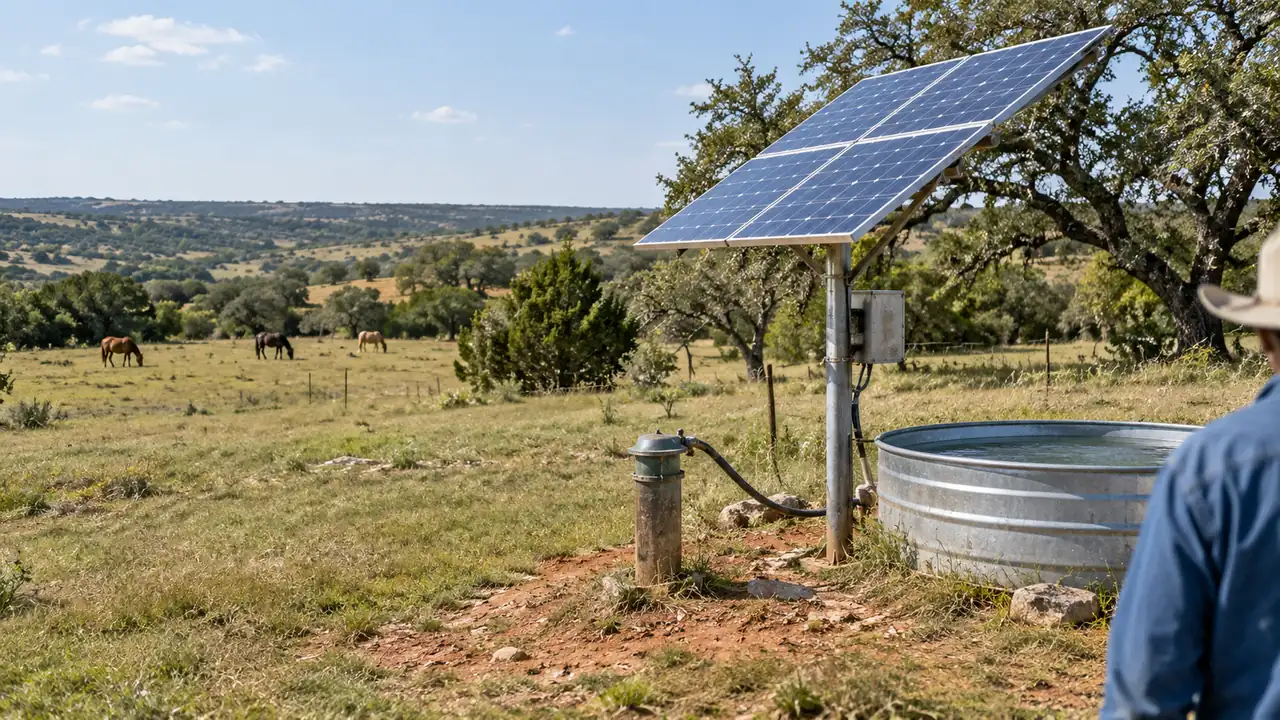
Where the nearest power pole is a long way off, a solar pump and a properly sized storage tank can water a herd without trenching a line across the pasture.
(817) 382-3840 · Open 24 hours, 7 days a week
Call if you see
- Pasture or stock well far from power
- Old windmill that needs replacing
- Generator-run pump that someone has to start daily
- Cabin or barn without electric service
Last updated
Water Well Drilling Weatherford handles solar well pump installation for pastures, hunting cabins and off-grid wells across Parker County. The pitch for solar is simple: bringing power a quarter mile across a pasture can cost more than the pump. What makes a solar system work is matching three numbers: the lift, the daily demand, and the sun you get in December, not June.
Lift is more than depth
A pump works against total lift: from the water level while pumping, up to the storage tank, plus pipe friction on the run to the tank. State driller reports put the median water level in new wells around Peaster and Poolville at 80–90 ft. Around Aledo it’s closer to 176 ft, and around Granbury 260 ft. That difference decides whether a standard DC kit will do or whether you need a deep-well solar pump and a bigger array.
Storage does the heavy lifting
Solar output falls on cloudy days and stops at night. The pump fills a storage tank while the sun is up, and the herd drinks from the tank around the clock. We size storage for two to three days of peak demand. For 20 head of cattle, that’s roughly 1,000–1,500 gallons. A float valve at the trough and dry-run protection in the controller keep the system from overflowing or burning the pump if the well draws down.
Built for North Texas weather
Panels need mounts rated for spring wind, and a hail-exposed array should be tilted and positioned with that in mind. Controllers and wiring go in a vented, shaded enclosure: summer heat in a closed metal box shortens electronics life. Lightning is part of life here, so arrestors and good grounding are part of every install.
Replacing a windmill
Many Parker County pastures still have windmill wells. A solar pump can usually go down the same well after the rod, cylinder and old pipe come out. First we check the casing and water level, and we plug the old well if it isn’t worth reusing.
Typical cost
$2,000–$10,500 installed
About $2,000 is typical for a shallow, modest-demand system. Deep wells of 300 ft or more need larger pumps and arrays, at $3,500–$10,500.
What's included on every solar well pumps call
- Water level and yield measured to set the lift
- Daily demand worked out from head count or household use
- DC submersible pump and controller matched to lift and flow
- Panel array sized for winter sun hours
- Ground or pole mount with hail and wind in mind
- Storage tank and float switch or float valve
- Dry-run and low-level protection wired in
- System tested at the well and at the trough
Related resources for solar well pumps
Solar Well Pumps: three ways it gets done
| Item | Windmill | Generator + pump | Solar pump + storage |
|---|---|---|---|
| Daily attention | Low, but repairs need a tower crew | Someone starts it every day | None; runs whenever the sun is up |
| Output on calm or cloudy days | Stops on calm days | Only when run | Reduced; storage covers the gap |
| Fuel | None | Gasoline or diesel | None |
| Depth range | Limited by the rod and cylinder | Any pump the generator can run | Most kits 200–500 ft; deeper with helical-rotor pumps |
How solar well pumps works, start to finish
-
Measure the well
Water level, yield and pipe run to the tank set the total lift the pump has to work against.
-
Size the system
Pump, panels and storage are sized to your daily demand on a short winter day, not a July noon.
-
Install
The pump is set in the well, panels mounted and wired to the controller, and the storage tank plumbed with float control.
-
Prove it
We confirm flow at the tank, check the dry-run shutoff, and set expectations for cloudy-day output.
Need solar well pumps in Weatherford or Parker County?
A person answers 24/7 and prices the job before work starts.
Solar Well Pumps questions
Are solar well pumps any good?
How deep a well will a solar pump work in?
Most packaged DC kits handle 200–500 ft of total lift. Helical-rotor and positive-displacement solar pumps can go deeper at lower flow. Parker County's typical 200–260 ft wells in the west and north fit comfortably. Deep Aledo and Hood County wells need a careful look at lift.
How much does a solar well pump cost?
Angi's 2026 data puts a typical system around $2,000, with a range of $900–$4,500 for common setups. Deep wells of 300 ft or more cost $3,500–$10,500. Storage tanks and trough plumbing are extra.
Can solar run a household well?
It can, but household demand is spikier than a trough's. Showers and laundry come at night and in the morning. A home on solar needs more storage and often a small booster pump. For most Parker County homes near a power line, a grid pump is simpler.
Do you answer after hours and on weekends?
Yes. The phone is answered 24 hours a day, 7 days a week. After-hours work is priced before we roll, and if the fix can safely wait until morning we will tell you so.
Sources
Related well services
-
Livestock & Ranch Wells
Stock-tank and pasture wells for cattle, horses and small ranches, sized to head count and summer demand.
-
Well Water Storage Tanks
Storage tank and booster systems that let a low-yield well keep up with a household.
-
Well Pump Replacement
Submersible pumps sized to your well's depth, water level and household demand, set on new drop pipe and wire when the old run is worn.
Request solar well pumps
Tell us what the well is doing and where it is. Not urgent? We'll call back first thing.
Faster by phone, any hour: (817) 382-3840