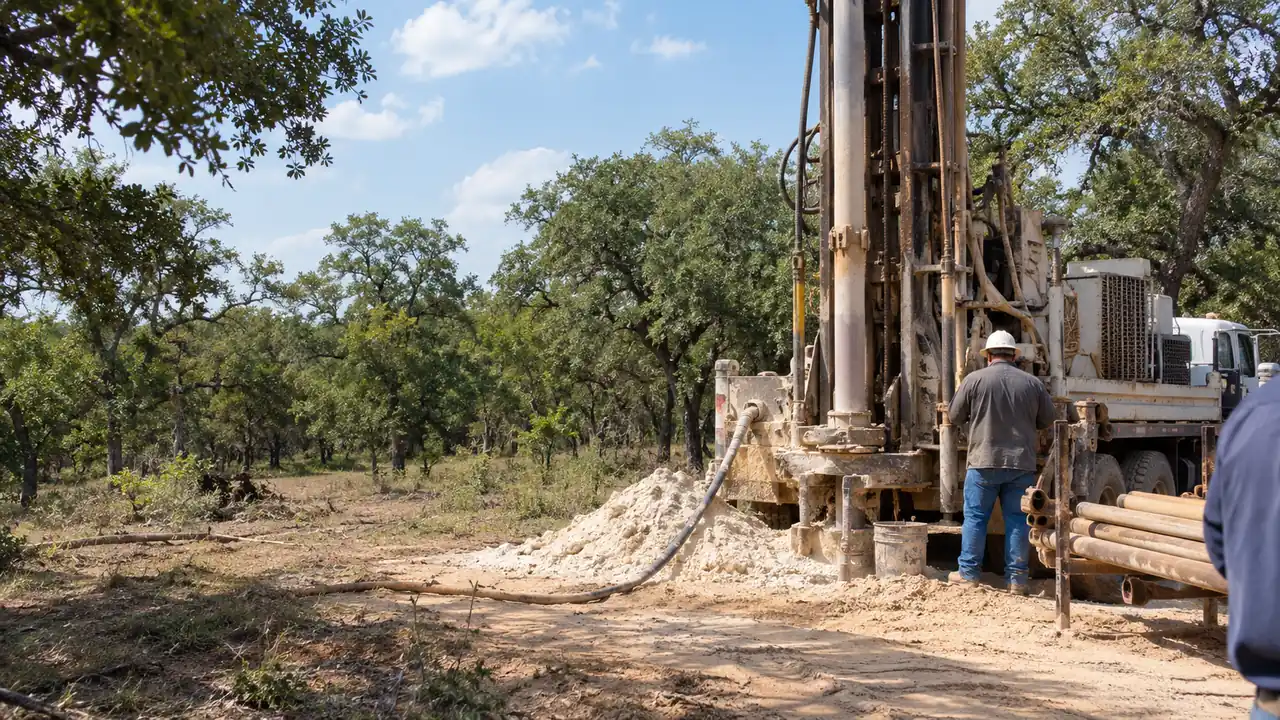
Water Well Drilling Weatherford drills and services water wells in Springtown and across the Parker–Wise county line. It’s a town where the ground makes guessing expensive. Springtown sits where SH 199 crosses FM 51, about 18 miles north of Weatherford. Much of its housing is older homes on larger lots that were built before HOAs, many still on their original wells, alongside newer subdivisions along the highway corridors.
The groundwater picture changes as you head north. The Upper Trinity district’s management plan describes how the Glen Rose limestone thins northward until it disappears around central Wise County. North of that line, the Paluxy and Twin Mountains sands merge into a single unit called the Antlers. Springtown sits on the approach to that transition, and the well records show it. Of the 178 new household wells drilled within about five miles of town since January 2021, 15% finished shallower than 200 ft and 21% went 400 ft or deeper. The median, 240 ft, hides a lot of variety. That’s why we pull the state reports for wells nearest your lot before quoting. Two properties a mile apart can need very different wells.
The records also show depths moving around over time. Wells drilled here in 2011–2015 and 2016–2020 had median depths of 340 and 325 ft. The 2021–2026 median is 240 ft, with water standing about 100 ft down. We can’t tell from the reports alone whether drillers are finding good water shallower or just spreading across more of the county. Either way, a Springtown well quote should be based on neighboring records, not a county average.
Springtown is also where the Upper Trinity Groundwater Conservation District keeps its office, on West Highway 199. That’s handy when a registration needs sorting out. About half of the recent wells in our radius were drilled on the Wise County side. The district’s 2027 rules put a 5-acre minimum on new subdivisions where the Trinity is 60 ft thick or less, and the district’s list of affected areas names western Wise County communities. If you’re buying acreage north of town, we check the tract against the district’s map before you close.
On older properties, the first job is often an inspection: pulling the original report, checking the cap and seal, and making sure the well was ever registered. Many older Springtown wells weren’t. Registering a well drilled before 2009 is free, and it’s worth doing, because a registered well gets spacing protection when neighbors drill.