Water Well Drilling Weatherford drills and services water wells in Azle on both sides of the Parker–Tarrant county line, and the line matters more than most owners expect. Azle sits on SH 199, the old Jacksboro Highway, about 16 miles northwest of downtown Fort Worth. Most of the town is in the northwest corner of Tarrant County, and it extends into Parker County on the west. Its early settlers built along Ash Creek, Silver Creek and Walnut Creek. Today, homes line the west shore of Eagle Mountain Lake and spread out along FM 730 and SH 199.
The Parker County side of Azle belongs to the Upper Trinity Groundwater Conservation District, the same district that covers Weatherford. The Tarrant County side belongs to the Northern Trinity Groundwater Conservation District, a single-county district the Legislature created in 2007. Each district registers wells, sets spacing and charges fees its own way. Upper Trinity requires registration before drilling, at least 2 acres, and today 50 ft from property lines and 150 ft from other registered wells. From January 1, 2027, household-class wells move to 100 ft and 300 ft. Northern Trinity publishes its own quick-reference guide for registration, spacing and exceptions. Before we schedule a rig, we confirm which district your parcel falls in and file with the right one.
Underground, Azle is one of the more predictable parts of our area. Of the 324 new household wells drilled within about five miles of town since January 2021, the median depth is 220 ft, and the middle half fall between 200 and 240 ft. That median has barely moved in 20 years: 200 ft in 2006–2010, 200 ft in 2011–2020, 220 ft now. Water stands about 80 ft down in a typical new well. Shallower wells are cheaper to drill and pump from, but they also sit closer to whatever happens at the surface. So on the smaller lots around the lake, the septic setbacks and a good surface seal matter more.
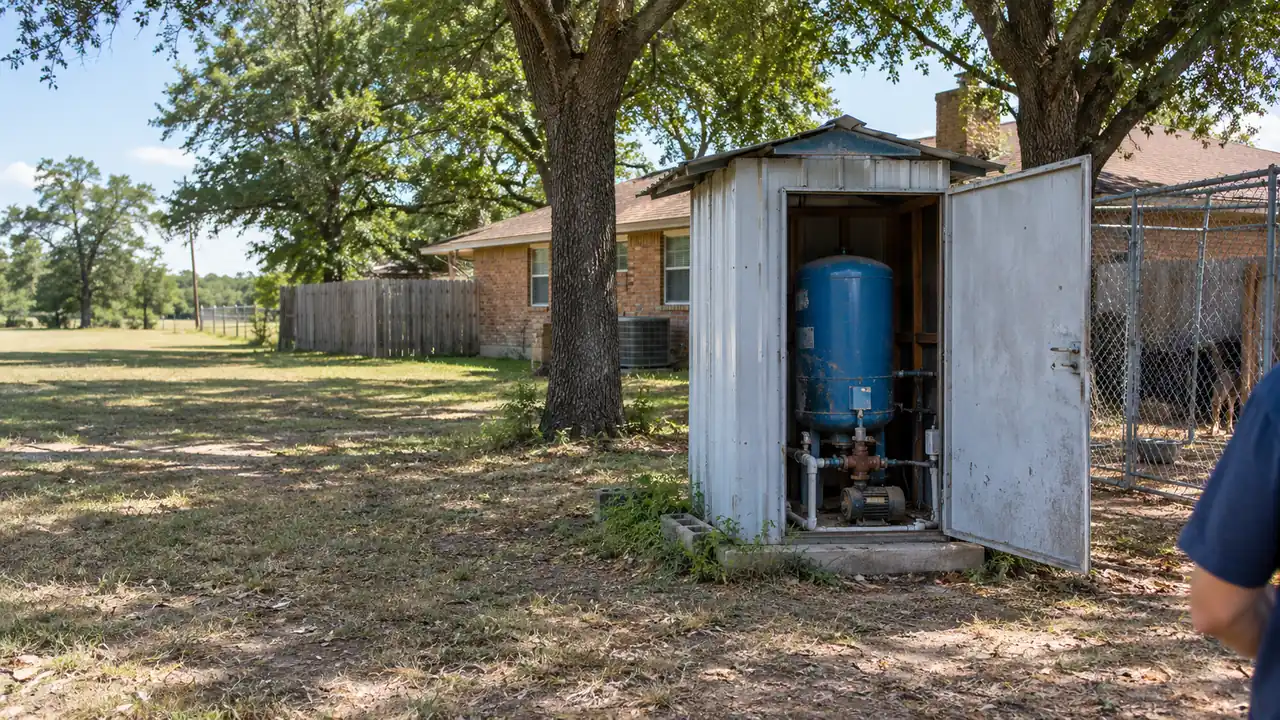
Azle also has a large stock of aging wells. Drillers have filed more than 2,100 household well reports within about five miles of town since 2001. Submersible pumps typically last 8–15 years and bladder tanks 10–15, so many of those systems are due. Most of our Azle calls are for existing wells: a pump that quit after a storm, a waterlogged tank, or a buyer’s inspection before closing on a lake house.