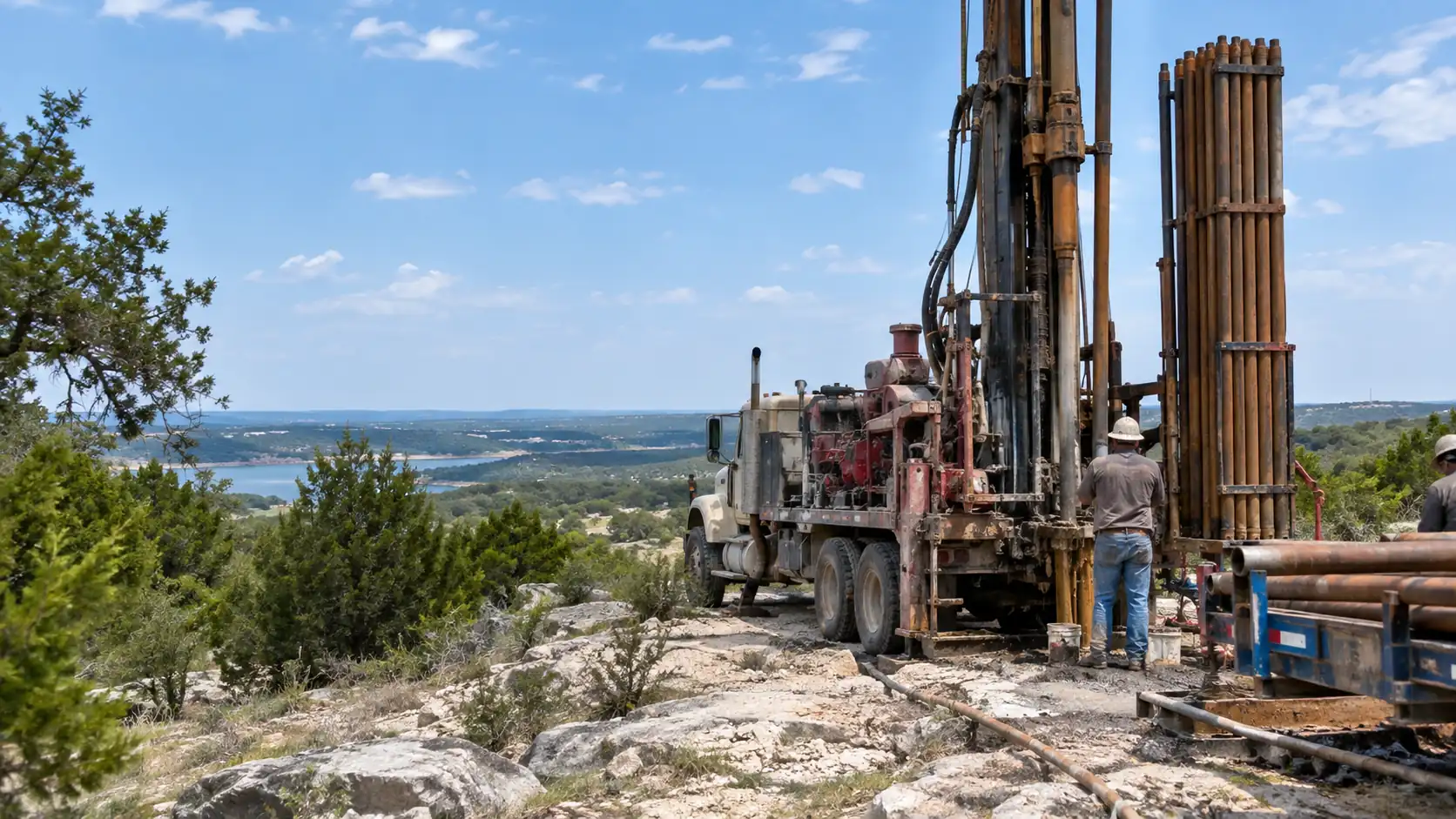
Water Well Drilling Weatherford drills and services water wells in Granbury and across Hood County, where well depth is the first number in every conversation. Granbury is the Hood County seat, built around a historic courthouse square on the Brazos River. The river became Lake Granbury when De Cordova Bend Dam was completed in the late 1960s. DeCordova Bend Estates grew up along the lake at the same time, and Pecan Plantation followed in the early 1970s. Today, acreage communities like Rolling Creek Ranch, Mountain Lakes and Stewart Ranch spread out along US 377 and SH 144.
Hood County is Upper Trinity district territory, the same district as Parker County. Underground, though, it leans deep. The district’s management plan tracks Hood County’s Trinity aquifer as the Paluxy, Glen Rose and Twin Mountains. The Twin Mountains there includes the Travis Peak, Hensell and Hosston sands. Its planning targets allow the deep (downdip) Twin Mountains in Hood County to draw down about 72 ft between 2010 and 2080. In practice, the driller reports show the result. The 157 new household wells drilled within about six miles of Granbury since January 2021 have a median depth of 360 ft, and 41% went 400 ft or deeper. Water stands about 260 ft down in a typical new well, and pumps are set around 310 ft.
The records also show two populations of wells. About a quarter of recent Granbury-area wells stopped short of 200 ft, likely in shallower sands or river alluvium. Most went deep, into the Twin Mountains. The depth trend has also risen: medians of 320–325 ft in 2006–2015, 400 ft in 2016–2020, and 360 ft since. A quote for a Granbury lot starts with the nearest records, not the county average, and it should price a deep-set pump, heavier wire and a correctly sized tank from the start.
Water quality is worth testing here. The Trinity carries iron and hardness, and deeper Twin Mountains wells can carry hydrogen sulfide. Hood and Parker counties were also the focus of methane studies in the 2010s. UT Austin researchers in 2017 attributed most of the methane they found to natural shallow gas, though other work disagreed. A water test that includes a methane screen settles the question for your own well.
For lake-lot owners, the constraint is usually space rather than water. State setbacks from septic systems and district spacing from property lines and neighboring wells can rule out a new well on small lots. In those cases, deepening an existing well or adding treatment may be the practical path.