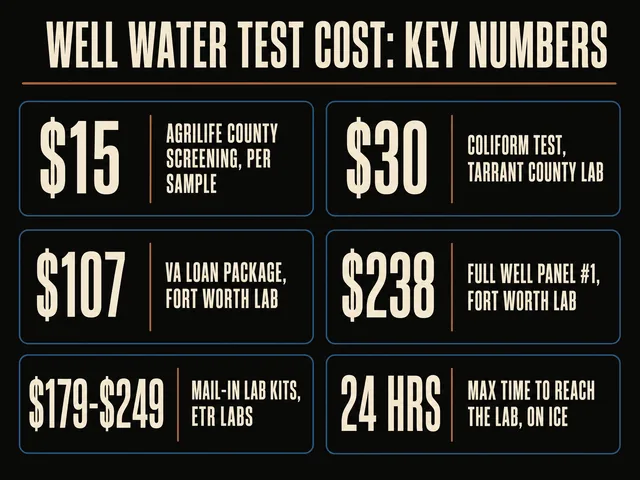
What does a well water test cost in Texas? Well water test cost runs from about $15 for a county screening of bacteria, nitrate and salinity to $238–$248 for a full well panel at the Fort Worth water lab. A bacteria-only test is $30 at the Tarrant County lab, and mail-in kits run $179–$249.
Key takeaways
- Texas A&M AgriLife's Texas Well Owner Network screenings charged $15 per sample in late 2024 and $10 at a 2019 Parker County event, covering coliform bacteria, E. coli, nitrate-nitrogen and salinity (AgriLife Today; TRWD).
- The Tarrant County Public Health lab lists a coliform presence/absence test at $30 per sample (2024 brochure).
- The Fort Worth Water Department lab charges $238 (Panel #1) or $248 (Panel #2) for a full well panel, $107 for a VA loan package, and double for rush results (City of Fort Worth).
- Mail-in lab kits range from $179 (53 substances) to $249 (113 substances) at one accredited lab (ETR Laboratories).
- The EPA recommends testing a private well every year for coliform bacteria, nitrates, total dissolved solids and pH (US EPA).
- The Tarrant lab can reject a sample that is not kept cold, is not delivered within 24 hours, or is not filled to the 120 mL line, so a bad sample can mean paying again.
Water Well Drilling Weatherford hears the same question before almost every pump, treatment or home-purchase job: what does a well water test cost, and which one do I actually need? The honest answer is a ladder of prices, from $15 to several hundred dollars, and the cheapest rung is the right one for some owners and the wrong one for others. This guide lays out the published prices, what each test covers, and how our well water testing work fits in.
How much does a well water test cost in Texas?
A well water test in Texas costs about $15 to $30 for bacteria-focused screening and $107 to $248 for a lab panel, per published local prices. The table below collects the figures from public labs and programs near Weatherford, plus mail-in and inspector prices for comparison.
| Test | Price | What it covers | Source |
|---|---|---|---|
| AgriLife county screening (Texas Well Owner Network) | $15 per sample (Dec. 2024); $10 at a 2019 Parker County event | Total coliform, E. coli, nitrate-nitrogen, salinity | AgriLife Today; TRWD |
| Coliform presence/absence, Tarrant County lab | $30 per sample (2024), +$15 weekend or holiday | Total coliform and E. coli | Tarrant County Public Health |
| VA loan package, Fort Worth lab | $107 standard / $214 rush | Lead, nitrate, nitrite, bacteria | City of Fort Worth |
| VOCs only, Fort Worth lab | $130 standard / $260 rush | Volatile organic compounds | City of Fort Worth |
| Well Water Panel #1, Fort Worth lab | $238 standard / $476 rush | Presence/absence of coliform and E. coli, plus chloride, conductivity, fluoride, iron, nitrate, manganese, pH, sulfate, hardness, TDS | City of Fort Worth |
| Well Water Panel #2, Fort Worth lab | $248 standard / $496 rush | Same, with quantitative coliform and E. coli counts | City of Fort Worth |
| Mail-in lab kit, Basic / Premium | $179 (53 substances) / $249 (113 substances) | Broad contaminant list; accredited lab in Massachusetts | ETR Laboratories |
| Home test strips | $10–$30 | Rough readings; cannot detect bacteria | Mid Atlantic Water |
Standard turnaround at the Fort Worth lab is 11 calendar days, and rush is 5 business days at double the price. Those prices are the lab’s list prices; I confirmed them in October 2026.
What does a well water test actually include?
It depends on the tier. A screening checks the few things that make a well unsafe or obviously off, and a lab panel adds the minerals and metals that decide what treatment you need.
The AgriLife screening covers total coliform bacteria, E. coli, nitrate-nitrogen and salinity, per AgriLife Today. The Fort Worth panels add chloride, conductivity, fluoride, iron, manganese, pH, sulfate, hardness and total dissolved solids. Neither is a full contaminant scan. If your concern is gas, see methane in well water in Parker County, because the EPA lists chloride, sodium, barium and strontium as the contaminants to check near gas drilling.
How often should you test a private well, and what should you test for?
Test every year for total coliform bacteria, nitrates, total dissolved solids and pH. That is the US EPA’s recommendation, and it notes that the EPA does not regulate private wells, so the testing is up to you.
The EPA adds that you should test right away when components are replaced or repaired, when the taste, color or odor changes, or when conditions near the well change. Our rotten egg smell guide covers one of those triggers.
Which well water test should you buy?
Match the test to the reason. The reason decides the price, and buying a bigger test than the situation needs is the most common way to overspend.
| Your situation | Test that fits | Published price |
|---|---|---|
| Routine yearly check | County screening, or a coliform plus nitrate test | $15–$30 per sample |
| After a pump, tank or well repair | Bacteria test | $15–$30 |
| Buying a house with a well | Full panel (Fort Worth Panel #1 or similar) | $238 |
| VA loan | VA loan package | $107 |
| New well, or sizing a filter or softener | Full panel with iron, manganese, hardness, TDS | $238–$248 |
| Strange taste, gas near the property | Panel plus a targeted test, as the lab advises | Ask the lab |
For a home purchase, the Water Systems Council advises testing before closing and making the sales contract contingent on the results, and says FHA-insured loans require water testing. Our guide to buying a house with a well in Texas walks through the whole process, and a water well inspection covers the flow and equipment side; see well inspection cost for what that adds to the price.
What do inspectors and homeowners report paying?
Bundled tests cost far more than the lab fee, and the gap is where most owners overspend. In an InterNACHI inspector forum thread on test packages, one Washington-licensed inspector said a total coliform test costs them $24 at the lab and is charged to the client at $150, and a coliform-plus-nitrate test costs $45 and is charged at $175. The same inspector described a full panel at $375 lab cost, charged at $750 (InterNACHI forum). Another poster said they charge $150 and include a free E. coli follow-up on a positive.
Those are Washington State inspector prices from a forum, not Texas prices, and they include a trip to pick up bottles and drop off samples. They show the pattern, not a rate you will see in Weatherford. You can usually pick up the bottle yourself and pay the lab directly, which is what the $15 to $30 and $238 prices above assume.
One more cost trap: the Mid Atlantic Water guide warns that advertised kit prices often leave out shipping of $15 to $40 and that per-analyte charges of $20 to $60 add up fast when you test items one by one (Mid Atlantic Water). It recommends budgeting $199 to $250 for a proper baseline panel, which lines up with the Fort Worth lab’s $238.
How do you collect a sample so the lab accepts it?
Use the lab’s bottle, fill it to the 120 mL line, keep it cold and get it to the lab within 24 hours. The Tarrant County Public Health brochure is the clearest local checklist, and it says a sample that breaks these rules can be rejected, which means paying again.
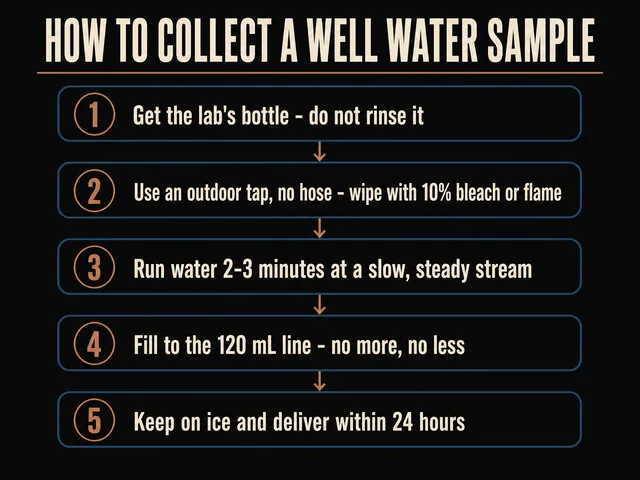
- Pick the tap. An outside faucet that does not leak, with no rubber hose attached. Flame the mouth of the tap with a propane torch or swab it with a 10% bleach solution.
- Run it. Let the water run 2 to 3 minutes at a slow, steady stream to clear the line.
- Fill it. Do not rinse the bottle, do not touch the inside, and fill exactly to the 120 mL line.
- Chill it. Keep it on ice or ice packs, never frozen, and get it to the lab within 24 hours.
- Deliver it on time. The Tarrant lab takes samples until 5 p.m. Monday to Thursday and 4 p.m. on Friday.
A sample that is extremely turbid or silty, or from a leaking bottle, cannot be accepted, per the same brochure. If your water runs cloudy or sandy, sort that out first (see well water sediment), or the lab may turn the sample away and you will pay for a second bottle.
Where can you get a well tested near Weatherford?
Three public routes are within an easy drive, and each has a catch.
- Parker County AgriLife Extension, Weatherford. The Texas Well Owner Network ran a $10 per sample screening here in April 2019 at the Parker County Extension office, 604 N Main St., Suite 200, with a results meeting the next day (TRWD). It is an event, not a standing service, so call the office at 817-598-6168 (the number listed in 2019) to ask for the next date.
- Tarrant County Public Health, North Texas Regional Laboratory, 1101 S. Main Street, Fort Worth, 817-321-4750. Bacteria only, NELAP accredited, $30. Results are emailed within 48 hours.
- Fort Worth Water Department Laboratory, 2600 SE Loop 820, Fort Worth, 817-392-5900. Full well panels. I could not confirm from the lab’s page whether it accepts samples from outside the city, so call before you buy.
For chemistry beyond bacteria, the Tarrant brochure points owners to the Texas Commission on Environmental Quality’s list of certified labs. If you would rather not run bottles across the county line, we can collect and deliver the sample as part of a well water testing visit.
What happens if the test comes back positive?
A positive coliform result means the well, tank or plumbing may be contaminated, not that the well is ruined. The Tarrant brochure says private well owners should treat the well system with chlorine bleach and then submit a new sample.
If it comes back positive again, the next step is finding how bacteria are getting in. Common entry points are a damaged casing, a loose well cap or a bad seal. That is a job for well rehabilitation and, if you want a safety margin, UV disinfection; our well water filtration system cost guide prices UV at $700 to $2,500 installed. For hardness, iron or smell results, see iron filter vs water softener before you buy equipment.
Author’s take: how would I budget for well water testing?
This section is the author’s analysis of the sources above, written by Chris Fugate, a water well driller with 24 years of experience. It draws conclusions from the cited evidence and does not describe any particular customer or job.
Test bacteria and nitrate every year, and buy the full panel once. A $15 to $30 yearly test plus a $238 panel at purchase or on a new well comes to roughly $313 over five years by my arithmetic (five screenings at $15 and one panel). That is less than one inspector-bundled full panel at $750.
Do not buy treatment before you have the panel. The cheapest way to waste $3,000 is to size a softener or iron filter from a guess. The panel’s iron, manganese, hardness and TDS numbers tell you which stages you need, and our cost guide shows what each stage costs.
Skip the $899 mega panel unless you have a specific reason. Broad scans like ETR’s 249-substance kit make sense if there is industrial or gas activity near the well or a health concern. For a typical Parker County home, the Fort Worth-style panel answers the questions a lender or treatment installer will ask. Ask the lab what it recommends before paying extra.
How was this guide researched?
This guide compares published price lists from three public programs (Texas A&M AgriLife’s Texas Well Owner Network, Tarrant County Public Health, and the City of Fort Worth Water Department laboratory), one commercial lab (ETR Laboratories), one national price guide (Mid Atlantic Water), federal guidance (US EPA, Water Systems Council) and one inspector forum thread. It contains no original measurements. Prices are list prices; they change, and I checked them in October 2026. The AgriLife $15 figure is from a December 2024 Wilson County notice and the $10 figure from an April 2019 Parker County event, so confirm the current rate with the county office. The inspector prices are Washington State anecdotes from a forum and are used only to show how bundling inflates cost. If your well is acting up now, call a well tech at the number below.
Frequently asked questions
How much does a well water test cost in Texas?
Published Texas prices run from $15 per sample for an AgriLife county screening and $30 for a bacteria-only lab test to $238–$248 for a full well panel at the Fort Worth water lab. National guides put comprehensive lab panels at $199 to $400.
How much does it cost to test well water for bacteria?
$30 per sample at the Tarrant County Public Health lab (2024 brochure), plus $15 for weekend or holiday service. AgriLife county screenings charged $15 per sample in 2024 and include bacteria and nitrate. A home inspector may charge $150 or more for the same bacteria test.
Is there a cheap way to get my well tested in Parker County?
Yes. The Texas Well Owner Network has run $10 to $15 per sample screenings through the Parker County AgriLife Extension office in Weatherford, with a follow-up meeting to explain results. Events are periodic, so call the office for the next date.
How often should I test my well water?
The EPA recommends every year for total coliform bacteria, nitrates, total dissolved solids and pH. Test sooner after a pump or tank repair, a flood, or any change in taste, color or smell.
Are home test strips good enough for a well?
For a baseline, no. Strips run $10 to $30 but cannot detect bacteria, according to one national price guide, and give rough readings only. A certified lab report is what a lender, buyer or treatment installer will accept.
What does a well water test cost for a home purchase or VA loan?
The Fort Worth lab lists a VA loan package (lead, nitrate, nitrite and bacteria) at $107 and a full panel at $238. FHA-insured loans also require testing. Inspector-bundled tests can cost several times the lab fee.
What happens if my well water tests positive for coliform?
The Tarrant County lab tells private well owners to treat the well system with chlorine bleach and submit a new sample. A repeat positive means finding the entry point, which may call for well rehabilitation or UV disinfection.
Sources
- AgriLife Today, Private water well screenings Dec. 17-18 for Wilson County (Dec. 3, 2024)
- Tarrant Regional Water District, Texas Well Owner Network private water well screening, Weatherford (April 2019)
- Tarrant County Public Health, North Texas Regional Laboratory water brochure (Jan. 2024)
- City of Fort Worth Water Department Laboratory, Well Water Testing
- ETR Laboratories, Well water testing cost
- Mid Atlantic Water, Well water test cost (2026)
- US EPA, Protect your home's water (private wells)
- Water Systems Council, Water testing requirements when buying a home with a well
- InterNACHI forum, What water testing packages to offer