2 wire vs 3 wire well pump: which is better? Neither is better for every well. A 2-wire pump has its starting parts sealed in the motor and needs no control box. A 3-wire pump starts through a control box above ground, so a failed capacitor or relay is fixed without pulling the pump. Above 1.5 hp, single-phase pumps are 3-wire.
Key takeaways
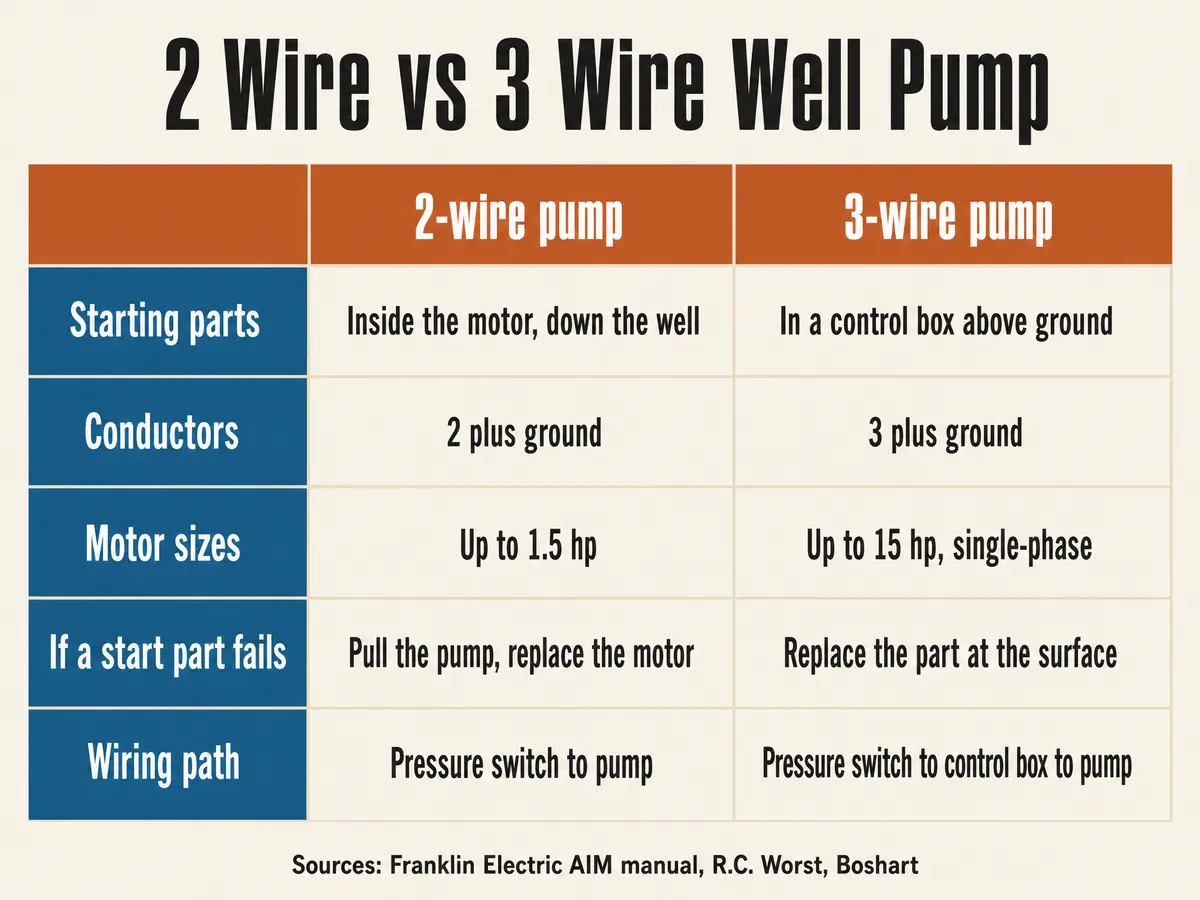
- The only difference is where the starting parts sit: inside the motor on a 2-wire pump, in an above-ground control box on a 3-wire pump (Boshart, Sept. 2022).
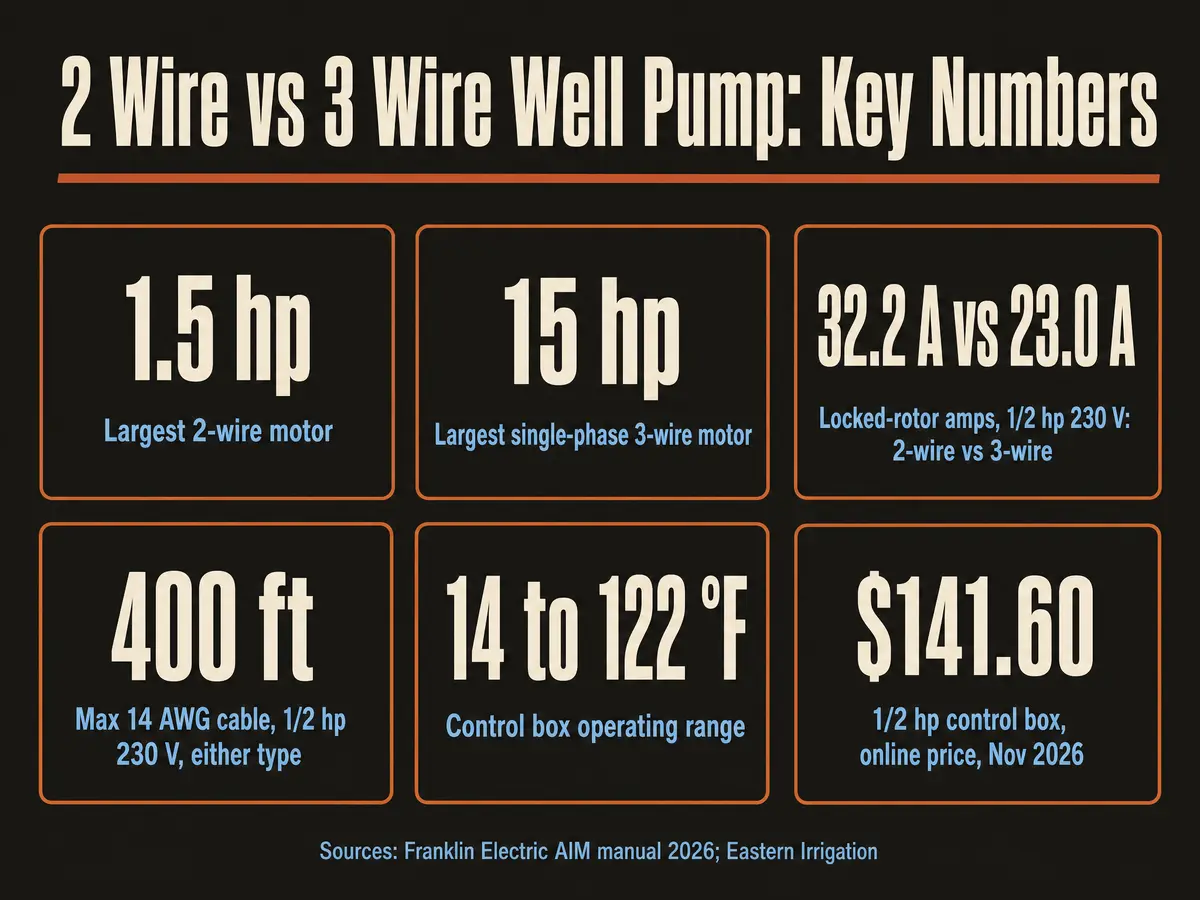
- 2-wire motors are sold only up to 1.5 hp; single-phase 3-wire motors go up to 15 hp (R.C. Worst, Oct. 2018).
- The ground wire is not counted. A 2-wire pump has two conductors plus a green ground, and a 3-wire pump has black, red and yellow plus ground (R.C. Worst).
- At 1/2 hp and 230 V, both types draw the same 5.0 amps at full load, but locked-rotor current is 32.2 A for the 2-wire motor and 23.0 A for the 3-wire (Franklin Electric AIM manual, 2026, p. 39).
- A control box or its capacitor runs $150 to $400 installed and the pump stays in the well; a new submersible at Parker County depths runs $1,800 to $4,500 (our repair cost guide; our replacement cost guide).
- One retailer listed a Franklin 1/2 hp 2-wire motor at $819.20 and the 3-wire motor plus its control box at $852.80 in November 2026, a gap of $33.60 (Eastern Irrigation; our addition).
- Franklin limits control boxes to 14 °F to 122 °F, out of direct sun and out of damp well pits (AIM manual, p. 4).
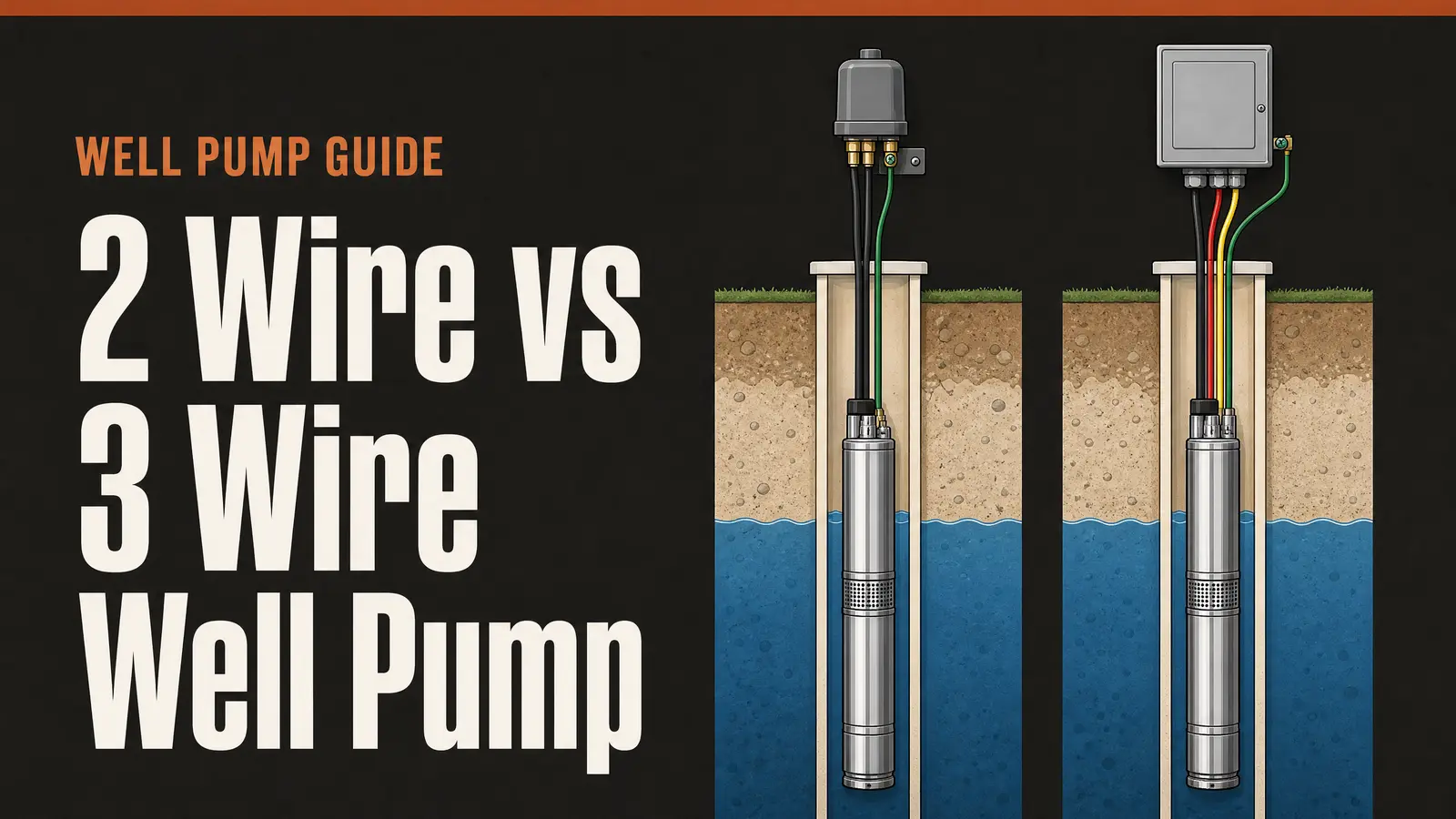
Water Well Drilling Weatherford gets the 2 wire vs 3 wire well pump question on most replacement quotes. Both are submersible pumps, and both lift the same water. They differ in where the motor’s starting parts sit, and that changes what a repair involves ten years on. This guide covers the difference, the size limits, the prices we could verify and how to choose. Our well pump replacement page covers the job itself.
What is the difference between a 2-wire and a 3-wire well pump?
The difference is where the starting parts are. A 2-wire pump has them sealed inside the motor at the bottom of the well. A 3-wire pump has them in a control box mounted above ground. Boshart, a pump parts supplier, puts it this way: “The only difference between 2-wire and 3-wire pumps is where the motor starting components are located” (Boshart, Sept. 2022).
The names do not count the ground. A 2-wire pump has two conductors plus a green ground. A 3-wire pump has black, red and yellow conductors plus a green ground, and the red wire feeds the start winding (R.C. Worst, Oct. 2018). Boshart sells the matching cables as “3-wire” and “4-wire” because it counts the ground, so read a cable label with care.
How does a 2-wire well pump start without a control box?
A 2-wire motor starts through a solid-state switch built into the motor. Franklin Electric calls its version a BIAC switch. A bi-metal strip and a triac power the start winding, then drop it out as the motor comes up to speed, and the motor runs on its main winding alone (Franklin Electric AIM manual, 2026, p. 11).
That switch needs about 5 seconds to reset after the motor stops. Franklin warns that restarting a 2-wire motor within 5 seconds may trip the motor’s overload. This is one reason a waterlogged tank is hard on these pumps, and our well pump short cycling guide covers that fault.
The same switch does one useful thing on a stuck pump. When sand locks the pump, Franklin says the BIAC switch creates a “reverse impact torque” in either direction until the sand is dislodged, and then the motor starts in the correct direction.
How does a 3-wire well pump use its control box?
A 3-wire motor cannot start without its control box. The box holds a start capacitor and a start relay, and in some sizes overload protectors, run capacitors and a contactor. Franklin’s manual says three-wire motors “require the use of control boxes” and that running one without a box, or with the wrong box, “can result in motor failure and voids warranty” (AIM manual, p. 12).
The box and the motor are sold as a matched pair. Franklin calls them “two pieces of one assembly” and tells installers to match horsepower and voltage exactly. Power runs from the breaker to the pressure switch, then to the control box, then down the well on three conductors and a ground.
The box needs a decent place to live. Franklin’s limits are 14 °F to 122 °F, never in direct sunlight, and not in a damp well pit, “to avoid corrosion and component failure” (AIM manual, p. 4). John Schmitt, a columnist for The Driller who wrote that he had sold both types, was blunter: “Control boxes don’t like dampness – or rain and snow for that matter” (The Driller, May 2011).
What do the numbers say about 2 wire vs 3 wire well pumps?
Franklin’s 2026 motor tables show the same running current for both types and a lower starting current for 3-wire. The size ceiling is the hard limit: 2-wire motors stop at 1.5 hp.
| 4-inch motor, 230 V | Full-load amps, 2-wire | Full-load amps, 3-wire | Locked-rotor amps, 2-wire | Locked-rotor amps, 3-wire |
|---|---|---|---|---|
| 1/2 hp | 5.0 | 5.0 | 32.2 | 23.0 |
| 3/4 hp | 6.8 | 6.8 | 40.7 | 34.2 |
| 1 hp | 8.2 | 8.2 | 48.7 | 41.8 |
| 1.5 hp | 10.6 | 10.0 | 66.2 | 51.4 |
The figures are from Franklin’s 4-inch single-phase motor specifications (AIM manual, pp. 39-40), with standard control boxes on the 3-wire side. Locked-rotor current is what the motor pulls at the instant it starts. On these four sizes the 3-wire motor pulls 14% to 29% less. The percentages are our arithmetic.
Lower starting current is not the same as more torque, but the trade says 3-wire starts harder. Schmitt wrote that with a control box “the motor is going to have more starting torque than a two-wire has,” and R.C. Worst lists “greater starter torque” as a 3-wire advantage. We found no published torque figures for either type.
Wire size does not separate them. Franklin prints one cable table for 2-lead and 3-lead motors (AIM manual, p. 50). On 14 AWG copper at 230 V, the limit from the service entrance to the motor is 400 ft at 1/2 hp, 300 ft at 3/4 hp, 250 ft at 1 hp and 190 ft at 1.5 hp. A 3-wire pump needs one more conductor in the cable, and R.C. Worst notes 2-wire cable “is lighter and may cost less.”
What does a 2-wire pump cost compared with a 3-wire pump?
Up front, close to the same. One online retailer’s November 2026 listings put the two Franklin 1/2 hp options within $34 of each other (Eastern Irrigation, viewed Nov. 22, 2026).
| Franklin 4-inch, 1/2 hp, 230 V | Listed price, Nov. 2026 |
|---|---|
| 2-wire motor (2445059004GS) | $819.20 |
| 3-wire motor (2145059004GS) | $711.20 |
| QD control box, 1/2 hp (2801054915) | $141.60 |
| 3-wire motor plus control box | $852.80 |
Those are motor-only list prices from one seller, and both motors showed as sold out when we checked. The pump end, cable, pipe and labor are extra and are the same for either type. The sum and the $33.60 gap are our addition. The same seller listed 3/4 hp and 1 hp control boxes at $156.78 and $152.00.
The real cost gap shows up at the first failure. On a 3-wire system, 2026 cost guides put a new control box at $200 to $400 installed and a capacitor or relay at $150 to $400, with the pump left in the well, as our well pump repair cost article lays out. On a 2-wire pump the same parts are inside the motor. R.C. Worst states the result plainly: “if starting components fail, the motor must be pulled and replaced.” A new submersible at Parker County depths runs $1,800 to $4,500, per our well pump replacement cost guide.
Which one fails more often?
Sources disagree, and none gives failure rates. R.C. Worst says sealed 2-wire parts are “less likely to oxidize and fail,” and that control box parts are “exposed to above ground elements, and more likely to oxidize and fail.” The same company lists 10 to 15 years for a residential 3-wire pump and 8 to 13 for a 2-wire pump (R.C. Worst). So the box may fail sooner while the pump lasts longer.
Sellers split by region. Bob Pelikan wrote in The Driller that “a little more than half of the motors sold in the U.S. are three-wire motors,” and that in some parts of the country “you could not give away a three-wire motor,” with the reverse true elsewhere (The Driller, Aug. 2004). Dave Keith wrote on the Keith Specialty blog in 2011 that a local plumbing contractor had “far fewer problems” with 2-wire pumps and that “at least 90%” of the pumps his company sold were two-wire (Keith Specialty, June 2011). Both articles are old, and neither cites a count.
Lightning is often raised in this debate. Franklin’s manual says all submersible motors require a dedicated surge arrestor, and that motors 5 hp and smaller marked “Equipped with Lightning Arrestors” have one built in. We found no manufacturer data showing either wire type survives a strike better. Our lightning damage to well pumps article covers protection.
What do owners say about living with a control box?
Three public threads show both sides of the 3-wire bargain. None is from Parker County, and two are more than ten years old.
An owner in Kaslo, British Columbia, lost water pressure on a well with a submersible pump. He swapped in the control box cover from an identical well on the property and the water came back. The capacitor’s indicator tab had turned black. He ordered a new capacitor and reported: “Installed it and works great” (permies.com thread). The pump never left the well.
A small-farm owner posting in September 2010 had a 1/2 hp pump with its control box in a cinderblock well pit. The water stopped from time to time until he pulled and reseated the box cover, and a new set of box parts lasted him about a year. Replies blamed moisture on the terminals. One wrote that “a control box will last half as long as the pump so most pumps go through 2 in a lifetime,” and that yearly failure pointed to a problem (Straight Dope, Sept. 2010). The thread records no final fix.
A third owner, in June 2015, found a melted capacitor, replaced the whole control box, and watched the new capacitor leak and smoke on power-up. Replies said the box was a symptom and pointed to the motor, relay or wiring. He was told, “You need to call someone,” and agreed (Straight Dope, June 2015). A cheap box does not help when the fault is down the hole.
Which should you choose for a Parker County well?
Start with horsepower, then the box location, then service. For most household wells here, either type will work.
- Above 1.5 hp, it is 3-wire. Boshart’s advice for motors over 1-1/2 hp is “to go with a 3-wire well pump to ensure it starts and runs properly.” Deep irrigation and stock wells land here.
- No dry, shaded spot for a box favors 2-wire. A metal well house in Texas summer sun, or a damp pit, is outside Franklin’s limits for a control box.
- A long pull favors 3-wire. The deeper the pump, the more a pull costs, and the more a surface repair is worth. The median new Parker County well is 240 ft, per our guide to how deep water wells are in Parker County.
- Match what is in the well. A well wired for 3-wire can take a 2-wire pump of 1.5 hp or less. Going from 2-wire to 3-wire means new cable to the pump. Schmitt wrote that “you can replace a three-wire with a two-wire easily, but going the other way is going to be difficult and expensive.”
Check cable length against Franklin’s table before sizing up. A 1 hp pump set at 220 ft with a 60 ft run from the panel has 280 ft of cable. That is over the 250 ft limit for 14 AWG and inside the 400 ft limit for 12 AWG. The example is ours, and the table is the same for both wire types.
Constant pressure does not decide it either. Franklin’s SubDrive Utility drive is built for 115 V and 230 V single-phase two-wire systems and also runs 230 V three-wire motors, up to 2 hp (Franklin Electric). Our guide to how to increase well water pressure covers when a drive is worth it, and submersible vs jet pump covers the choice that comes before this one.
Our take: what I would install
This section is the author’s analysis of the sources above, written by Chris Fugate, a water well driller with 24 years of experience. It draws conclusions from the cited evidence and does not describe any particular customer or job.
Up to 1 hp with a dry, shaded place for the box, I lean 3-wire. The listed parts cost about the same. A capacitor or relay is the kind of part that fails, and the sources agree it is a surface repair on a 3-wire system and a pump pull on a 2-wire one. At 240 ft, that is a wide gap in price.
Where the box would bake or sit damp, I lean 2-wire. The 2010 well-pit thread shows what a bad location does: a box replaced every year. A sealed motor avoids that, and Franklin’s own limits say the box should not be there.
Do not let the wire count pick the pump. Size the pump to the well and the house first. Our what is a good gpm for a well data helps with that, and tank size and cycling will decide how long either motor lasts.
A new box is a test, not a cure. If a replacement capacitor fails at once, stop. The 2015 thread ended the right way, with a call to someone who could test the motor and cable.
When should you call a well technician?
Call when a pump hums and will not start, when a control box trips or smells burnt, or before you buy a replacement pump of a different wire type. Control boxes carry 230 volts and a charged capacitor. In Texas, anyone who installs a well pump for pay needs a pump installer license, and our guide on how to check a well driller license in Texas shows how to verify one.
Our how to tell if a well pump is bad guide lists the checks that come before a pull. For a fault tonight, see well pump repair, or request a site visit to price a replacement either way.
How was this guide researched?
This guide draws on Franklin Electric’s 2026 AIM manual, two trade articles from The Driller (2004 and 2011), supplier articles from R.C. Worst (2018), Boshart (2022) and Keith Specialty (2011), one retailer’s listed prices viewed on November 22, 2026, and three public forum threads. Percentages, sums and the cable example are our arithmetic. Motor figures are Franklin’s and other brands differ. We could not open the Reddit, Terry Love, TractorByNet or Mike Holt threads that rank for this topic, so none are used. No pump was tested for this guide.
Frequently asked questions
Is a 2-wire or 3-wire well pump better?
Neither wins everywhere. Bob Pelikan wrote in The Driller that the choice is strictly a matter of personal preference for motors both types cover. A 2-wire pump is simpler to install. A 3-wire pump lets a technician replace a failed capacitor or relay at the surface. Above 1.5 hp, 3-wire is the only single-phase option.
Can you run a 3-wire well pump without a control box?
No. Franklin Electric's manual says single-phase three-wire submersible motors require a control box, and that running one without a box, or with the wrong box, can cause motor failure and voids the warranty. The box holds the start capacitor and relay the motor needs to start.
How do I tell if my well pump is 2-wire or 3-wire?
Look for a control box, a grey metal box near the pressure tank, between the pressure switch and the well. A control box means a 3-wire pump. At the wellhead, a 3-wire pump has black, red and yellow conductors plus a green ground; a 2-wire pump has two conductors plus ground.
Can I replace a 3-wire pump with a 2-wire pump?
Usually yes, if the new pump is 1.5 hp or smaller. John Schmitt wrote in The Driller that you can replace a three-wire with a two-wire easily, while going the other way is difficult and expensive because the well lacks the right wiring. The control box comes out and the pump is fed from the pressure switch.
Does a 3-wire well pump last longer than a 2-wire pump?
One seller says so. R.C. Worst lists 10 to 15 years for a residential 3-wire pump and 8 to 13 years for a 2-wire pump. Franklin's manual gives no separate life for either. Cycling, water quality and voltage do more to set pump life than the wire count.
Do 2-wire and 3-wire pumps need different wire sizes?
No. Franklin's cable table is the same for both: at 230 V on 14 AWG copper, the limit from the service entrance to the motor is 400 ft at 1/2 hp, 300 ft at 3/4 hp and 250 ft at 1 hp. A 3-wire pump needs one more conductor in the cable.
What does a well pump control box cost?
The part is cheap. One retailer listed Franklin QD control boxes at $141.60 for 1/2 hp, $156.78 for 3/4 hp and $152.00 for 1 hp in November 2026. Installed, 2026 cost guides put a control box at $200 to $400 and a capacitor or relay at $150 to $400.
Sources
- Franklin Electric, AIM Manual: 60 Hz Submersible Systems (2026 edition)
- R.C. Worst & Company, 2-Wire Versus 3-Wire Well Pump Motors (Oct. 31, 2018)
- Boshart Industries, What the heck is 2 vs. 3 or 4 Wire Pump Cable? (Sept. 16, 2022)
- John Schmitt, Let Me Tell Ya: More about Submersible Pumps, The Driller (May 1, 2011)
- Bob Pelikan, Single-phase Electrical Components, The Driller (Aug. 1, 2004)
- Dave Keith, Submersible pumps: 2 or 3 wire?, Keith Specialty blog (June 1, 2011)
- Eastern Irrigation, Franklin Electric control box and motor listings (viewed Nov. 22, 2026)
- Franklin Electric, SubDrive Utility product page
- permies.com, Submersible Motor control Capacitor replacement (forum thread)
- Straight Dope Message Board, Well Pump and control box issues (Sept. 22-24, 2010)
- Straight Dope Message Board, Water well start capacitor burns (June 13, 2015)
- R.C. Worst & Company, How Long Should My Submersible Well Pump Last?