Why does a well pump short cycle? Well pump short cycling, the pump starting and stopping every few seconds instead of running at least one minute, usually means the pressure tank has lost its air charge. Next suspects are a worn pressure switch, a leak or a stuck-open check valve, and a tank too small for the pump.
Key takeaways
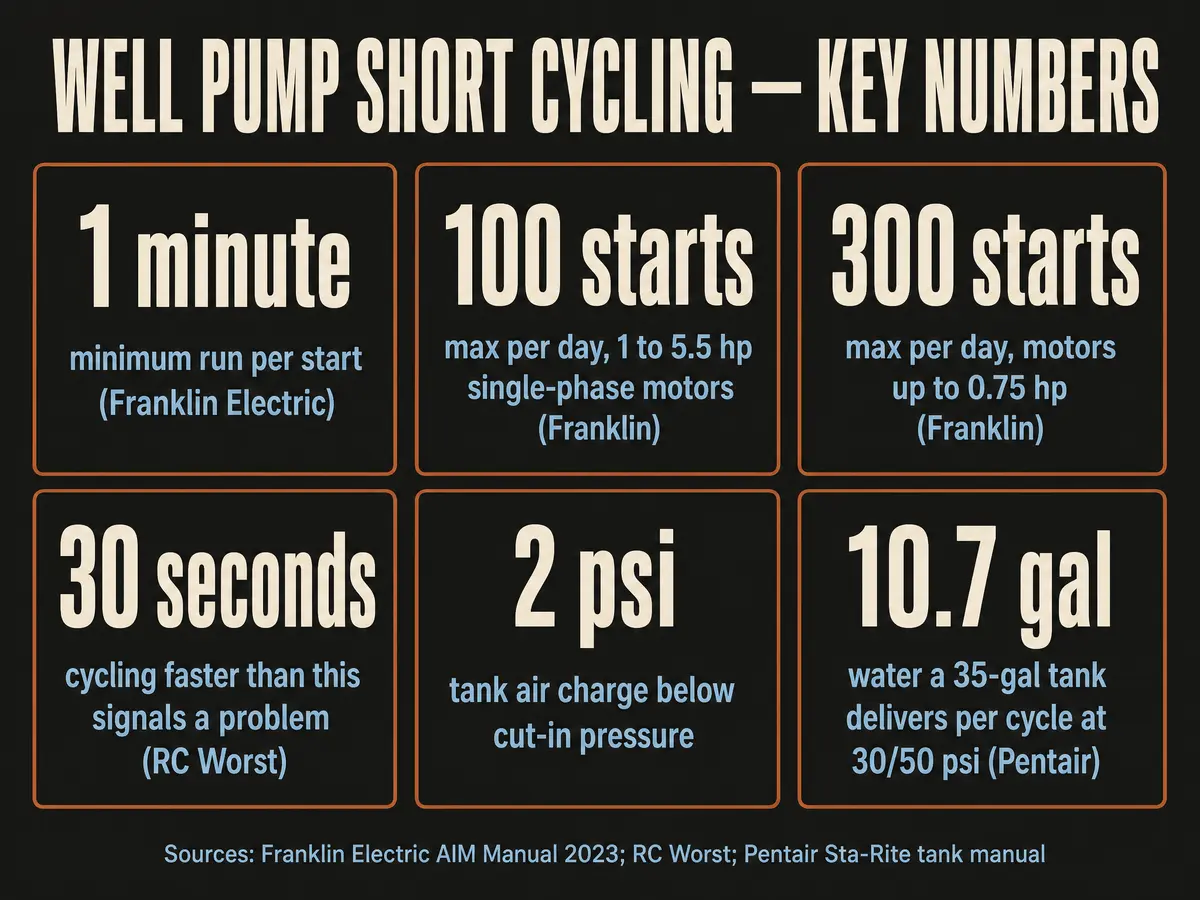
- Franklin Electric says a submersible motor should run at least 1 minute per start, and allows 100 starts a day for 1 to 5.5 hp single-phase motors and 300 for motors up to 0.75 hp (Franklin Electric AIM Manual, 2023).
- RC Worst treats a pressure switch cycling more than once every 30 seconds as rapid cycling, and lists four causes: switch, waterlogged tank, a leak and a check valve stuck open (RC Worst, 2017).
- InspectApedia's Daniel Friedman calls a lost tank air charge "perhaps the most common cause" of short cycling (InspectApedia).
- A 35-gallon tank at 30/50 psi delivers about 10.7 gallons per cycle, roughly one minute of run time for a 10 gpm pump (Pentair Sta-Rite tank manual).
- The tank's air charge should read about 2 psi below cut-in with the system drained: 28 psi on a 30/50 switch, 38 psi on 40/60.
- Fixes run $150–$300 for a switch and $800–$1,800 for an installed tank, against $1,800–$4,500 for the submersible that short cycling wears out (tank cost guide; pump cost guide).
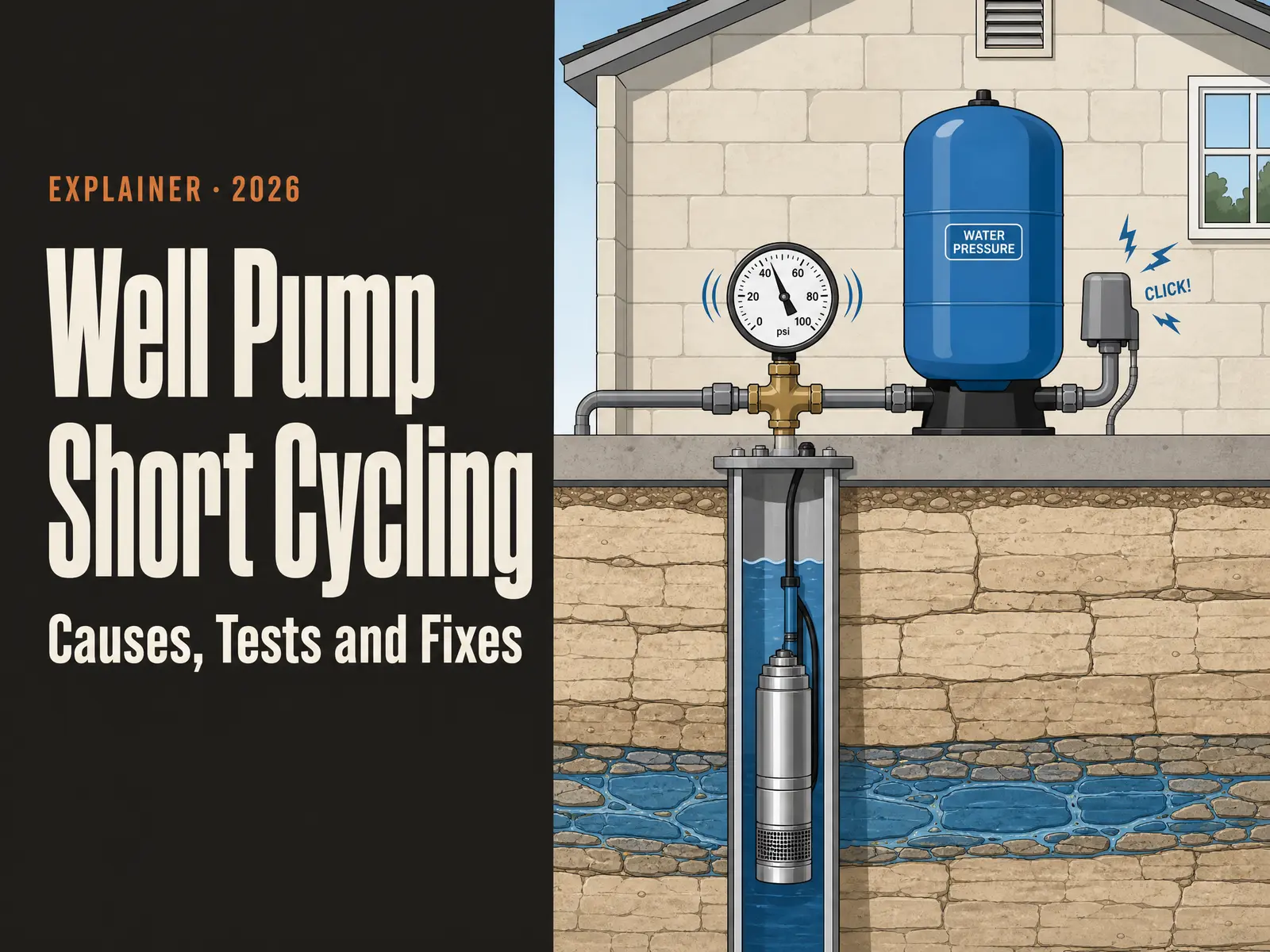
Well pump short cycling is one of the most common calls Water Well Drilling Weatherford hears from Parker County homeowners: the switch clicks, the pump runs a few seconds, stops, and starts again while the shower is on. The pump is rarely the cause, but it is what pays for the problem. Below is why short cycling happens, the order to test the causes in, the numbers a technician works from, and when well pressure tank replacement is the right fix.
What is well pump short cycling?
Well pump short cycling is a pump that starts and stops too often, running seconds instead of minutes each time. RC Worst, a pump distributor that trains installers, treats cycling “more than once every 30 seconds” as the threshold for rapid cycling. InspectApedia describes the classic pattern as on and off “perhaps every 10 to 20 seconds or even more frequently.”
The normal pattern looks very different. Open a tap and the tank pushes water out until pressure falls to the cut-in setting, often 30 or 40 psi. The pump then starts, refills the tank to cut-out, 50 or 60 psi, and stops. With a healthy tank, that run lasts a minute or more.
Short cycling is not the same as a pump that never stops. If yours runs continuously, see why a well pump runs constantly. If it starts every minute or two with every tap closed, that is a leak or a check valve, covered below.
Why does short cycling damage a well pump?
Every start heats the motor windings, and the motor needs run time to shed that heat. Franklin Electric’s AIM Manual, the installer reference for its submersible motors, says to run the motor at least one minute per start.
Franklin also caps how often a motor should start. Its table allows 300 starts in 24 hours for single-phase motors up to 0.75 hp and 100 for 1 to 5.5 hp. It warns that excessive cycling shortens the life of switches, starters, relays and capacitors and can damage splines and bearings.
A pump short cycling every 15 seconds through a 10-minute shower starts about 40 times. A household that showers, cooks and does laundry can pass 100 starts before lunch. RC Worst’s 2020 article contrasts a home averaging 10 cycles a day, which it expects to last decades, with one cycling “over 300 times per day,” which it doubts would last two years. Our pump lifespan guide covers the other things that shorten pump life.
What causes a well pump to short cycle?
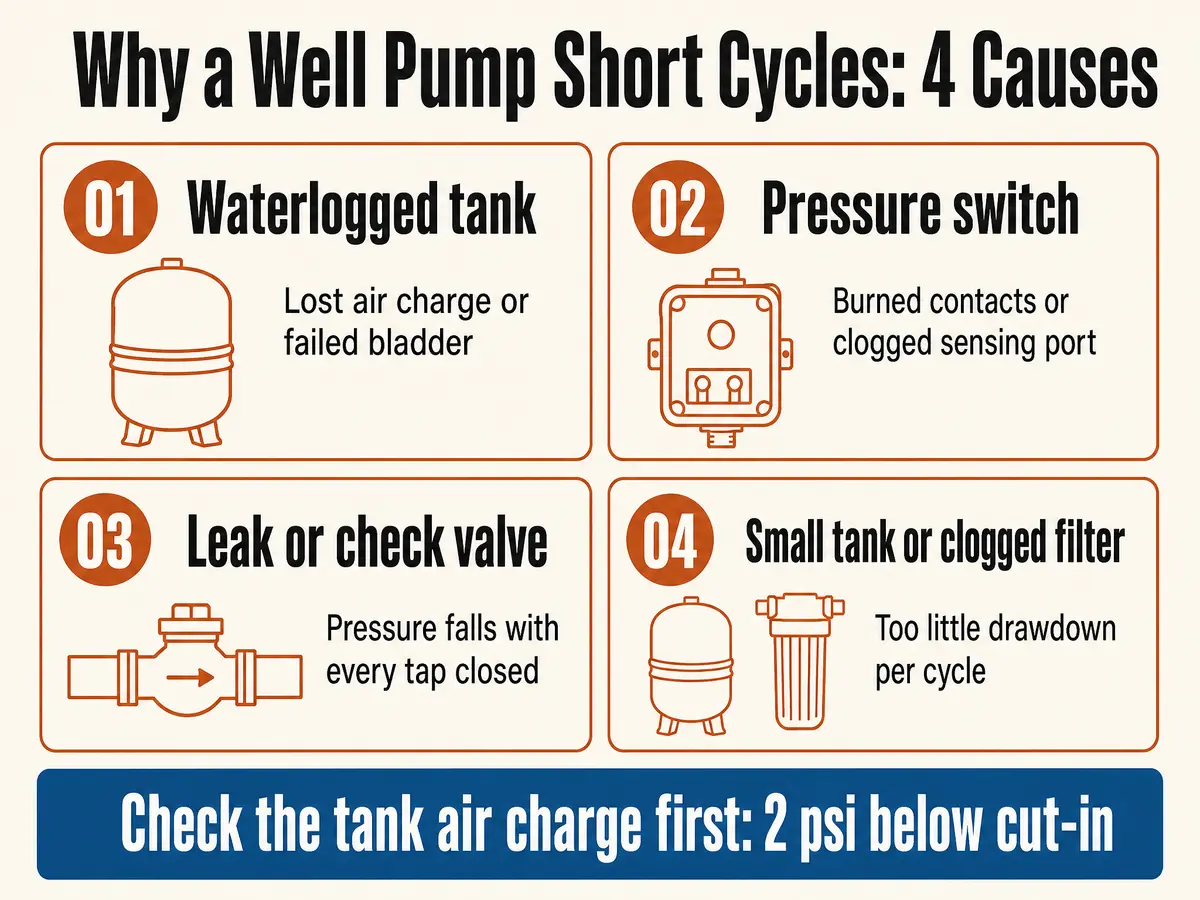
Four causes cover nearly every case: a waterlogged pressure tank, a faulty pressure switch, a leak or stuck-open check valve, and a tank too small for the pump or a clogged filter. InspectApedia’s cause list puts the tank’s lost air charge first, calling it “perhaps the most common cause.”
This table matches each cause to the symptom that points to it and the test that confirms it. It follows the cause lists from RC Worst and InspectApedia.
| Cause | What you notice | How it is confirmed | Typical fix |
|---|---|---|---|
| Waterlogged tank (lost air or failed bladder) | Starts every few seconds with a tap open; pressure drops cut-out to cut-in in seconds | Tire gauge on the drained tank’s air valve reads low, or water comes out | Recharge air, or replace the tank |
| Pressure switch | Clicking or chatter; cycling continues after the tank checks out | Burned contacts or clogged sensing port seen with the power off | Clean port or replace switch |
| Leak or check valve stuck open | Pump starts with every tap closed; pressure creeps down | Close the main valve after the tank and watch the gauge | Repair leak; replace check valve |
| Small tank or clogged filter | Short runs with a tank that holds its charge | Tank drawdown under the pump’s gpm; cycling stops with the filter bypassed | Larger tank; change the cartridge |
How do you test a pressure tank for short cycling?
Check the air charge. Turn off the pump breaker, open a faucet until the gauge reads zero, and put a tire gauge on the air valve at the top of the tank. It should read about 2 psi below cut-in. RC Worst gives 2 to 3 psi below, or roughly 38 psi on a 40/60 system.
If water comes out of the air valve, the bladder has failed and the tank needs replacing. If the charge is low but no water comes out, add air with a compressor to the right number. If you have to re-air the tank again within weeks, the bladder or a fitting is leaking.
Watch the gauge for a second sign. When an InspectApedia reader named Robert reported in July 2011 that pressure fell from his 50 psi cut-out back to 30 psi within seconds of the pump stopping, the editor’s reply was that a drop that fast points to a waterlogged tank. Boshart adds a dull knock on the upper half of the tank, a cold or wet top and pulsing pressure in the shower. Our signs of a bad pressure tank guide covers the rest.
Too much air causes short cycling too. InspectApedia notes that an overcharged tank holds less water, which shortens each run. Set the charge to the number, not “more is better.”
How much water should a tank deliver per cycle?
Enough that the pump runs at least a minute. Pentair’s drawdown chart for its Sta-Rite tanks gives the gallons each size delivers between cut-out and cut-in. Divide that by the pump’s flow in gallons per minute to get the run time on a refill with no water in use.
| Tank size | Drawdown at 30/50 psi | Run time, 10 gpm pump | Run time, 7 gpm pump |
|---|---|---|---|
| 19 gal | 5.8 gal | about 35 seconds | about 50 seconds |
| 35 gal | 10.7 gal | about 64 seconds | about 92 seconds |
| 50 gal | 15.5 gal | about 93 seconds | about 2.2 minutes |
| 85 gal | 26.0 gal | about 2.6 minutes | about 3.7 minutes |
Drawdown figures are Pentair’s; the run times are our arithmetic (drawdown divided by pump gpm) and assume no water is drawn while the pump refills. Drawdown shrinks at higher settings: the same 35-gallon tank delivers 9.3 gallons at 40/60.
The table also shows why a waterlogged tank cycles so fast. A 35-gallon tank that has lost most of its air might deliver a gallon or less, and a 10 gpm pump refills that in about 6 seconds. Our pressure tank sizing guide works through the sizing math, and our 30/50 vs 40/60 comparison explains what the setting does to drawdown.
Can a pressure switch cause short cycling?
Yes. Burned or pitted contacts can chatter, and the small sensing port under the switch can clog with sediment or scale so the switch misreads pressure. InspectApedia lists the switch right after the tank air charge, and RC Worst says to check the settings and inspect it “for defects and wear.”
Hard water makes the clogged port more likely here. The Texas Water Development Board describes water from the Trinity Aquifer, which supplies most Parker County wells, as fresh but very hard in the outcrop. One InspectApedia reader, Jeff Crosby, reported “an extreme amount of mineral buildup inside the pump where the copper tubing initially comes out”; his pump service company cleared it.
A switch with its cut-in and cut-out too close together also shortens each run. The usual gap is 20 psi. Our pressure switch walkthrough covers the settings and the safety steps; the switch carries 240 volts, so the breaker comes off before the cover does.
How do leaks and check valves cause short cycling?
They let pressure bleed away when nobody is using water, so the pump restarts on its own. The test is simple: close the main valve on the house side of the tank and watch the gauge. If pressure holds, the leak is in the house. If it still falls, the water is going back toward the well.
RC Worst says that when the system will not hold pressure after the pump shuts off, “typically when this happens it’s a failed check valve located between the pump and the pressure tank.” An InspectApedia reader named Lori described this pattern in October 2012: the pump cycled every 1 minute 38 seconds with no water running, and a trickle could be heard at the tank. The editor pointed to a leaking foot valve or check valve or a well piping leak.
Check the cheap things first. A running toilet, a dripping hose bib or a yard hydrant can trigger the same restarts. If the bad check valve is down the well, replacing it means pulling the drop pipe. In Parker County that is a real job: the median recorded pump setting in our analysis of Texas Water Development Board driller reports is 200 ft, with water a median of about 110 ft down (static water level data).
What about filters and cycle stop valves?
A clogged sediment filter between the pump and the tank restricts flow, so pressure at the switch spikes and the pump cuts out early. InspectApedia’s test is to open the filter’s bypass valve, or pull the cartridge, and see if the cycling stops. Our well water sediment guide explains why a filter should sit after the tank, not before it.
A cycle stop valve is a different tool. It throttles the pump’s output to match demand so the pump keeps running at a steady pressure, 2 to 8 psi below cut-out, instead of starting and stopping. InspectApedia’s editor says it suits homes where the pump runs for long periods, such as irrigation, and that “a cycle stop valve is not a proper repair” for rapid short cycling. Check the tank first. The valve’s inventor, Cary Austin, disputes that in the page’s comments; the publisher still prefers fixing the root cause (InspectApedia).
What have other well owners found?
Public forum threads show the pattern, and how often the first fix is not the whole fix.
- A new tank that solved half the problem. On the Fine Homebuilding forum in September 2005, a homeowner reported cycling that had worsened over six months to about every 10 seconds, with bursts of hot then cold water in the shower. Replacing the roughly 30-gallon tank brought cycling back to “maybe every couple of minutes when showering,” but the hot-cold bursts continued. Replies suspected a leak between the pump and tank or a back-feeding hot line, and noted that the original tank might only have needed its air recharged. The poster also mentioned a leaking yard hydrant. No final fix was posted (Fine Homebuilding).
- Starts every few seconds with no tank at all. An InspectApedia reader in May 2014 described a pump that ran about 4 seconds, then stayed off about 40, on a system with no pressure tank installed. The editor’s reply: without a tank, the pump reaches cut-off in seconds (InspectApedia).
None of these is a Texas case, and none is our job. They show why the order of tests matters: recharge or replace the tank, then look for the leak.
Author’s take: what would I do first?
This section is the author’s analysis of the sources above, written by Chris Fugate, a water well driller with 24 years of experience. It draws conclusions from the cited evidence and does not describe any particular customer or job.
Put a gauge on the tank before anything else. InspectApedia calls a lost air charge the most common cause, and Franklin and RC Worst both list a waterlogged tank among the first checks. The test costs nothing but ten minutes and a tire gauge, and it rules out the most common cause.
Treat a recharge that does not hold as a verdict. If the charge drops again within weeks, the bladder or a fitting is leaking. Re-airing it every month just keeps the pump short cycling between visits.
Size the tank to the pump, not the closet. If a 19-gallon tank sits on a 10 gpm pump, the pump runs about 35 seconds per refill even when everything works, short of Franklin’s one-minute minimum. A bigger tank costs less than the pump it protects.
Do not let a valve hide the problem. A cycle stop valve has a place on irrigation and big-draw systems. On a house with a failed bladder, the tank is still the fix.
When should you call a pro, and what does it cost?
Call when the tank re-waterlogs after a recharge, water comes from the air valve, pressure falls with the house valve closed, or the switch contacts look burned. Texas licenses pump installers through TDLR, and work on the pump and well piping is licensed work.
Septic & Well Pro’s 2026 guide, summarised in our well pump repair cost guide, puts a pressure switch at $150 to $300 installed and a check valve at $150 to $350, more if the pipe has to be pulled. A replacement tank runs $800 to $1,800 installed, per our pressure tank replacement cost guide. Leaving the problem alone risks the pump: a submersible at Parker County depths typically costs $1,800 to $4,500 to replace. If you are not sure whether the pump is already damaged, see how to tell if a well pump is bad, book well pump repair, or start with the well problem checker.
How was this guide researched?
This guide uses Franklin Electric’s 2023 AIM Manual for starts and run-time limits, RC Worst’s two troubleshooting articles, InspectApedia’s cause list, cycle stop valve page and dated reader questions, Pentair’s tank drawdown chart and Boshart’s tank guide. The run times in the drawdown table are our own arithmetic from Pentair’s figures, not field measurements. The 200 ft pump setting and 110 ft water level are medians from our analysis of Texas Water Development Board driller reports for Parker County wells completed 2021 to 2026 (n=4,746). Repair prices come from Septic & Well Pro (Michigan, 2026) and this site’s cost guides; they are not Texas quotes. Reddit and TractorByNet threads were blocked from our fetch tool, so none are quoted. Your tank and motor manuals win if they differ.
Frequently asked questions
What is a good cycle time for a well pump?
At least one minute of run time per start. Franklin Electric's installer manual calls for a minimum of one minute so the motor sheds the heat of starting, and RC Worst recommends two minutes for 4-inch motors above 3/4 hp. Off time depends on how fast you use water; with nothing running, the pump should not start at all.
How many times a day should a well pump turn on?
There is no fixed number, but Franklin sets the ceiling at 100 starts a day for single-phase motors from 1 to 5.5 hp and 300 for motors up to 0.75 hp. RC Worst contrasts a home averaging 10 cycles a day, which it expects to last decades, with one cycling over 300 times a day, which it doubts would last two years.
Can a bad pressure switch cause short cycling?
Yes. Burned or pitted contacts can chatter, and a sensing port clogged with sediment or scale makes the switch misread pressure. InspectApedia lists the switch right after a lost tank air charge as a short-cycling cause. A switch costs about $150 to $300 installed, so a technician checks it early.
Can a bad check valve cause a well pump to short cycle?
Yes, when water drains back down the well after the pump stops. Pressure falls with every tap closed and the pump restarts on its own. RC Worst says a system that will not hold pressure is typically a failed check valve between the pump and the tank. A check valve alone rarely causes starts every few seconds, though.
How do I stop my well pump from short cycling?
Turn the pump off, drain the system to zero, and check the tank's air valve with a tire gauge. Set it 2 psi below cut-in. If water comes out of the valve, the bladder has failed and the tank needs replacing. If the charge is right and cycling continues, look for leaks, then have the switch and check valve tested.
Is a cycle stop valve a fix for short cycling?
It is not a repair for a failed tank. A cycle stop valve throttles the pump's output to match demand so it keeps running instead of starting and stopping. InspectApedia's editor says it is not a proper repair for rapid short cycling and that the tank should be checked first; the valve's inventor disagrees. It suits long, steady draws like irrigation.
Why does my well pump turn on when no water is running?
Something is using or losing water. Look for a running toilet, a dripping hydrant or an irrigation leak, then test whether pressure falls with the main valve after the tank closed. If it still falls, the leak is in the well piping or the check valve is letting water back down the well. That needs a licensed pump installer.
Is short cycling an emergency?
Not usually, but do not ignore it. Each start heats the motor and wears the switch contacts, and Boshart warns that a waterlogged tank will burn out the pump. Fix it within days, not months. If the pump stops building pressure or the breaker trips, treat it as urgent.
Sources
- Franklin Electric, AIM Manual: 60 Hz Submersible Systems, 2023 edition (Frequency of Starts, p. 3; Table 17 System Troubleshooting)
- RC Worst & Co., Troubleshooting Submersible Well Pumps 101: Motor Starts Too Often (Sept. 28, 2017)
- RC Worst & Co., Is Your Well Pump Cycling Too Often? (Dec. 8, 2020)
- InspectApedia (Daniel Friedman), Causes of water pump short cycling
- InspectApedia (Daniel Friedman), Short cycling water pump
- InspectApedia, Water pump short cycling diagnostic FAQs (reader questions 2011 to 2014)
- InspectApedia (Daniel Friedman), Cycle stop valves
- Pentair Sta-Rite, ProSource Plus Steel Pressure Tanks installation manual (Chart II drawdown)
- Boshart Industries, How can I tell if my pressure tank is waterlogged?
- Fine Homebuilding forum, pressure tank malfunction (Sept. 17 to 19, 2005)
- Septic & Well Pro, Michigan Well Pump Repair Cost (Apr. 10, 2026)
- Texas Water Development Board, Trinity Aquifer
- Texas Department of Licensing and Regulation, Water Well Drillers and Pump Installers at a Glance