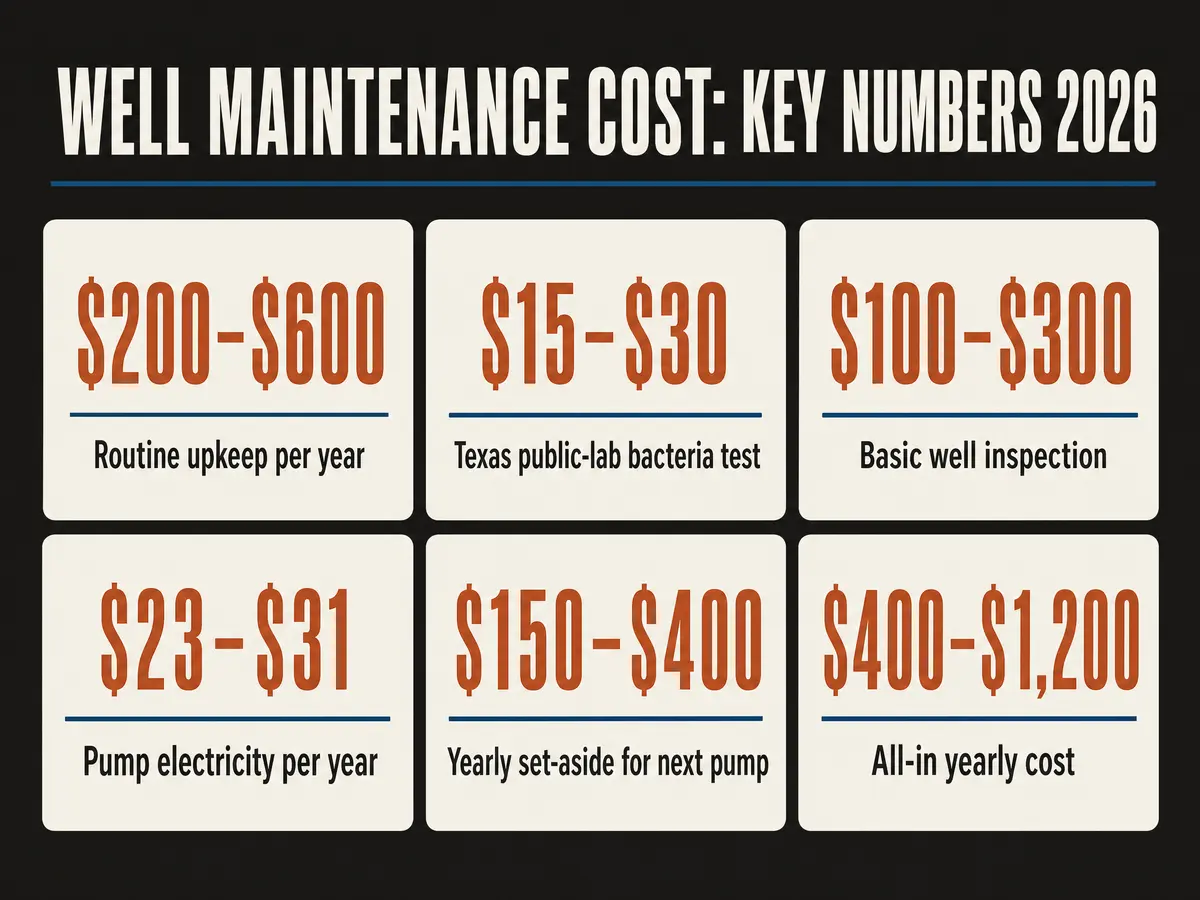
What does well maintenance cost? Well maintenance cost runs about $200 to $600 a year for routine upkeep: a water test, a wellhead and tank check, and a few dollars of electricity. Add savings for the next pump and pressure tank and a Parker County well averages $400 to $1,200 a year.
Key takeaways
- Routine yearly upkeep is $200 to $600, with a water test at $50 to $200 and a basic inspection at $100 to $300, in one national guide updated April 7, 2026 (Digital Signet well cost guide).
- Texas public screenings cost far less: $15 per sample at a Texas Well Owner Network event (AgriLife Today, Dec. 2024) and $30 for a bacteria test at the Tarrant County lab (Tarrant County Public Health, 2024).
- Texas guidance is to test every year for E. coli and nitrate-nitrogen, and the owner is responsible for maintaining the well (Texas Groundwater Protection Committee, revised Sept. 18, 2024).
- Pumping 6,000 gallons a month with a 1-hp submersible uses about 12 to 16 kWh, or $23 to $31 a year at the Texas average of 15.91 cents per kWh (our arithmetic from EIA, August 2026, and Franklin Electric motor data).
- The big costs come once a decade: a pump at $1,800 to $4,500 and a pressure tank at $800 to $1,800 in our Parker County guides. Spread over their service lives, that is roughly $210 to $550 a year to set aside (our arithmetic).
- One Maryland landlord with seven properties on wells reported "Minimal issues over 25 years" and about $1,500 per pump replacement (BiggerPockets forum, Aug. 2018).
- We found no published Texas or Parker County survey of what owners spend on well maintenance. The yearly totals here are budgets built from the cited line items, not measured averages.
Water Well Drilling Weatherford hears the well maintenance cost question most from people about to buy acreage, who want to know what a well costs once it is in the ground. The honest answer has two parts: a small routine bill every year, and a larger one every decade or so. Our water well service page covers what a yearly visit checks.
How much does well maintenance cost per year?
Routine well maintenance cost is about $200 to $600 a year in a national guide from Digital Signet, updated April 7, 2026. That covers a water quality test at $50 to $200 and a basic inspection at $100 to $300. It leaves out the pump and tank, which are the costs that matter most.
The table below sets that guide’s line items beside Texas prices we could source. The public screening prices are for an owner who carries the sample in, so they sit well below a contractor’s quote.
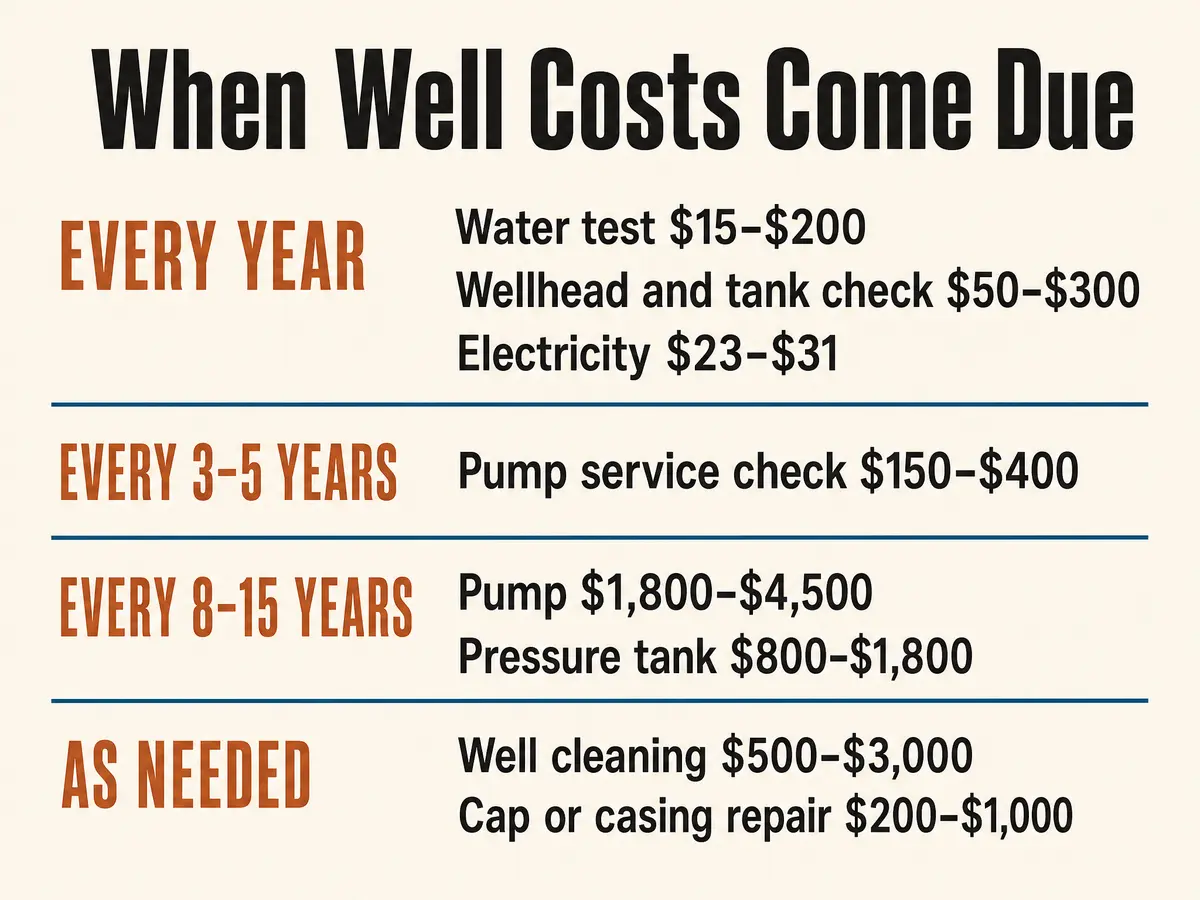
| Line item | How often | Published price | Source |
|---|---|---|---|
| Bacteria and nitrate screening | Every year | $15 per sample | Texas Well Owner Network event (AgriLife Today, Dec. 2024) |
| Bacteria test, county lab | Every year | $30 per sample | Tarrant County Public Health (2024) |
| Water quality test, national range | Every year | $50 to $200 | Digital Signet (Apr. 2026) |
| Basic well inspection | Every 1 to 3 years | $100 to $300 | Digital Signet (Apr. 2026) |
| Pressure tank inspection | Every year | $50 to $150 | Digital Signet (Apr. 2026) |
| Pump servicing or check | Every 3 to 5 years | $150 to $400 | Digital Signet (Apr. 2026) |
| Electricity, 6,000 gallons a month | Every year | $23 to $31 | Our arithmetic (EIA, Franklin Electric) |
| Well cleaning or rehabilitation | Every 10 to 15 years | $500 to $3,000 | Digital Signet (Apr. 2026) |
| Cap or casing repair | As needed | $200 to $1,000 | Digital Signet (Apr. 2026) |
What does yearly well maintenance include?
Yearly well maintenance is a water test, a look at the wellhead and a check of the tank and controls. The CDC says, “At a minimum, check your well every spring to make sure there are no mechanical problems,” and to test the water at least once each year (CDC).
Texas puts the job on the owner. The Texas Groundwater Protection Committee states that “you are responsible for maintaining your water well and plugging unused water wells on your property” (TGPC, revised Sept. 18, 2024). The same FAQ says the well should have a concrete pad or sleeve at the surface that directs drainage away from it.
Most of the yearly check costs nothing but time. The EPA lists what to look for on the exposed parts of the well: a cracked, corroded or damaged casing, a broken or missing cap, and settling or cracking of surface seals (EPA). The Edwards Aquifer Authority’s 2025 owner guide says to inspect the wellhead several times a year and to make sure the casing extends at least one foot above the ground.
The paid part is the equipment check: tank air charge, pressure switch contacts, amp draw and a cycle count. That is what the $50 to $300 inspection lines in the table buy. A real-estate style inspection costs more, and our well inspection cost guide explains why.
What does a well water test add to well maintenance cost?
A yearly water test adds $15 to $200 to well maintenance cost, depending on who runs it. A Texas Well Owner Network screening was $15 per sample in December 2024, and the Tarrant County lab lists a bacteria test at $30. A national guide puts a yearly test at $50 to $200.
The state’s recommendation is narrow and cheap to meet. The Texas Groundwater Protection Committee recommends annual testing for E. coli bacteria and nitrate-nitrogen. Joel Pigg, a Texas A&M AgriLife Extension program specialist with the Texas Well Owner Network, put it this way: “we suggest that you test for bacteria on an annual basis” (Texas Water Resources Institute, Aug. 23, 2023).
Wider panels cost more and are not needed every year. Our well water test cost guide lists every Texas lab price we found, and the well water testing page covers sampling done for you. If a test finds E. coli, the state FAQ says the well should be disinfected, inspected for repairs and sampled again.
How much electricity does a well pump use in a year?
A household well pump uses about 12 to 16 kWh a month, or $23 to $31 a year in Texas, by our arithmetic. That assumes a 1-hp submersible pumping 6,000 gallons a month at 10 gallons per minute, which is about 10 hours of run time.
The inputs are published. Franklin Electric’s 2026 AIM manual lists its 1-hp, 230-volt, 2-wire motor at 1,210 watts at full load and 1,600 watts at maximum load. The EIA reports the Texas average residential price at 15.91 cents per kWh for August 2026, against 18.16 cents nationally.
Your number will differ with pump size, depth and how much you irrigate. A pump that runs far longer than this for the same water is a repair signal, not a power bill problem. See why a well pump runs constantly and well pump short cycling for the causes.
Which big well costs should you save for?
Save for the pump and the pressure tank. In our Parker County guides, well pump replacement cost is $1,800 to $4,500 and pressure tank replacement cost is $800 to $1,800. Those two parts are most of what a well costs over its life.
Spread over their service lives, the yearly set-aside is modest. A pump that lasts 8 to 15 years works out to roughly $150 to $400 a year, and a tank replaced every 10 to 15 years to about $60 to $150 (our arithmetic, mid-range lifespans). Together that is about $210 to $550 a year.
Add routine costs and treatment supplies and you reach the $400 to $1,200 a year in our well water vs city water comparison. That total assumes a paid lab panel at $100 to $350. With a public screening the low end drops, and with no treatment equipment the high end does too.
Smaller repairs fall between the two. A pressure switch or control box runs $100 to $400 in the guides we cite in our well pump repair cost breakdown. Well cleaning is rarer, and our well rehabilitation page explains when a well needs it.
What do well owners report spending?
Owner reports we could read describe long quiet stretches and then one large bill. Matthew Paul, a landlord in Severna Park, Maryland, wrote on the BiggerPockets forum in August 2018 that he had seven units on well and septic with “Minimal issues over 25 years,” and put a pump replacement at about $1,500 (BiggerPockets).
He also described how water chemistry sets the schedule: about 10 to 12 years for a pump in acidic water, and perhaps 15 to 20 otherwise. In a March 2014 thread he reported replacing a pump more than 20 years old himself for just under $1,000 in materials, against a best quote of $2,900 from a well company (BiggerPockets).
The other pattern is the surprise. In the same 2014 thread, Adam Stanton of Fredericksburg, Virginia, wrote that the pump in his 500-foot well failed a month after he bought the house, and that plumbers replaced the pump and wire for about $2,600. These are three posts from two states, not a survey, and neither owner is in Texas.
Our take: how I would budget well maintenance
This section is the author’s analysis of the sources above, written by Chris Fugate, a water well driller with 24 years of experience. It draws conclusions from the cited evidence and does not describe any particular customer or job.
Budget the reserve first, the routine second. The routine items in the table add up to a few hundred dollars. The pump and tank add up to thousands, and the owner reports above show they arrive without much warning. Setting aside $18 to $46 a month covers the $210 to $550 yearly figure.
Do the free checks yourself and pay for the electrical ones. Looking at the cap, the casing and the slab costs nothing, and carrying a sample to a public screening costs $15 to $30. The tank air charge, switch and amp draw are where a paid visit finds a problem before the pump fails.
Keep the records. The EPA says to “keep accurate records of well maintenance,” and it is the cheapest item on the list. A file with the driller’s report, test results and repair dates is also what a buyer asks for, as our guide to buying a house with a well in Texas explains.
Does water treatment change well maintenance cost?
Yes. Treatment equipment adds $50 to $400 a year per system in supplies, based on the vendor figures in our well water filtration system cost guide. That is salt for a softener, cartridges for a sediment filter or a lamp for a UV light. A well with no treatment equipment skips this line.
Hard, iron-heavy Parker County water uses more salt and wears media faster, so budget toward the top of that range. If you are deciding what to install, start with a test and then compare an iron filter and a water softener. The yearly supply cost belongs in the well budget either way.
What well maintenance can you do yourself in Texas?
You can do the visual checks, the sampling and the record keeping yourself. Work on the pump is different: the Texas Department of Licensing and Regulation says a license is required to drill a water-related well and to install a pump for one (TDLR).
A short owner list, drawn from the EPA, CDC and Edwards Aquifer Authority guidance above:
- Walk to the wellhead each season and look at the cap, casing and slab.
- Keep the ground sloped away from the well and store fuel and chemicals elsewhere.
- Take one water sample a year to a certified lab or a public screening.
- Note the pressure gauge readings when the pump starts and stops, and write them down.
- Before a hard freeze, follow our steps to protect a well pump from freezing.
If the gauge readings drift, the pump starts more often or the water changes, that is the time for a paid visit. Our signs of a bad pressure tank guide shows what to check first. To book a yearly check, request a site visit and we will quote it in writing before any part is replaced.
How was this guide researched?
This guide draws on 13 sources: four agency pages (TGPC, CDC, EPA, TDLR), two Texas extension and aquifer-authority publications, EIA price data, a Franklin Electric manual, two Texas lab price lists, one national cost guide and two forum threads. The national guide has no named author, and we found no second independent source for several of its line items, so treat them as a budget, not a quote.
We found no Texas or Parker County survey of what owners spend, so every yearly total marked as arithmetic is our own calculation from the cited figures. Angi, HomeGuide and an Early Retirement forum thread returned errors to our fetch tool, the National Ground Water Association’s checkup page came back empty, and Reddit was blocked, so none of them are used. The owner reports are three forum posts from Maryland and Virginia.
Frequently asked questions
How much does it cost to maintain a well per year?
One national guide updated in April 2026 puts routine well maintenance at $200 to $600 a year, covering a water test and a basic inspection. Our Parker County figure is $400 to $1,200 a year once you add savings for the next pump and pressure tank and any treatment supplies.
How often should a well be serviced?
Check it at least once a year. The CDC says to check a well every spring for mechanical problems and to test the water at least once each year. The Edwards Aquifer Authority's 2025 owner guide goes further and says to inspect the wellhead several times a year.
Is well water expensive to maintain?
Usually not in an ordinary year. A water test, a visual check and electricity can come to under $100 with a public screening, by our arithmetic. The expensive years are the ones when the pump or pressure tank is replaced, which is why a yearly set-aside matters more than the routine costs.
How much electricity does a well pump use?
A 1-hp submersible motor draws 1,210 watts at full load and 1,600 watts at maximum load in Franklin Electric's 2026 manual. Pumping 6,000 gallons a month at 10 gallons per minute is about 10 hours of run time, or 12 to 16 kWh. At 15.91 cents per kWh that is about $2 to $2.55 a month (our arithmetic).
Do I have to test my well water every year in Texas?
No law requires it for a private household well, but the state recommends it. The Texas Groundwater Protection Committee says annual testing for E. coli bacteria and nitrate-nitrogen is recommended, and the EPA notes that private well owners are responsible for their own water quality.
What is the biggest cost of owning a well?
Replacing the pump. Our Parker County guide puts a submersible replacement at $1,800 to $4,500, and pumps typically last 8 to 15 years. The pressure tank is next at $800 to $1,800 every 10 to 15 years. Routine testing and inspection are small by comparison.
Sources
- Digital Signet Limited, Well Maintenance cost guide (updated Apr. 7, 2026)
- Texas Groundwater Protection Committee, As a Property Owner, What Should I Know About My Water Well? (revised Sept. 18, 2024)
- CDC, Guidelines for Testing Well Water
- US EPA, Protect Your Home's Water
- Texas Water Resources Institute, How often should I get my well water tested? (Aug. 23, 2023)
- Edwards Aquifer Authority, Guide to Responsible Well Ownership (2025)
- US Energy Information Administration, Electric Power Monthly Table 5.6.A, average residential price by state (August 2026)
- Franklin Electric, AIM Manual, 60 Hz Submersible Systems (2026 edition), 4-inch single-phase motor specifications
- AgriLife Today, Texas Well Owner Network water well screening ($15 per sample, Dec. 2024)
- Tarrant County Public Health, North Texas Regional Laboratory water testing brochure (issued Jan. 8, 2024)
- BiggerPockets forum, Yearly Cost of Well Water & Septic System (Aug. 2018)
- BiggerPockets forum, Replacing well pump, not too bad (Mar. 2014)
- Texas Department of Licensing and Regulation, Water Well Drillers and Pump Installers at a Glance