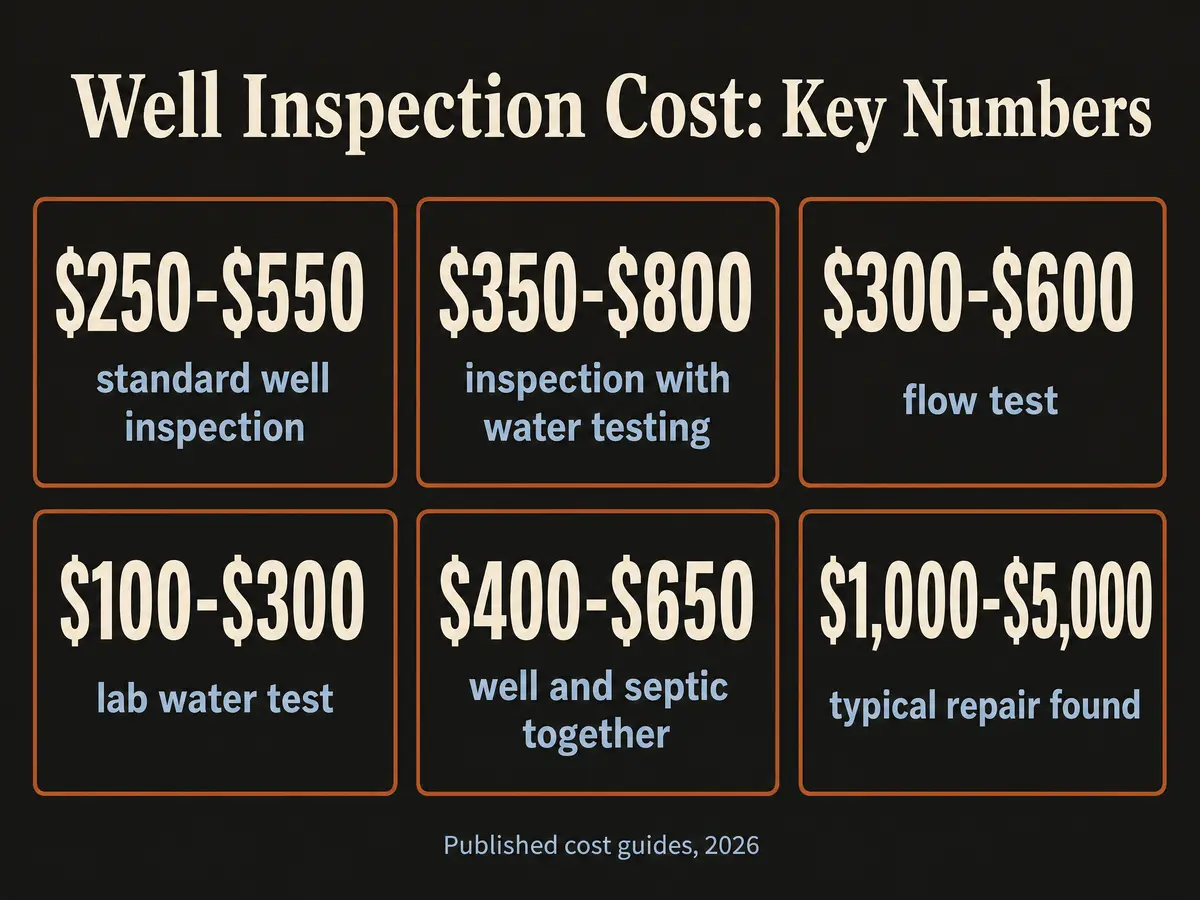
Well inspection cost is about $250 to $550 in most published guides, or $350 to $800 once lab water testing is included. A separate flow test adds $300 to $600 where it is not bundled. Ask what the quote includes, because the flow test and lab fees are the items that change the price.
Key takeaways
- A standard well inspection runs $250 to $550, and $350 to $800 with water testing (iBuyer, Sept. 14, 2026, citing HomeGuide and SC Well Service).
- A Texas Hill Country buyer guide puts a flow test at $300 to $600, pumping the well for about four hours, and lab water tests at $100 to $300 (Ed Neuhaus, Feb. 26, 2026).
- Bundling a well and a septic inspection averages $400 to $650 together (iBuyer).
- A well inspector quoted by HomeLight says $300 to $500 buys a reputable inspection, and repairs found run $1,000 to $5,000 or more (HomeLight, Aug. 27, 2026).
- Lenders often want at least 3 gpm from a true flow test, but a casual 3 to 4 hour test is not a certified one (InspectApedia).
- Texas public labs screen well water for far less than a full panel: $15 per sample through the AgriLife Texas Well Owner Network (AgriLife Today, Dec. 2024).
- Our own service page lists $350 to $800 for a Parker County inspection with lab testing (water well inspection, from HomeGuide, 2026).
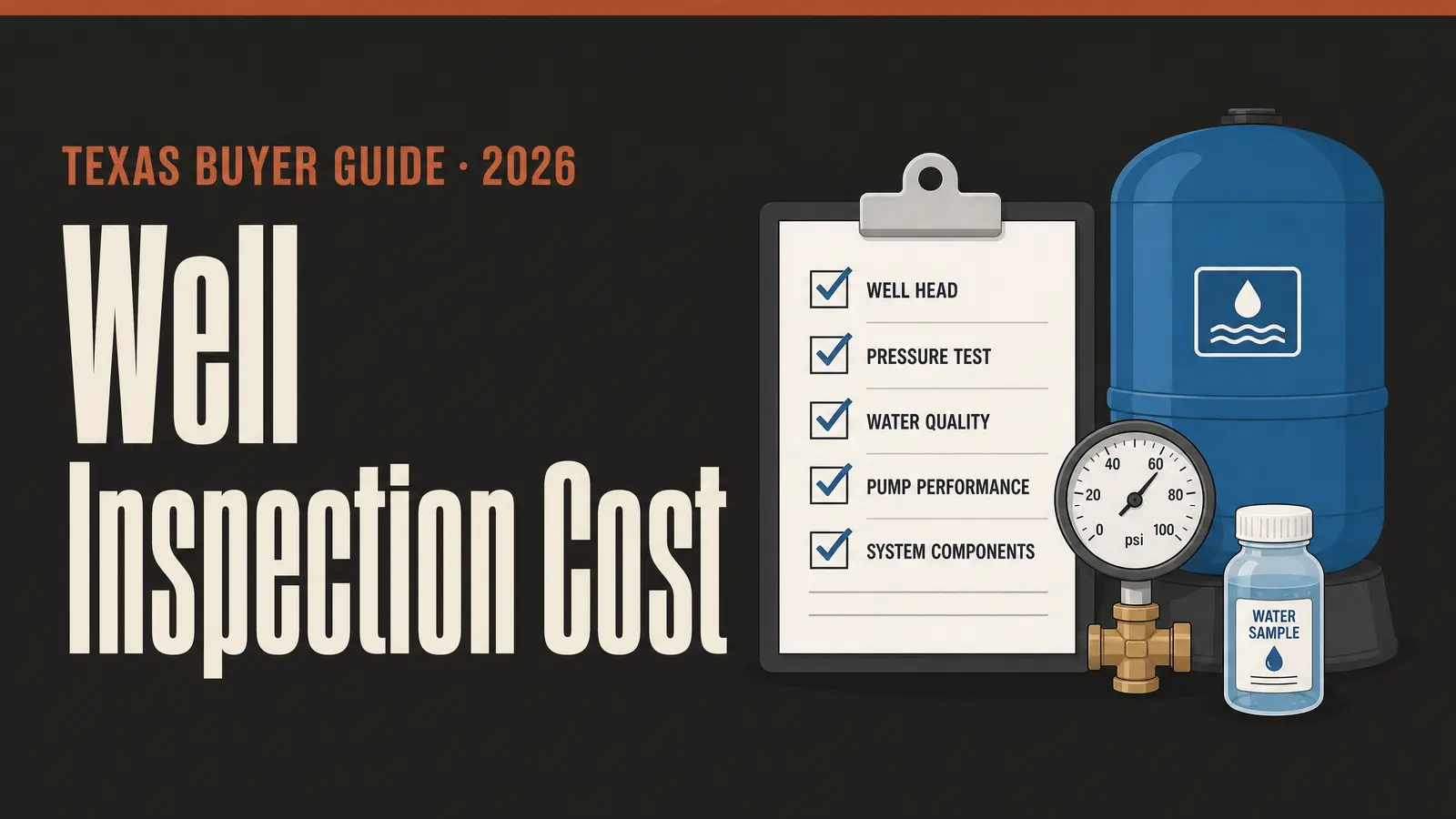
Water Well Drilling Weatherford gets asked about well inspection cost most often from buyers who have a contract on an acreage and a few days left in the option period. The short version: expect $250 to $550 for the inspection and $350 to $800 once lab water testing is added. Below is what is in those numbers, what a flow test adds, and the questions that keep a quote honest. Our water well inspection service page covers what we check in Parker County.
How much does a well inspection cost?
Most 2026 cost guides land on $250 to $550 for a standard inspection and $350 to $800 with lab water testing (iBuyer, Sept. 14, 2026, which draws on HomeGuide and SC Well Service). A well inspector quoted by HomeLight says $300 to $500 buys a reputable inspection, while Angi’s estimate, cited there, reaches $900 for deeper wells and extra testing.
Those are national figures. We found no published Texas-wide price table for a well inspection, and a Texas buyer guide we read gives prices only for the flow test and lab work. Treat the ranges as a budget and get two or three local quotes.
| Inspection level | What it covers | Typical price |
|---|---|---|
| Basic visual and mechanical | Wellhead, casing, flow rate, pressure | $150 to $400 |
| Standard with water testing | Basic plus a certified lab panel | $350 to $550 |
| Comprehensive | Standard plus an expanded lab panel | $550 to $800 |
| Well and septic together | Both inspections in one visit | $400 to $650 |
Source: iBuyer, Sept. 14, 2026, citing HomeGuide (2026) and SC Well Service (Feb. 2026). Prices are national, not Parker County quotes.
What does a well inspection include?
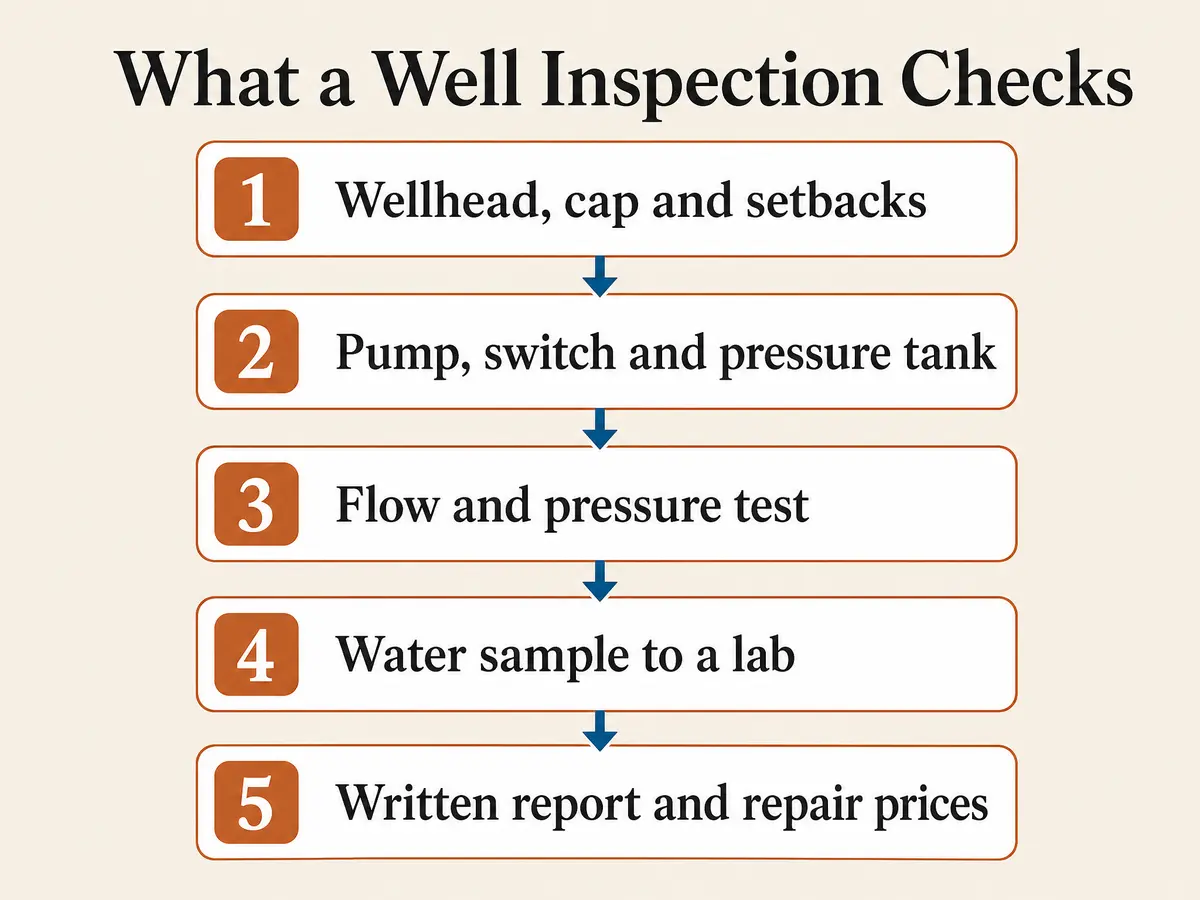
A standard well inspection has four parts, according to HomeLight and iBuyer: a visual review of the wellhead, cap and casing; a check of the pump, pressure tank, switch and wiring; a flow and pressure test; and water sampling for a lab. The inspector should also note setbacks to septic and other hazards.
Setbacks matter in Texas. A Hill Country guide cites the state’s on-site sewage rules (30 TAC 285) as 50 feet from a septic tank and 100 feet from the drain field, assuming the well meets construction standards (Neuhaus, Feb. 2026). Our setback guide covers the distances we check.
How much does a well flow test cost?
A flow test costs $300 to $600 in a Texas Hill Country buyer guide, which describes it as pumping the well continuously for four hours and measuring output in gallons per minute (Ed Neuhaus, Feb. 26, 2026). Some inspectors fold a shorter flow reading into the base price, so the line to ask about is how long the pump runs.
The test length is not standardized. InspectApedia says a true drawdown test uses a special pump attached to the well and is not normally part of a pre-purchase home inspection, and that a casual 3 to 4 hour inspector test is not a certified one (InspectApedia). Its author also notes that running water for a DIY test wastes well water, which may be inappropriate in a drought.
What flow rate do lenders want? Sources disagree. InspectApedia says lenders often want at least 3 gpm. The Hill Country guide’s summary says 1 gpm, but its body says 3 to 5 gpm for FHA on an existing well, and it does not reconcile the two. Ask your lender for the number in writing.
What do lab water tests add to a well inspection?
Lab testing adds $100 to $300 in the Hill Country guide. iBuyer breaks it down: a basic bacteria panel (total coliform and E. coli) at $50 to $150, a nitrate test at $20 to $50, a standard certified panel at $100 to $200 and a comprehensive panel with metals and VOCs at $200 to $350. It also says testing may be bundled into the inspection fee or billed as a separate lab pass-through.
Where you buy the lab work matters. A public lab can cost far less than an inspector’s markup. The AgriLife Texas Well Owner Network offered screening for coliform, E. coli, nitrate-N and salinity at $15 per sample in December 2024 (AgriLife Today), and Tarrant County Public Health lists coliform at $30 per sample (Tarrant County brochure, Jan. 2024). Neither is a substitute for a full inspection. Our well water test cost guide goes through the Texas lab options.
What have inspectors and buyers said about the price?
Inspector forums show how the lab line gets priced. In a 2016 InterNACHI thread, a Washington inspector wrote that he charged $150 for a total coliform test and $175 for coliform plus nitrates, and a second inspector also charged $150 for coliform (InterNACHI, May 2016). Those are other regions and other years, but they show why lab testing is quoted anywhere from $15 to $150.
A 2004 InterNACHI thread shows why flow testing is priced separately. A Cleveland inspector asked for a flow test procedure, and replies said flow testing is outside a home inspection’s scope, that a 4 to 5 gpm well may suit an elderly couple but not a family of five, and that recovery rate matters more than capacity. A member of the association’s education committee warned that quoting flow rates creates liability (InterNACHI, 2004). No test length was agreed. The thread is old, but it explains why a general inspector’s quote often leaves the flow test out.
One national lab-testing company lists a combined well and water inspection at $340 in Wisconsin (Clean Water Testing, undated), which sits inside the national range above.
What makes a well inspection cost more?
Four things move the price, based on the guides above.
- A bigger lab panel. A comprehensive panel with metals and VOCs is $200 to $350, against $100 to $200 for a standard one, by iBuyer’s numbers.
- A flow test that runs for hours. The Hill Country guide’s four-hour test is priced at $300 to $600.
- Depth. iBuyer says deeper wells may need a camera or special flow-test equipment, which raises the cost. It gives no figure for either, so we do not either.
- Extra tests. HomeLight says heavy metals and PFAS tests increase the bill.
A combined well and septic visit is $400 to $650 per iBuyer. For wells in Parker County, our how deep are water wells in Parker County guide shows depths from Texas Water Development Board driller reports, which helps you judge whether a deep-well surcharge is likely.
Our take: how I would budget for a well inspection
This section is the author’s analysis of the sources above, written by Chris Fugate, a water well driller with 24 years of experience. It draws conclusions from the cited evidence and does not describe any particular customer or job.
Budget $400 to $800 and ask for the line items. The national ranges are wide because inspectors bundle different things. A quote that does not say how long the pump will run, or which analytes the lab will report, is not a quote you can compare.
Pay for the flow test and the equipment check, and buy the lab test sensibly. The forum record shows the flow test is where inspectors disagree and where a general inspection stops. A lab screen through a public program is cheaper, but if a lender wants a specific panel, use the lender’s list.
Book it inside the option period. The point of the inspection is to have the result while you can still renegotiate. HomeLight’s figure of $1,000 to $5,000 or more for repairs makes a few hundred dollars look small. A new pump on the other hand runs at $1,800 to $4,500 in our pump replacement cost guide, so a pump near the end of its life is the kind of finding to negotiate over.
What should you ask before booking a well inspection?
Put these in the quote request and get the answers in writing:
- Is the flow test included, and how many hours will the pump run?
- Which lab will analyze the sample, and which tests are in the price?
- Are the pump, switch and pressure tank checked, or only the water?
- Is the written report included, with repair prices?
- Will the inspector look up the State Well Report and the groundwater district registration?
For a Parker County purchase, our buying a house with a well in Texas guide lays out the whole option-period sequence, and the printable land buyer checklist puts it on one page. If you want a local quote, you can request a site visit and we will price the flow test and lab work as separate lines.
How was this guide researched?
This guide draws on three 2026 cost guides (iBuyer, HomeLight and a Hill Country buyer guide), one InspectApedia reference page, two InterNACHI forum threads, AgriLife Today and a Tarrant County brochure. We found no Texas-wide price table for well inspections, so every inspection price is a national or regional figure, and the iBuyer tiers are summaries of HomeGuide and SC Well Service, which we could not open directly. We did not use Reddit or Facebook posts that appeared in search because our fetch tool could not read them. This guide contains no original price survey or field tests.
Frequently asked questions
How much does a well inspection cost?
Published 2026 guides put a standard well inspection at $250 to $550 and $350 to $800 with lab water testing. One inspector quoted by HomeLight says $300 to $500 for a reputable inspection, and Angi's estimate runs as high as $900 for deeper wells and extra tests.
Does a well inspection include a flow test?
It depends on the inspector. Some guides list flow and pressure as part of a standard inspection, while a Hill Country guide prices a four-hour flow test separately at $300 to $600. Ask for the quote to say whether the flow test is included and how long the pump will run.
Does the well inspection price include the water test?
Not always. iBuyer notes that testing may be bundled into the fee or billed as a separate lab pass-through. A standard certified panel runs $100 to $200 and a comprehensive one $200 to $350, so confirm in writing before you book.
Who pays for a well inspection when buying a house?
HomeLight says the buyer usually pays, although it can be negotiated. In Texas, order it during your option period so a failed flow test or water result still gives you room to renegotiate or walk.
Can a home inspector do the well inspection?
A general home inspection checks that water runs at the faucet. Inspectors on the InterNACHI forum have said quantitative flow testing is beyond a home inspection's scope and carries liability, so most buyers hire a well specialist for the flow test and equipment check.
Is a well inspection worth the cost?
It costs a fraction of what it can uncover. HomeLight's inspector puts repairs at $1,000 to $5,000 or more, and up to $10,000 if a new well is needed. Compare that with a $250 to $800 inspection.
Sources
- iBuyer, Water Well Inspection Cost: What You'll Pay (Sept. 14, 2026; cites HomeGuide 2026, SC Well Service Feb. 2026)
- Neuhaus Realty Group, Water, Wells, and Septic: What Hill Country Homebuyers Need to Know (Ed Neuhaus, Feb. 26, 2026)
- HomeLight, Well Inspections: A Home Buyer's Guide (Richard Haddad, Aug. 27, 2026)
- InspectApedia, Well Flow Test (Daniel Friedman)
- InterNACHI forum, Well Flow Rate Test (Aug. 2004)
- InterNACHI forum, What water testing packages to offer (May 2016)
- AgriLife Today, Texas Well Owner Network screening (Dec. 2024)
- Tarrant County Public Health, Water testing brochure (Jan. 8, 2024)
- Clean Water Testing, Home Water Testing Services FAQs