How to increase well water pressure: read the gauge, clear a clogged filter, set the tank's air charge 2 psi below cut-in, then raise the pressure switch about 2½ psi per full turn of the nut. Pentair says never set cut-off above 60 psi, and keep it 5 psi under what the pump can build.
Key takeaways
- On a Pentair switch, one full turn of the nut changes pressure by 2½ psi, so four turns raise a 30/50 setting by 10 psi to 40/60 (Pentair U80-129).
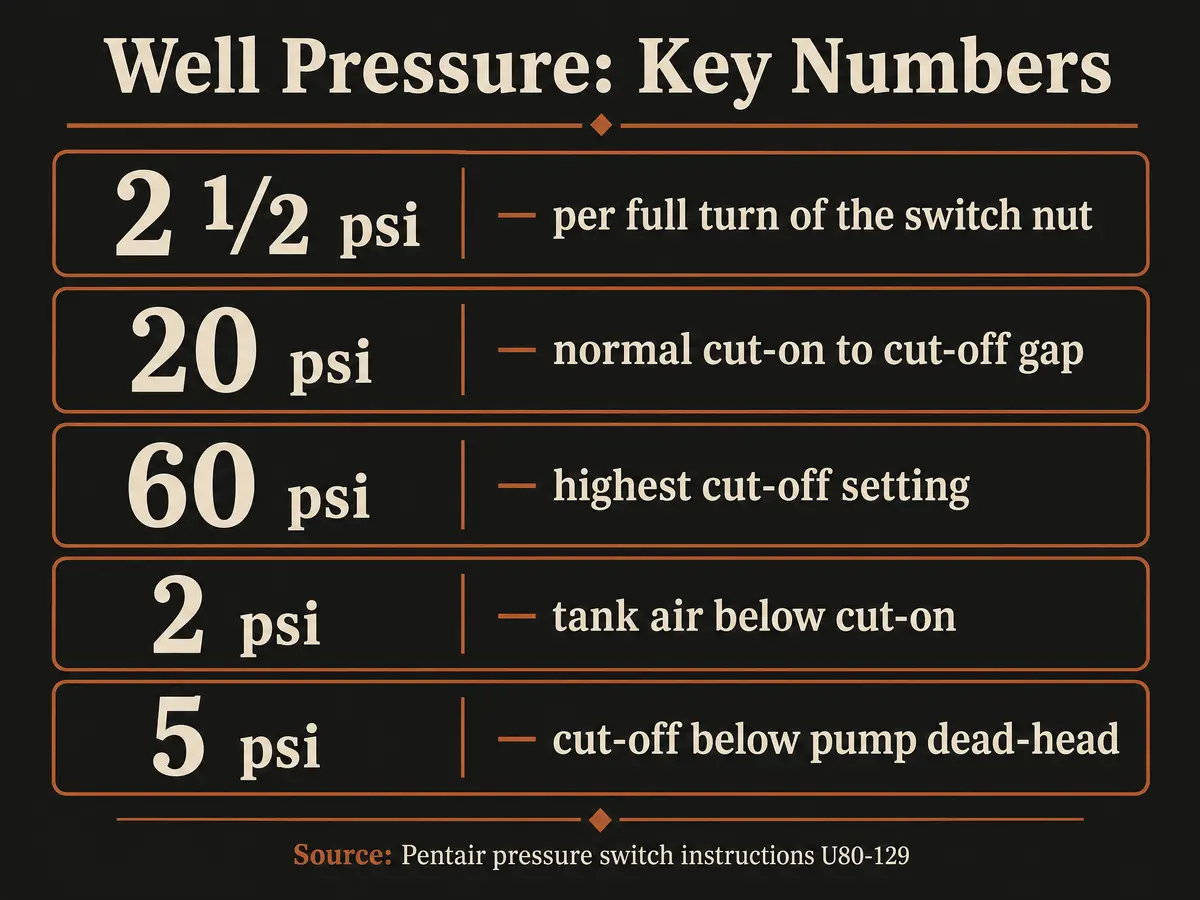
- Pentair's notice says never set cut-on below 20 psi or cut-off above 60 psi, and keep cut-off at least 5 psi below the pump's dead-head pressure (Pentair U80-129).
- Set the tank's air charge 2 psi below cut-in, measured with no water pressure: 28 psi for a 30 cut-in, 38 psi for a 40 cut-in (Pentair U80-129).
- A clogged filter is the cheap cause to rule out first: Boshart warns a sediment filter between the pump and the tank can clog until the pump never shuts off, so filters belong after the tank (Boshart).
- A constant-pressure system holds pressure steady but is not a cheap fix: one pump service puts a 2 HP controller failure near $1,800, against $250–$305 for a switch or control box (Oakville Pump Service).
- New wells near Weatherford finish with water a median of 110 ft down, so the pump's own output limits how much pressure you can add (TWDB driller reports, our analysis).

Water Well Drilling Weatherford gets this question when showers weaken and the tank gauge sits low: how to increase well water pressure. The answer is a short ladder of fixes, cheapest first, with one hard limit. Start with the gauge, then the filter, the tank and the switch. If the pump cannot reach the pressure you want, the next step is a well pressure tank replacement or well pump repair call, not another turn of the nut.
Why is your well water pressure low in the first place?
Low pressure at the tap is either a low setting, a restriction or a pump that cannot keep up. Only the first is fixed by turning a nut, so find out which you have before changing anything.
A well has no city main behind it. The pump fills a tank, and the pressure switch starts the pump at a low number (cut-in) and stops it at a higher one (cut-off). Your faucets see whatever the gauge reads between those two numbers. A 30/50 switch swings between 30 and 50 psi, and a 40/60 between 40 and 60. Our 30/50 vs 40/60 comparison explains the trade-off.
Hunker’s guide starts the same way: check for clogged pipes first, because raising pressure in clogged plumbing “could cause serious damage” (Hunker, updated March 24, 2022). A weak shower that gets worse over a long soak is a flow problem. A weak shower that is weak from the first second, with the gauge near its cut-in number, is a pressure setting. Our low pressure diagnosis guide walks through that split.
How do you increase well water pressure, in what order?
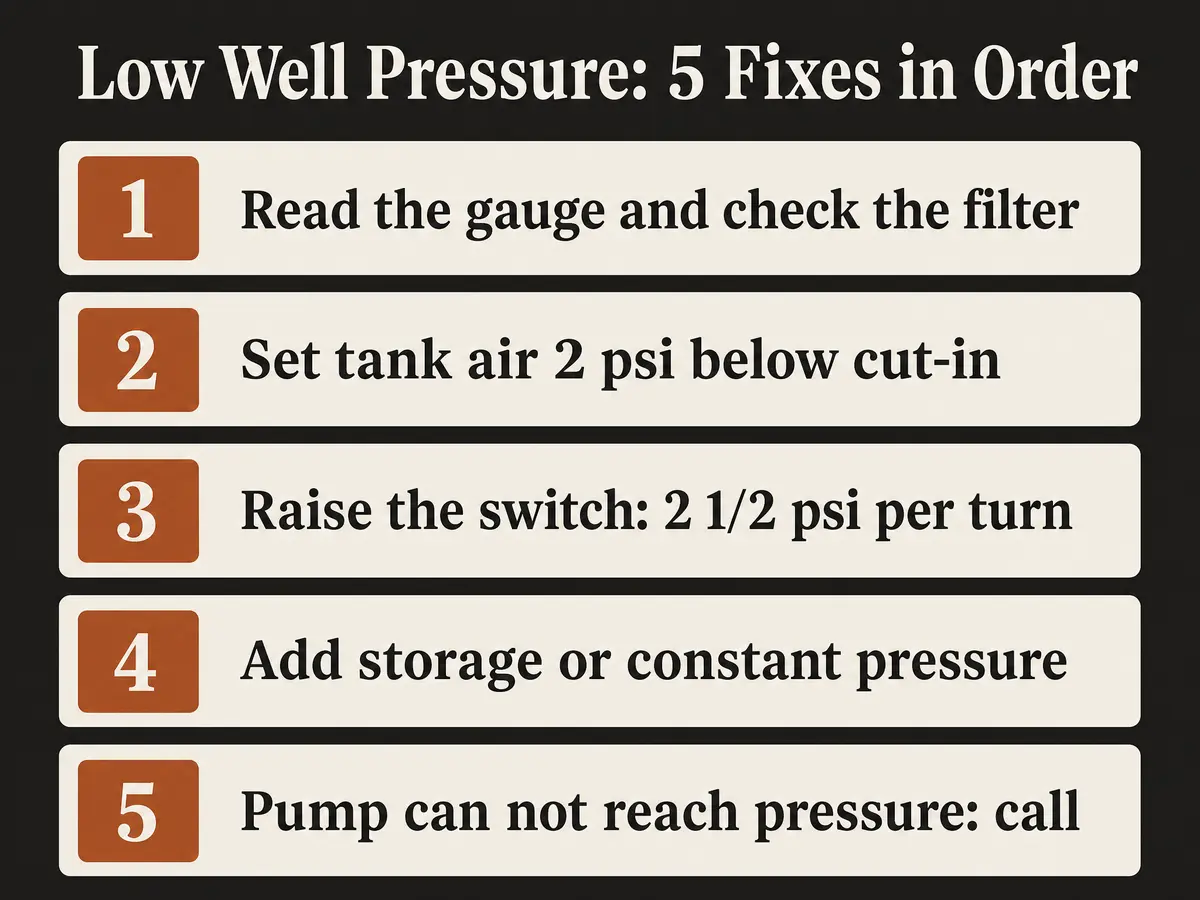
Work down this table from the top. Each step costs more than the one above it, and the first three are the only ones most homes ever need.
| Order | Fix | When it is the answer | Rough cost |
|---|---|---|---|
| 1 | Read the gauge and change a clogged filter | Pressure drops after a filter, or fades over time | Cartridge only |
| 2 | Reset the tank air charge | Pump cycles fast, or gauge swings widely | Gauge and air; a new tank if the bladder failed |
| 3 | Raise the pressure switch setting | Pressure is steady but low, and the pump can reach more | Free if you do it yourself; $150–$300 for a new switch |
| 4 | Add storage or a constant-pressure system | Pressure swings annoy you or the pump cycles too often | Quote-based; see the cost section |
| 5 | Repair or replace the pump | Pump runs but cannot reach cut-off | $1,800–$4,500 for a submersible at Parker County depths |
The switch cost is the HomeGuide-sourced range in our pressure tank replacement cost guide, and the pump range is from our well pump replacement cost guide.
How do you check the gauge and the filter first?
Read the tank gauge while a faucet runs, then look at any filter. Both take minutes and cost nothing, and a restriction explains more weak showers than a wrong switch does.
With the breaker on, open a faucet and watch where the needle starts and where the pump stops. If the pump starts at 30 and stops at 50, the setting is working as designed. If it stops well below the number it should, the pump, a leak or the sensing port is the problem. A filter test is simple: read pressure upstream and downstream, and change the cartridge if the downstream number is clearly lower.
Boshart adds a placement warning. A sediment filter between a submersible pump and the tank can clog, and because the switch sits after the filter it cannot see the pressure building, so the pump keeps running until it reaches its maximum (Boshart). The filter belongs after the tank. Other vendors disagree on pre-tank filters, so check your own system’s design before moving anything.
How do you set the tank air charge before you raise pressure?
Set the air charge 2 psi below cut-in, with the tank drained of water pressure. The air cushion is what lets the tank deliver water between pump cycles, and a wrong charge wastes any change you make at the switch.
Pentair’s instructions define it plainly: tank precharge is set 2 psi less than cut-on, with no water pressure in the tank. Its chart gives 18 psi for a 20 cut-on, 28 for 30 and 38 for 40 (Pentair U80-129). Boshart’s knowledge base says the same thing in a wider form for some switches: at least 2 psi below cut-in on a 20/40, and more margin for a 40/60, with the tank at room temperature and fully drained (Boshart). The two sources differ on how much margin; follow the label on your tank first.
The order matters. Switch off the breaker, open a faucet until the gauge reads zero, then check the air valve on the tank with a tire gauge. If water squirts from the valve, the bladder has failed and the tank needs replacing. Our tank sizing guide covers the rest of the setup.
How do you raise the pressure switch setting?
Turn the large nut clockwise in small steps. On a Pentair switch each full turn adds 2½ psi, and the nut moves cut-on and cut-off together so the 20 psi gap stays the same.
Pentair’s own example is that four complete clockwise turns raise the setting 10 psi, which is the move from a 30/50 switch to a 40/60. Turning counter-clockwise lowers it. The second nut on a two-post switch changes only cut-off, and Pentair says very few applications need it, so leave it alone. The instructions also open with a hazard notice: disconnect power before working on the motor or the switch. Our full pressure switch walkthrough covers the nuts, the cover and the test cycle step by step.
How high can you safely raise well water pressure?
Not past 60 psi cut-off on a standard household switch, and never past what the pump can build. Pentair’s notice says the switch should never be set to cut on below 20 psi or cut off above 60 psi.
The pump’s limit is the one people miss. Pentair defines dead-head pressure as what the pump produces against a closed outlet, and says cut-off should always be at least 5 psi below it. A 60 psi cut-off therefore needs a pump that can build about 65 psi or more, our arithmetic from that rule. If it cannot, the pump runs and never shuts off. Pentair warns of a risk of explosion if a pump runs against a closed discharge longer than needed to read the pressure, so this is not a test to improvise.
This is a conflict between sources worth naming. Some forum and retailer posts treat 50/70 as an option for special cases, and our own switch walkthrough lists it only as arithmetic from the 2 psi rule. Pentair’s instructions are the manufacturer’s word, and they cap the setting at 60.
When does a bigger tank or a constant-pressure system help?
Both help pressure that swings, not water that runs out. A larger tank gives the pump longer rests, and a constant-pressure system varies the pump speed to hold one pressure. Neither makes a well produce more water.
The public record shows the trade-offs. In a GreenBuildingAdvisor thread started March 7, 2020, an owner drilling a 500-ft well was told to use a variable-speed pump and that a 32-gallon tank would do, and that the control box would cost $1,700 to replace. One expert member said variable-speed systems hold pressure steadier but preferred a conventional system with a large tank for simplicity, cost and outage reserve. A well pump installer replied in January 2021 that he installs variable-speed drives routinely, put a drive at about $1,000 and large conventional tanks near $1,000, and said 80% of his service calls involve pressure switches, control boxes or flooded tanks. A May 2021 reply from an owner reported a failed control box that let pressure climb to about 70 psi and caused a flood (GreenBuildingAdvisor). The thread does not say which system the original poster chose.
Oakville Pump Service gives the cost side: a switch or control box failure on a traditional 2 HP pump “may be in $250-$305 range”, while a 2 HP constant-pressure controller failure “will cost ~$1800”, and it advises against upgrading just to fix a switch, tank or control box (Oakville Pump Service). It also says the cheapest time to switch is when the pump has failed and must be pulled anyway.
What goes wrong when you increase well water pressure?
Four things go wrong most often: the pump runs on, the pump short-cycles, the pressure does not change, or the plumbing leaks at the new setting.
- The pump never shuts off. The new cut-off is above what the pump can build, or a clogged filter hides the pressure from the switch. Breaker off, back the nut down a turn, retest. If it persists, see why a well pump runs constantly.
- The pump starts every few seconds. The tank air charge no longer matches the new cut-in, or the bladder has failed. Reset the charge to 2 psi below cut-in.
- Nothing changed. The nut went the wrong way, or the gauge reads wrong. Check against a second gauge.
- Leaks and weeping fixtures. Older plumbing can show weak points at higher pressure. Raise in steps and walk the house.
A case from the Terry Love Plumbing forum, April 2020, shows how settings and tank charge interact. A new homeowner reported a 16-year-old tank, a 38 to 70 psi swing and only 9 psi of air charge; respondents pointed to the swing and the low charge, not the pump (Terry Love Plumbing forum).
Author’s take: what would I do first?
This section is the author’s analysis of the sources above, written by Chris Fugate, a water well driller with 24 years of experience. It draws conclusions from the cited evidence and does not describe any particular customer or job.
Fix the cause, not the number. The nut is the easiest part to turn and the least likely culprit. A filter, a tank charge or a clogged sensing port explains more weak showers than a low setting does, and each is cheaper than a new pump.
Treat 60 psi as the ceiling. Pentair’s notice leaves little room, and the failed-control-box flood in the GreenBuildingAdvisor thread shows what unchecked pressure does to a house. If 60 is not enough upstairs, a booster or a different system is the honest answer, not 70.
Measure the pump before you promise yourself more pressure. A well here has water about 110 ft down at the median. That is a lot of lift before the pump adds any pressure, so a tired pump runs out of headroom first. If it will not reach cut-off, stop and call.
What does it cost to increase well water pressure?
Raising pressure with the switch costs nothing but time. A new switch is typically $150–$300 installed, and a tank replacement runs $800–$1,800 installed, per the HomeGuide-sourced ranges in our tank cost guide.
Constant-pressure systems are quote-based. The only prices we found are the ones above: $1,800 for a failed controller and about $1,000 for a drive, from one pump service and one installer. A submersible pump replaced because it cannot reach cut-off typically runs $1,800–$4,500, per our well pump replacement cost guide. Our repair or replace guide explains how a technician decides.
Call a licensed pro if the pump runs without stopping, the breaker trips, air or water comes out of the tank’s air valve, or you cannot confirm the power is off. Texas requires a license to install or repair a pump on a water well (TDLR). With no water at all, see emergency well pump repair.
How was this guide researched?
This guide draws on one manufacturer’s switch instructions (Pentair U80-129), two Boshart knowledge-base pages, a Hunker guide, one pump service’s blog, and two public forum threads. It contains no original measurements or field tests. The 65 psi pump requirement is our arithmetic from Pentair’s rule that cut-off be at least 5 psi under dead-head. The 110 ft figure is the median from our own analysis of Texas Water Development Board driller reports. Reddit threads were blocked from our fetch tool and are not used. Prices are single-source figures from the pages named. Where sources differ, we say so. A different switch’s manual wins over Pentair’s if they disagree.
Frequently asked questions
How can I increase my well water pressure?
Read the gauge, clear a clogged filter, set the tank air charge 2 psi below cut-in and raise the pressure switch about 2½ psi per full turn. Pentair's instructions say never set cut-off above 60 psi. If the pump cannot reach the new setting, the fix is the pump or a storage upgrade, not the nut.
Can you increase the pressure on a well pump?
Yes, up to what the pump can build. Cut-off must stay at least 5 psi under the pump's dead-head pressure, and Pentair caps its switch settings at 60 psi cut-off. A pump already running at its limit cannot deliver more pressure from a switch change.
How do I increase well water pressure without a new pump?
Most fixes need no new pump: change a clogged filter, reset the tank's air charge, and raise the switch setting in small steps. A larger tank or a constant-pressure system smooths delivery. If the pump cannot reach cut-off, the pump is the limit.
What is a good water pressure for a well?
Household switches are usually 30/50 or 40/60 psi. Pentair's instructions set 20 psi between start and stop as the normal gap and say never to set cut-on below 20 psi or cut-off above 60 psi.
Is 30 psi too low for water pressure on a well?
On a 30/50 system 30 psi is where the pump starts, so the house sees 30 to 50 psi. Upstairs showers can feel weak. A 40/60 setting adds 10 psi if the pump can reach 60 psi and the plumbing allows it.
Why is my well water pressure low all of a sudden?
A sudden change usually points to a clogged filter or sensing port, a waterlogged tank or a failing pump, not the switch setting. Check the gauge and the tank's air valve first. If the pump runs but never reaches cut-off, call a well tech.
Will a bigger pressure tank increase well pressure?
No. A bigger tank stores more water between pump cycles but pressure still swings between cut-in and cut-off. It helps a pump that cycles too often. Pressure rises only if you raise the switch settings and the pump can reach them.
Does a constant pressure system fix low well pressure?
It holds pressure steady at one setting, but it does not add water. In a thread on GreenBuildingAdvisor, owners and an installer weighed it against a larger tank, and the installer put the drive at about $1,000. The pump and well must still supply the water.
Sources
- Pentair, Adjusting Well Pump Pressure Switches (U80-129)
- Boshart Industries, What PSI should a tank's pre-charge pressure be set to?
- Boshart Industries, Can sediment filters be installed between the pump and pressure tank?
- Hunker, How to Increase Water Pressure From a Well Pump (updated March 24, 2022)
- Oakville Pump Service, Should I put a variable frequency or constant pressure pump system in?
- GreenBuildingAdvisor Q&A, variable vs constant well pump (March 2020 to December 2022)
- Terry Love Plumbing forum, Well Water System Poor Pressure (April 2020)
- Texas Department of Licensing and Regulation, Water Well Drillers and Pump Installers at a Glance
- Texas Water Development Board, Submitted Drillers Reports