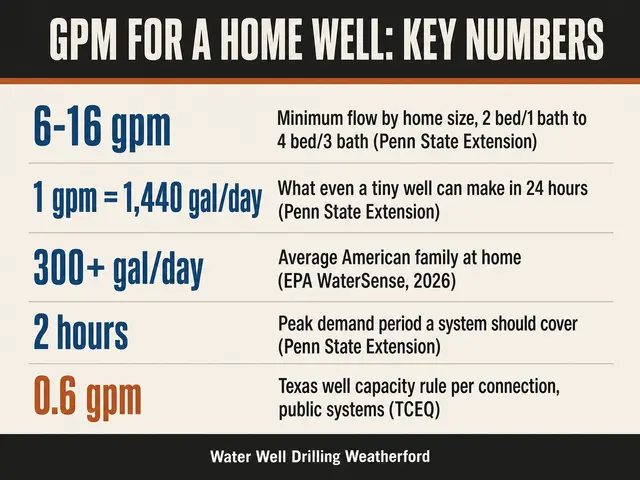
A good gpm for a home well is the flow that covers your busiest two hours, not your daily total. Penn State Extension's table puts that at 6 gpm for a 2-bedroom, 1-bath home up to 16 gpm for 4 bedrooms and 3 baths. Wells making 1–5 gpm can still work when a storage tank covers the peak.
Key takeaways
- Penn State Extension lists minimum flow of 6–16 gpm, from a 2-bedroom, 1-bath home to a 4-bedroom, 3-bath home. The table comes from a 1992 handbook, so treat it as a conservative design target (Penn State Extension, page updated May 29, 2025).
- Even 1 gpm produces 1,440 gallons a day, but a family of four's two-hour morning peak can top 300 gallons, while a 1-gpm well supplies only 120 in that time (Penn State Extension, Water Facts #3).
- The average American family uses more than 300 gallons a day at home, about 70% of it indoors (EPA WaterSense, updated August 4, 2026).
- Texas requires public water systems on wells to have 0.6 gpm per connection, a utility rule that does not apply to a private household well (30 TAC §290.45).
- We found no published Parker County table of household well yields, so no source can tell you a local "normal" gpm. The measured yield of your own well is the number that counts.
Water Well Drilling Weatherford gets asked “what is a good gpm for a well?” and most answers are one number with no source. This guide collects the published figures, shows what each flow rate actually supplies, and says plainly where the data stops. If your well is already struggling, start with our guide on whether your well is going dry.
What is a good gpm for a well?
A good gpm is enough flow to cover your busiest two hours. Penn State Extension says a system should supply a day’s projected use within a 2-hour peak, and its design table asks for 6 gpm in a 2-bedroom, 1-bath home and 16 gpm in a 4-bedroom, 3-bath home. Wells below that can work with storage.
Daily use is not the problem. Penn State’s Water Facts #3 notes that a well yielding only 1 gpm still produces 1,440 gallons in a day, but use is uneven, with peaks that last 30 minutes to 2 hours. The EPA says the average American family uses more than 300 gallons a day at home, about 70% of it indoors.
| Home (bedrooms / baths) | Minimum flow | Source |
|---|---|---|
| 2 / 1 | 6 gpm | Penn State Extension |
| 2 / 2 | 10 gpm | Penn State Extension |
| 3 / 1 | 8 gpm | Penn State Extension |
| 3 / 2 | 12 gpm | Penn State Extension |
| 4 / 1 | 10 gpm | Penn State Extension |
| 4 / 2 | 14 gpm | Penn State Extension |
| 4 / 3 | 16 gpm | Penn State Extension |
That table is credited on the Penn State page to the 1992 Private Water Systems Handbook, so it predates today’s low-flow fixtures. Read it as a cautious design target rather than a pass or fail line. The page itself was updated May 29, 2025.
How much water does a well make at 1, 3, 5 or 10 gpm?
Every gpm is 60 gallons an hour, 120 in a two-hour peak and 1,440 in a day. That is arithmetic, not an estimate. A 3-gpm well supplies 4,320 gallons a day and 360 in two hours, while a 1-gpm well supplies 1,440 a day but only 120 gallons in the same two hours.
| Well yield | Per hour | In a 2-hour peak | Per day | Source |
|---|---|---|---|---|
| 1 gpm | 60 gal | 120 gal | 1,440 gal | Penn State (daily and 2-hour figures); our arithmetic |
| 2 gpm | 120 gal | 240 gal | 2,880 gal | Our arithmetic; daily figure also on Fine Homebuilding thread |
| 3 gpm | 180 gal | 360 gal | 4,320 gal | Our arithmetic |
| 5 gpm | 300 gal | 600 gal | 7,200 gal | Our arithmetic |
| 10 gpm | 600 gal | 1,200 gal | 14,400 gal | Our arithmetic |
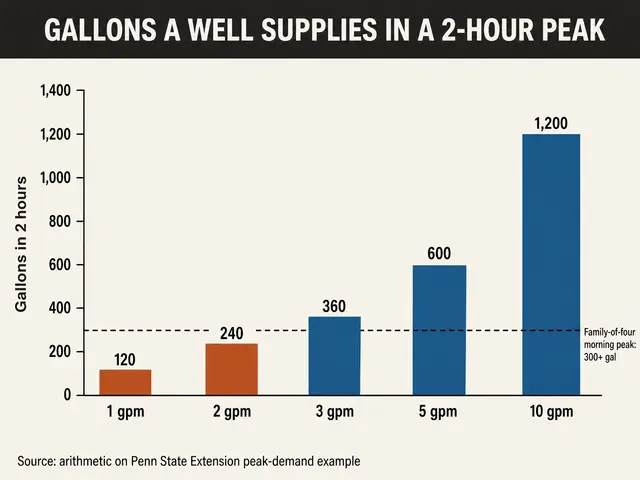
Penn State’s own example makes the point. A family of four with a 1-gpm well, using water without saving fixtures on a Saturday morning, could use over 300 gallons in two hours, and the well supplies 120. The gap is the real shortage, and a 2-gpm well is still short of that example at 240. From 3 gpm up, the well covers that example peak on paper, but only if the pump can actually deliver that flow, which depends on the water level, not the pump label.
Is 3 gpm enough for a house?
Yes with storage, marginal without it. A 3-gpm well supplies 4,320 gallons a day, many times a family’s 300-plus gallons, but only 360 in a two-hour peak. New York’s health department recommends 5 gpm or more where possible, and it lists 100–250 gallons of storage for wells in the 3–5 gpm range, depending on bedrooms.
The New York figures reach us through a search-result summary, because the department’s PDF returned an access error. Another state source, New Hampshire’s environmental agency, says a 1–3 gpm well may be acceptable if the casing and storage tanks hold enough water, though we saw that only as a search excerpt too. A Nebraska Extension publication suggests at least 10 gpm for a 2-bedroom, 2-bath house, which matches Penn State’s 10 gpm for that size.
What do people with low-yield wells actually do?
They add storage and spread out the load. Penn State’s Water Facts #3 lists two fixes: reduce peak use, or increase storage. A pressure tank alone does little, since a 42-gallon tank releases about 8 gallons before the pump restarts, an 82-gallon tank about 16 and a 120-gallon tank about 24.
A 2006 Fine Homebuilding thread shows the same advice from owners. A homeowner south of Atlanta was having a 650-ft well drilled for a four-bedroom house, and the driller called a 2-gpm yield adequate. Replies noted that 2 gpm is 2,880 gallons a day, and several owners of 2–3 gpm wells said they added holding tanks, often 1,500 to 7,500 gallons. One said that cost less than drilling about 150 more feet. A dry-run protection device at about $150 was also suggested. The thread is 20 years old and not from Texas, and it does not report the final result, so we use it only as an example of owner practice.
| Fix for a low-yield well | What it does | Source |
|---|---|---|
| Spread laundry and showers across the day | Lowers the two-hour peak at no cost | Penn State Extension, Water Facts #3 |
| Water-saving fixtures | Can cut household use by up to 30% | Penn State Extension, Water Facts #3 |
| Retrofit with water-saving devices | About $1,500–$2,000 (older figure, undated) | Penn State Extension, Water Facts #3 |
| Larger pressure tank | Adds only a few gallons of drawdown | Penn State Extension, Water Facts #3 |
| Non-pressurized storage tank | Holds water made between peaks | Penn State Extension, Water Facts #3 |
A storage tank and booster pump is what a well water storage tank service sets up, and our cistern vs well comparison covers when a tank becomes the main supply. For ordinary pressure tank sizing, see what size pressure tank you need.
What GPM rules apply in Texas?
Texas has no minimum gpm for a private household well that we could find. The 0.6 gpm per connection in 30 TAC §290.45 applies to public water systems, with 200 gallons of storage per connection. Local groundwater districts set pump limits instead: TWON says about 25 gpm is typical.
Under §290.45, a public system with fewer than 50 connections and no ground storage faces a higher bar of 1.5 gpm per connection. Those figures are for utilities serving many homes, so do not use them to judge a house well. The Texas Water Code exempts a household well from many district permits if it cannot produce more than 25,000 gallons a day, according to TWON, which shows no date.
Parker County adds its own gpm lines. The Upper Trinity district’s 2026 spacing changes treat wells producing 8–17.36 gpm as a household-size class needing wider spacing, and wells over 150 gpm get a separate class with enhanced review, as covered in our explainer on the 2026 groundwater rules. Our permit guide covers what a new well needs before drilling.
Does a lender or inspector require a minimum flow?
Sometimes. InspectApedia says lenders often ask for about 3 gpm on a flow test, but it also says a casual 3–4 hour test is not a certified one. The rule varies by lender, so ask for the written requirement. Our well inspection cost guide covers what a flow test adds.
A real test uses a pump and measures the water level, and a quick bucket count at a hose bib does not. The distinction matters because yield, in Penn State’s words, is the most a well can be pumped without lowering the water level below the pump intake. That ties yield to your static water level and to the depth the pump sits at. If the pump is rated above the yield, it can pull the well down and run constantly or lose water.
Check your numbers
Pick your home size and enter your well's measured yield. The result compares it with Penn State Extension's minimum flow table and shows what it supplies.
This compares your number with one extension table. It does not test your well. For a measured answer, use our well problem checker or call a well tech.
Author’s take: how I’d think about gpm
This section is the author’s analysis of the sources above, written by Chris Fugate, a water well driller with 24 years of experience. It draws conclusions from the cited evidence and does not describe any particular customer or job.
Ask for the yield, not just the depth. A well’s depth tells you what it cost. Its gpm tells you whether the house will keep up on a Saturday morning. If a driller’s report or a flow test gives a number, write it down with the date, the same way you would keep your static level.
Do not chase a big number. The sources agree that peak demand drives the answer, and that storage can make a 3-gpm well workable. A larger pump on a small well does not add water, it shortens the pump’s life. Chasing extra yield by going deeper costs per foot, so weigh it against a tank, as the forum owners did. Our drilling cost guide shows how footage adds up, and a pump that is too big for the well is a common reason to replace a pump early.
Be honest about the local gap. No source we found publishes household yields for Parker County, and our own state driller-report extract has no yield column. Anyone quoting a Parker County average gpm is guessing. The state records give us static levels and pump settings, not yield, and the depth ranges in our guide to well depths here are context, not yield.
How was this guide researched?
We opened each source named above between November 9 and 10, 2026, and used the EPA’s August 2026 update and Penn State’s May 2025 update as the freshest data. Older material is dated in the text: Penn State’s flow table is credited to a 1992 handbook, the forum thread is from 2006, and two pages (Water Facts #3 and TWON) show no date. The New York and New Hampshire figures come from search summaries because the pages would not load for us, so we state them only as reported.
The 1, 2, 3, 5 and 10 gpm tables are our own arithmetic (gpm × 60, × 120 and × 1,440), not measurements. We looked for a Parker County yield table in Texas Water Development Board and Upper Trinity material and found none, and the state driller-report extract we use elsewhere on this site does not include yield. We will update this page if a local source appears. To check who is drilling your well, see our guide to well driller licenses. For a measured flow rate on your own well, call a well tech at the number below.
Frequently asked questions
What is a good GPM for a house well?
Penn State Extension's design table runs from 6 gpm for a 2-bedroom, 1-bath home to 16 gpm for 4 bedrooms and 3 baths. New York's health department recommends a long-term yield of 5 gpm or more where possible. Lower yields can work with storage, as explained above.
Is 3 gpm enough for a house?
It can be, with storage. A well making 3 gpm yields 4,320 gallons a day, far above the EPA's 300-plus gallons for an average family, but only 360 gallons in a two-hour peak. Without a storage tank to cover the peak, a family can run short on a busy morning.
Is 1 gpm enough for a well?
Rarely on its own. One gpm gives 1,440 gallons a day, but Penn State Extension shows a family of four needing over 300 gallons in a two-hour morning peak when a 1-gpm well supplies about 120. Spreading laundry and showers out, plus a storage tank, is how people make it work.
How many gpm does a well pump make versus what the well yields?
They are different numbers. Yield is the most a well can be pumped without drawing the water below the pump intake, per Penn State Extension. A pump can be rated higher than that, and a pump pushed past the well's yield will run out of water, so size the pump to the well.
Do lenders require a minimum well flow rate?
Some do, and the number varies by lender and loan type. InspectApedia reports that lenders often ask for about 3 gpm on a flow test, but that is a rule of thumb, not a statute. Ask the lender for its written requirement before you order a test.
Sources
- EPA WaterSense, How We Use Water (page shows last updated August 4, 2026)
- Penn State Extension, Water System Planning: Estimating Water Needs (page updated May 29, 2025; Table 2 credited to the 1992 Private Water Systems Handbook)
- Penn State Cooperative Extension, Water Facts #3: Using Low-Yielding Wells (PDF; no publication date shown)
- New York State Department of Health, Individual Water Supply Wells Fact Sheet #2: Water Storage (figures taken from a search-result summary because the page returned HTTP 403)
- Cornell Legal Information Institute, 30 Texas Administrative Code §290.45, Minimum Water System Capacity Requirements
- Texas Well Owner Network (TWON), Resources page (no date shown)
- Upper Trinity Groundwater Conservation District, rules and documents
- Fine Homebuilding forum, thread "gallons per minute for well" (January 1–3, 2006)
- InspectApedia, Well Flow Test