Submersible vs jet pump: which fits a Parker County well? A submersible. New household wells here have a median depth of 240 ft with water typically about 110 ft down, far beyond the roughly 25 ft reach of a shallow-well jet pump and past the 70 ft lift rating of at least one common deep-well jet.
Key takeaways
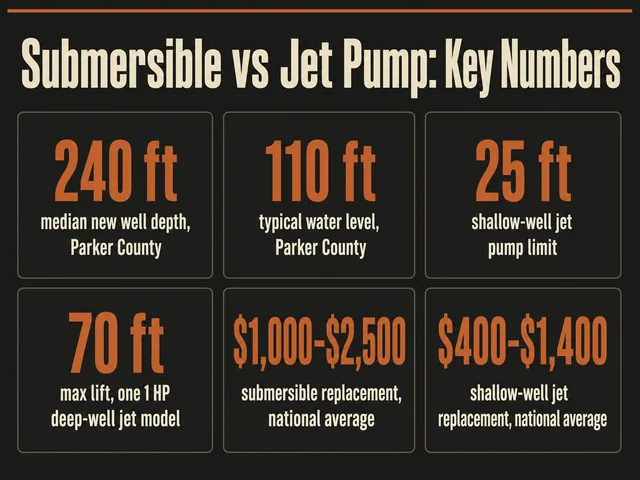
- Parker County's new household wells have a median depth of 240 ft and water typically stands about 110 ft down, from 4,746 Texas Water Development Board driller reports (our depth guide).
- Shallow-well jet pumps suit wells under about 25 ft deep, and deep-well jets are sometimes used past 100 ft, while submersibles typically cover 200–300 ft or more (This Old House, March 2026).
- One 1 HP cast-iron deep-well jet lists a 70 ft maximum lift and says it works at depths to water of 70 ft or less (Pentair Flotec FP4210).
- National replacement prices run $1,000–$2,500 for a submersible, $400–$1,400 for a shallow-well jet and $500–$1,400 for a deep-well jet (American Home Shield, Feb. 2026, citing HomeGuide).
- A Connecticut Department of Public Health conference deck says submersibles are more efficient, quieter and easier to install than deep-well jets, while jets are cheaper and easy to reach but need priming (CT DPH, 2018).
- Published lifespans run about 8–15 years for submersibles and 8–15 years across shallow and deep-well jets, so lifespan rarely decides the choice (SC Well Service).
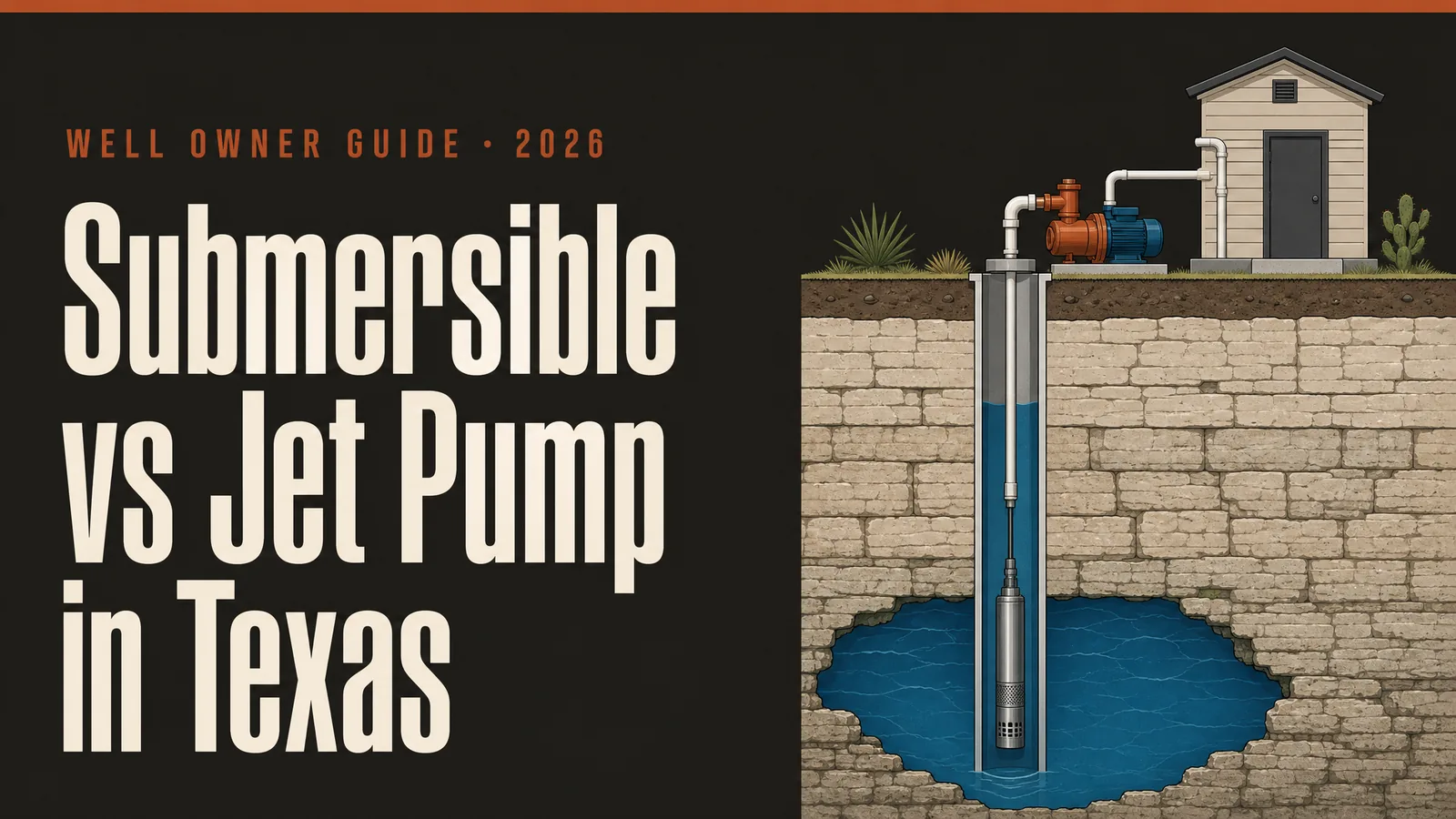
Water Well Drilling Weatherford gets the submersible vs jet pump question from owners who inherited an old pump, are pricing a replacement, or just saw a cheap jet pump at a hardware store. The two designs are not interchangeable. Where the water sits decides which one can work at all, and in Parker County it sits deep. This guide compares them on depth, cost, lifespan and upkeep, and shows how the choice plays out town by town. If your pump has already failed, our well pump replacement service covers the swap.
What is the difference between a submersible and a jet pump?
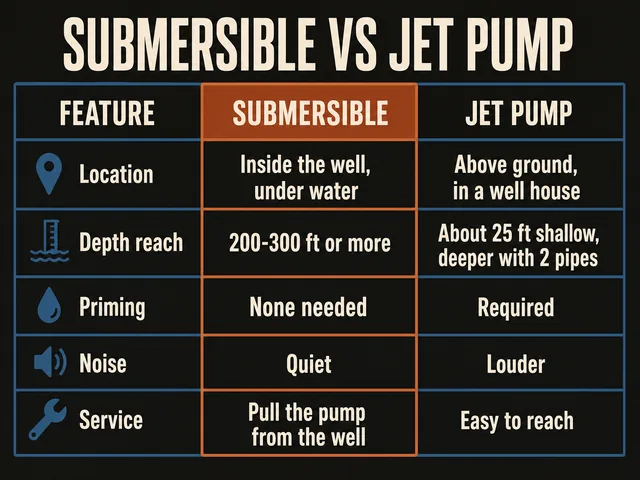
A submersible pump is a sealed motor and pump that hangs inside the well under the water and pushes water up. A jet pump sits above ground, usually in a well house, and pulls water up with suction. That one difference drives almost everything else in the comparison.
A Connecticut Department of Public Health conference deck describes a shallow-well jet as one pipe going to the well, capable of pumping up to 25 ft. A deep-well jet uses two pipes, a larger suction pipe and a smaller drive-water pipe, and the deck says a multi-stage jet can pump up to 220 ft (CT DPH, 2018). Real products are rated lower than that, which is covered below.
How deep can each pump work?
Depth is the deciding factor. A shallow-well jet suits wells under about 25 ft, a deep-well jet is used beyond that and sometimes past 100 ft, and a submersible typically covers 200–300 ft or more, according to This Old House (updated March 2026).
Published limits vary, so the table lists each source with its figure rather than one number.
| Pump | Published depth figure | Source |
|---|---|---|
| Shallow-well jet | About 25 ft | CT DPH 2018; This Old House (under 25 ft) |
| Deep-well jet, one 1 HP model | 70 ft max lift; works at depths to water of 70 ft or less | Pentair Flotec FP4210 |
| Deep-well jet, general | Up to 150 ft | Plumbing Supply and More (supplier) |
| Deep-well jet, multi-stage | Up to 220 ft | CT DPH 2018 |
| Submersible | 200–300 ft or more; up to 400 ft | This Old House; Plumbing Supply and More |
The Flotec page is a good reminder that the number on the box is a limit on depth to water, not total well depth, and the rating is for that specific model. A deep well can still be served by a jet if the water level is within the jet’s lift, but the pump’s own spec sheet has the last word.
Which pump fits Parker County water levels?
A submersible fits almost every Parker County well. The state’s driller reports show a median new household well depth of 240 ft, with water typically standing about 110 ft down (our depth guide, built from 4,746 Texas Water Development Board reports since 2021).
| Area | Median depth | Typical water level | Within a 70 ft jet rating? |
|---|---|---|---|
| Parker County (all) | 240 ft | ~110 ft | No |
| Weatherford | 240 ft | ~110 ft | No |
| Aledo | 320 ft | ~176 ft | No |
| Springtown | 240 ft | ~100 ft | No |
| Azle | 220 ft | ~80 ft | No |
| Peaster | 220 ft | ~90 ft | No |
| Poolville | 215 ft | ~80 ft | No |
| Brock | 220 ft | ~125 ft | No |
| Granbury (Hood County) | 360 ft | ~260 ft | No |
Even the shallowest typical level in that table, about 80 ft at Azle and Poolville, is past the 70 ft rating of the Flotec model I checked. Water level is also a starting point: the level drops while the pump runs, so the lift a jet must overcome is greater than the static number. A shallow-well jet, at about 25 ft, is out of the question for any of these towns. How far below that level the pump itself sits is shown in our static water level data: the median submersible is set 100 ft below it.
How much does each type cost?
Jet pumps cost less up front. American Home Shield (February 2026, citing HomeGuide) lists replacement at $1,000–$2,500 for a submersible, $400–$1,400 for a shallow-well jet and $500–$1,400 for a deep-well jet, labor included (American Home Shield).
This Old House prices the pumps alone at about $200 for a shallow jet, $300 for a deep-well jet and $500 for a submersible, and puts a full replacement at $900–$2,500 on average (This Old House).
Those are national averages. In Parker County the realistic comparison is not jet against submersible, because a jet usually cannot do the job. Our well pump replacement cost guide puts a submersible replacement at $1,800–$4,500 locally, because the pump sits around 200 ft or deeper and the drop pipe and wire all come out with it.
How long do they last, and what do they cost to run?
Lifespans overlap, so they do not settle the question. SC Well Service lists 10–15 years for a shallow-well jet and 8–12 years for a deep-well jet, against 8–15 years for a submersible, and our well pump lifespan guide collects the ranges from five sources.
Running cost leans toward the submersible. The Connecticut deck lists higher efficiency as a submersible advantage. One plumbing supplier puts a submersible at about 500 watts and a jet at 800–2,000 watts (Plumbing Supply and More), though the same page gives two different energy-savings figures and the company sells both types, so use it as a direction, not a measurement.
What are the day-to-day trade-offs?
Jets are easier to reach and cheaper, and submersibles are quieter and need less fuss. The Connecticut deck lists these jet advantages: cost effective, no special equipment to install, accessible if something goes wrong, and up to 1.5 HP on 115 V. Its jet drawbacks: priming can be challenging, they are noisy compared with a submersible, and homeowners tend to fiddle with them. If you keep a jet, our guide on how to prime a well pump walks through the steps and the limits.
For submersibles, the same deck lists higher efficiency, deeper reach, higher flow than a deep-well jet, easier installation than a deep-well jet, and quiet operation out of reach of owners. Perry Pump Repair Service adds the catch: a submersible needs less maintenance, but repairs are harder because the pump has to be pulled from the well (Perry Pump Repair Service). When a submersible fails, the first question is whether to fix or replace it, which our guide to repairing or replacing a well pump walks through.
What do homeowners say about the choice?
Two old forum threads show how the decision tends to go, and neither is from Texas. In a January 2006 Terry Love plumbing forum thread, a new homeowner found a vertical pump next to the pressure tank in a pit and could not tell whether the well had a jet or a submersible. A reply gave a quick test: “If you can see a pump above ground, it’s not a submersible.” Another replier guessed the pit pump might be an unused deep-well jet left as a backup after a submersible was installed (Terry Love forum).
In a May 2004 Fine Homebuilding thread, an owner with a 20–22 ft well used only for outdoor watering decided to replace a dead jet pump with a new jet. One replier called a jet “couple hundred bucks, no fuss, no muss.” Another, who had replaced the jet on a 100 ft well with a 20 ft static level, concluded: “For all but the shallowest wells, the submersible seems to be the way to go.” Replies also noted that a pressure tank is still needed with a submersible (Fine Homebuilding forum).
Both threads match the published numbers: a jet is the reasonable answer for a shallow well used lightly, and the case for a submersible grows with depth.
Author’s take: what would I put on a Parker County well?
This section is the author’s analysis of the sources above, written by Chris Fugate, a water well driller with 24 years of experience. It draws conclusions from the cited evidence and does not describe any particular customer or job.
For a new or deep well here, the answer is a submersible. The state’s own reports say the typical Parker County well is 240 ft deep with water near 110 ft. A shallow-well jet is out of the question at that depth, and the one deep-well jet spec sheet I checked stops at 70 ft. The sizing question left is horsepower, flow and setting depth, not pump type.
A jet pump is a reasonable keep, not a reasonable buy. If an old jet still works on a shallow well, there is no reason to rip it out. If you are buying new for a well past about 100 ft, the national price gap of a few hundred dollars shrinks fast once you add the second pipe, the priming and the noise.
Check the pump before you buy it. Ask for the pumping water level, the setting depth and the pump’s rated flow at that lift. Under Texas rules, installing a pump on a water well is licensed work, per the TDLR guide, so confirm the installer’s license first with our guide to checking a well driller’s license.
How do you size the tank and controls around the pump?
Whichever pump you run, the pressure tank and switch still matter. A submersible also comes in two wiring types, and our 2 wire vs 3 wire well pump guide covers which needs a control box. A pressure tank is still required with a submersible, and one forum reply suggests a tank volume of about five times the pump’s gallons per minute to keep cycles near two minutes at 30/50 psi. That is a rule of thumb from a forum, not a standard, so check the manufacturer’s guidance. Our guides on what size pressure tank you need and how to adjust a well pressure switch cover the details, and low water pressure on a well is the place to start if the pump is running but the faucets are weak.
How was this guide researched?
This guide compares published sources: a Connecticut Department of Public Health conference deck, one manufacturer spec sheet (Pentair Flotec), two consumer price guides (American Home Shield, This Old House), two pump suppliers and installers (Plumbing Supply and More, Perry Pump Repair Service), a well service company (SC Well Service), two forum threads, a TDLR licensing summary, and the Texas Water Development Board driller database through our own depth guide. It contains no original measurements. Depth limits vary by model and source, so the table shows them side by side. National prices are not Parker County prices. The forum posts date from 2004 and 2006 and are used as illustrations only. No Reddit threads were used. If your well is acting up now, call a well tech at the number below.
Frequently asked questions
Which is better, a submersible or a jet pump?
For a deep well, a submersible. It sits in the water, needs no priming, runs quietly and handles 200–300 ft or more. A jet pump is the better fit only for a shallow well, roughly 25 ft or less to water, where its lower price and easy access count for more.
Can a jet pump work on a 200 ft well in Parker County?
Rarely in practice. Lift ratings count the depth to water, not just the well depth, and Parker County water typically stands around 80–176 ft down. One common 1 HP deep-well jet is rated to 70 ft, so check the manufacturer's rating against your pumping level before buying.
Is a submersible pump more efficient than a jet pump?
Yes, according to a Connecticut Department of Public Health conference deck, which lists higher efficiency as a submersible advantage. A plumbing supplier puts a submersible at about 500 watts against 800–2,000 watts for a jet, but that supplier sells both, so treat the figures as a rough guide.
Which costs more to replace, a submersible or a jet pump?
Nationally, a submersible runs $1,000–$2,500 installed against $400–$1,400 for a shallow-well jet, per American Home Shield (2026). In Parker County, submersible replacement runs $1,800–$4,500 because pumps sit deep and the pipe and wire have to be pulled.
Do I still need a pressure tank with a submersible pump?
Yes. Repliers on a 2004 Fine Homebuilding thread noted a pressure tank is still required with a submersible. The tank, the pressure switch and the pump work together, so size the tank to the pump's flow.
Can I swap my jet pump for a submersible?
Often, yes, if the casing is large enough and the water is deep enough to keep the pump submerged with room for drawdown. In Texas, installing a pump on a water well is licensed work under TDLR, so hire a licensed pump installer.
How do I tell which pump my well has?
If you can see the pump above ground, it is not a submersible, as a plumbing forum reply put it in 2006. A submersible shows only a cable and drop pipe entering the well cap, with the pump hanging below the water line.
Sources
- Texas Water Development Board, Submitted Drillers Reports (extract dated 2026-09-25)
- This Old House, Well Pump Cost (updated March 5, 2026)
- American Home Shield, What Is the Cost to Replace a Well Pump? (Feb. 6, 2026)
- Pentair Flotec FP4210 1 HP Cast Iron Convertible Deep Well Jet Pump (spec sheet)
- Connecticut Department of Public Health, Private Well Conference 2018: water pump systems (slides)
- Plumbing Supply and More, Submersible vs. Jet Pump Performance Explained
- Perry Pump Repair Service, The Key Differences Between Submersible Pumps and Jet Pumps
- SC Well Service, Well pump lifespan
- Terry Love Plumbing forum, Type of well - submersible or jet? (Jan. 30-31, 2006)
- Fine Homebuilding forum, jet pump vs submersable (May 2-3, 2004)
- Texas Department of Licensing and Regulation, Water well drillers and pump installers at a glance