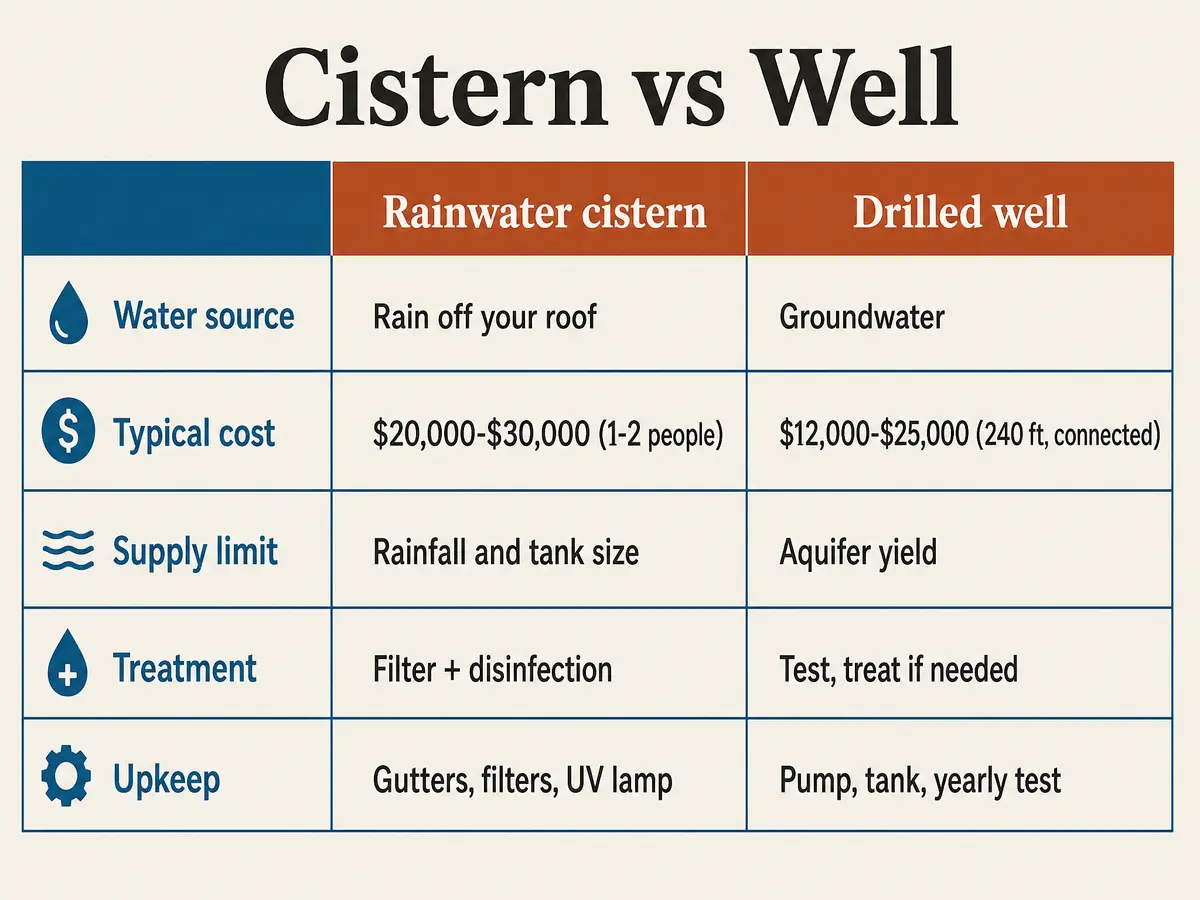
Cistern vs well: which is better for a Texas home? A well is usually cheaper and steadier where groundwater exists. A potable rainwater system for 1-2 people was estimated at $20,000-$30,000 in 2025, against $12,000-$25,000 for a typical connected Weatherford well. A cistern depends on rainfall and tank size, and needs filtration, disinfection and regular upkeep.
Key takeaways
- A 2025 Hill Country Alliance estimate puts a potable rainwater system at $20,000-$30,000 for 1-2 people (10,000-15,000 gal of storage) and $30,000-$45,000+ for a family of 3-4 (Hill Country Alliance, Aug. 2025).
- A typical new household well near Weatherford costs $12,000-$25,000 all-in, and the median new well is 240 ft deep (our cost guide).
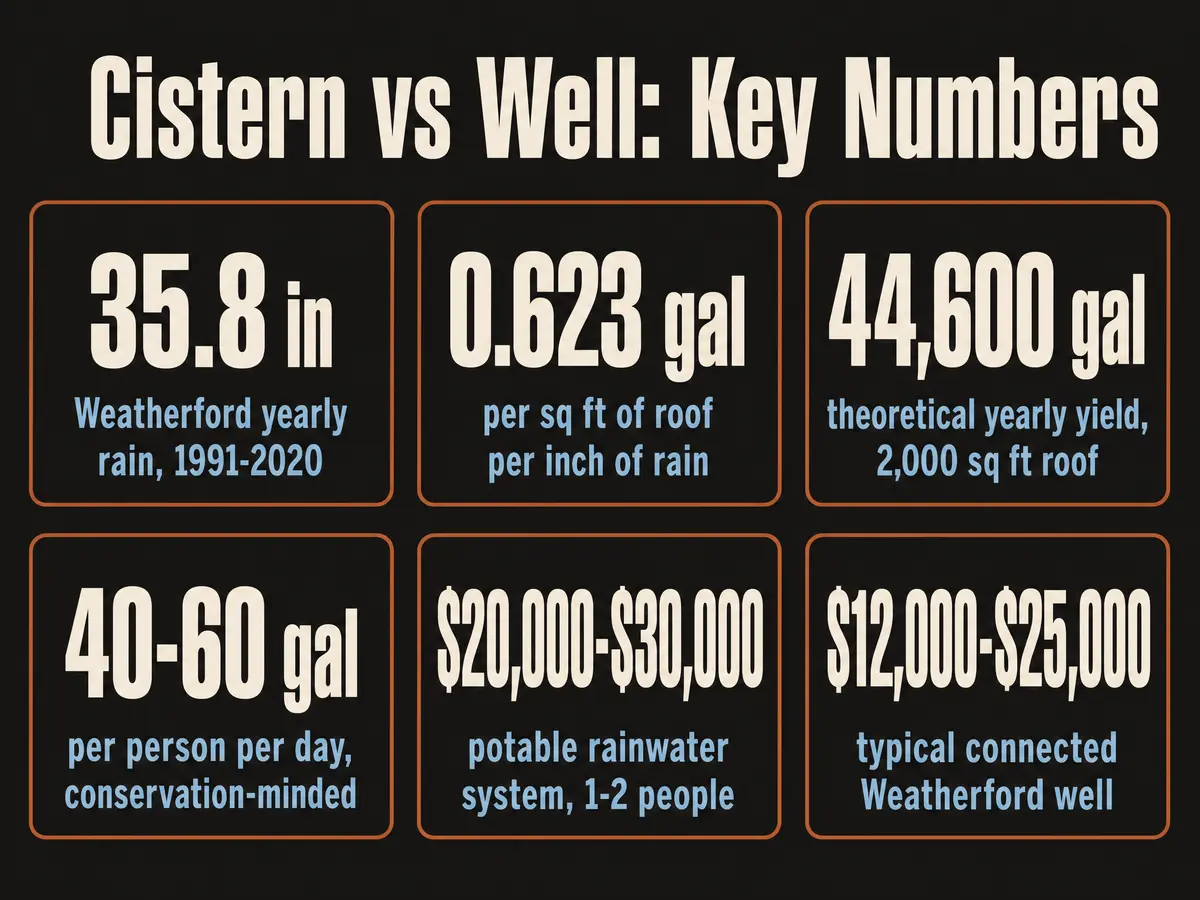
- Weatherford averages 35.8 inches of rain a year (1991-2020 normals), and a roof yields 0.623 gallons per square foot per inch, so a 2,000 sq ft roof gives about 44,600 gallons before losses (U.S. Climate Data; TWDB manual; our arithmetic).
- Conservation-minded households use 40-60 gallons per person per day, and the Alliance advises storing 3-6 months of water for year-round reliability (Hill Country Alliance).
- A rainwater owner becomes the operator of a water supply: filters, UV lamps, leaks and water-quality testing are the owner's job (TWDB, Texas Manual on Rainwater Harvesting).
- A well and a tank can be combined: a slow well can fill a storage tank all day and a booster pump serves the house (well water storage tank systems).
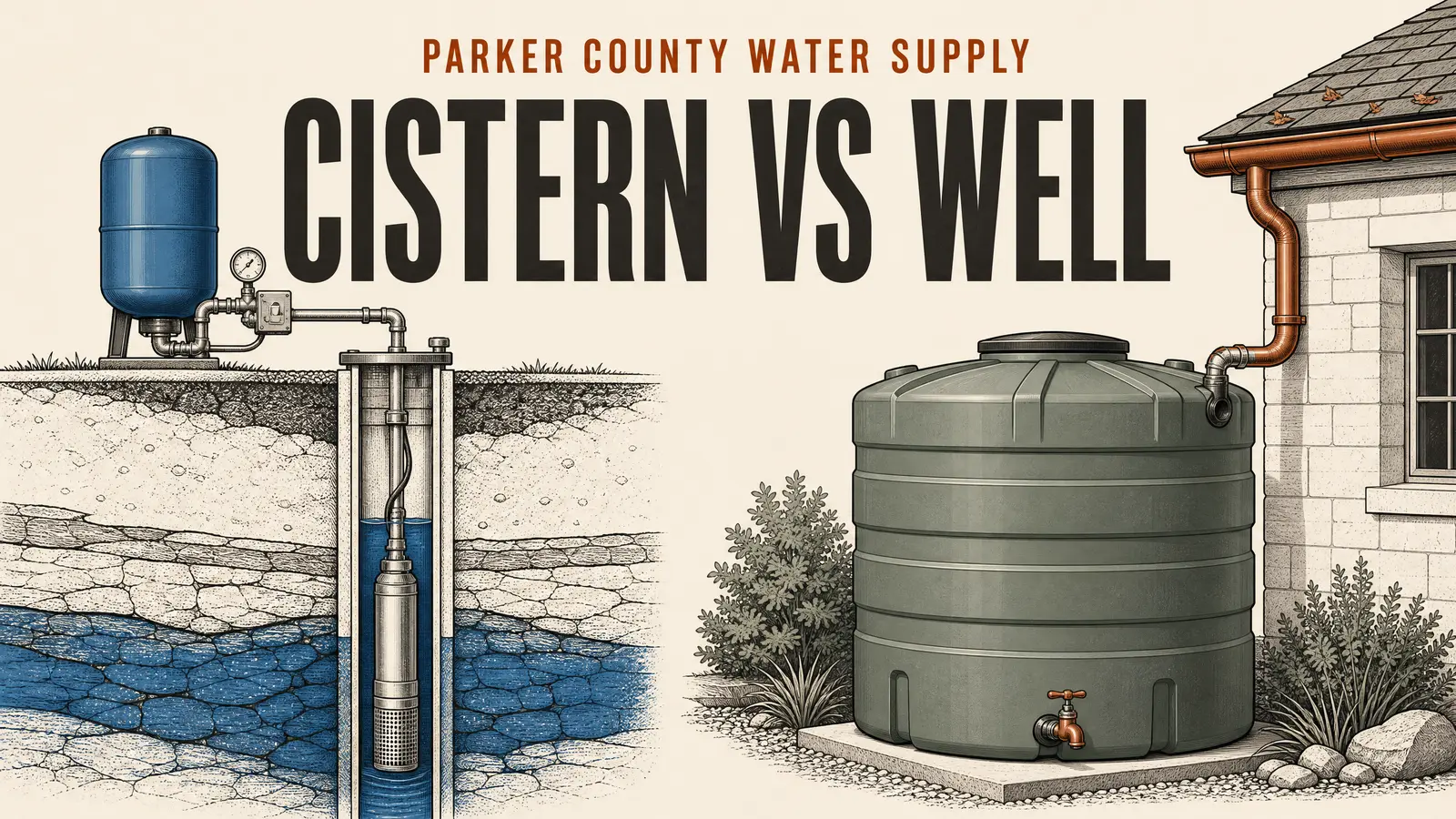
Water Well Drilling Weatherford covers the cistern vs well question for rural Texas homes with no city line, or with a slow well. A cistern is a tank that stores water. A well pulls it from the ground. This guide compares what each costs, how much water each can supply near Weatherford, and what each asks of you. Our residential well drilling page covers the process of a new well.
What is the difference between a cistern and a well?
A well taps groundwater through a drilled hole, and a pump lifts it to the house. A cistern holds water that arrived some other way, most often as rain off the roof, sometimes as hauled water. The tank stores water but does not make any.
That difference sets everything else. A well’s supply is limited by the aquifer under your lot. A cistern’s supply is limited by roof area, rainfall and tank size. In Parker County, the static water level and depth in nearby driller reports tell you what the ground can do.
How much does a cistern cost compared with a well?
A whole-house rainwater system costs more than a typical Weatherford well. The Hill Country Alliance’s 2025 estimates include tanks, gutters, filtration, UV or chlorine disinfection, a pump and professional installation (Hill Country Alliance, Aug. 2025).
| Household | Storage | Rainwater system (2025 estimate) |
|---|---|---|
| 1-2 people | 10,000-15,000 gal | $20,000-$30,000 |
| 3-4 people | 20,000-30,000 gal | $30,000-$45,000+ |
| Larger homes | 30,000+ gal | $45,000-$60,000+ |
| Typical new well near Weatherford, connected | n/a | $12,000-$25,000 (our cost guide) |
The same Alliance paper priced a 20,000-gallon rainwater system at $24,000-$35,000 against $50,000-$70,000+ for a drilled 450 ft well. That well is deeper than almost any in our county: the median new Parker County well is 240 ft. The comparison is Central Texas, not Weatherford, and the paper is an advocacy document from a group that promotes rainwater harvesting.
Tank price alone varies widely. The TWDB manual lists fiberglass at $0.50-$2.00 per gallon, polyethylene at $0.74-$1.67 and welded steel at $0.80-$4.00, in 2005 dollars (TWDB manual). Treat those as a ratio between materials, not as today’s prices. A landscape-only system is far cheaper, and the Alliance puts 1,000-2,500 gallons for a large garden at $1,800-$4,500.
How much water can a roof collect in Weatherford?
The formula is roof area in square feet, times rainfall in inches, times 0.623 gallons (TWDB manual). Weatherford’s 1991-2020 normal is 35.77 inches a year (U.S. Climate Data). A 2,000 sq ft roof therefore collects about 44,600 gallons in an average year, before losses to first-flush diverters, overflow and evaporation. The arithmetic is ours.
Rain does not fall evenly. The same normals give 4.59 inches in May and 2.14 in July, so a 2,000 sq ft roof yields about 5,720 gallons in May and about 2,670 in July. The TWDB manual notes that rainfall in most Texas locations is seasonal and calls for large storage to last through dry spells.
Can a cistern supply a whole household?
Sometimes, for a small household with a big roof. The Alliance says conservation-minded households use 40-60 gallons per person per day. At 50 gallons, two people use about 36,500 gallons a year, which is 82% of the 44,600-gallon theoretical yield. A family of four uses about 73,000 gallons, which is more than the roof collects.
| Household | Use at 50 gal/person/day | Share the roof can cover |
|---|---|---|
| 2 people | about 36,500 gal/yr | about 120% before losses |
| 4 people | about 73,000 gal/yr | about 61% |
Those percentages are our arithmetic from the figures above, for a 2,000 sq ft roof in an average year. A dry year, a smaller roof or a leaky system cuts them. Adding the garage or a carport roof raises the catchment, which the Alliance names as a quick way to collect more.
What does each one ask of the owner?
Both are your responsibility, but the tasks differ. The TWDB manual says owners of rainwater systems that supply all domestic needs become owners of their own water supply system. Its list covers monitoring tank levels, cleaning gutters and first-flush devices, repairing leaks, changing filters, maintaining ultraviolet lamps and regularly testing water quality (TWDB manual).
A well has its own list: a pump that wears out, a pressure tank and a yearly lab test. Our well pump lifespan article puts submersible pumps in the 8-15 year range, and our well water test cost post covers the lab side. The Hill Country Alliance rates rainwater maintenance as low (annual UV lamp changes and quarterly filter changes) and a well as moderate. Owners in the threads below would not all agree.
Is cistern water safe to drink?
Only if it is filtered and disinfected. The TWDB manual says rainwater for drinking must be treated, and lists E. coli, Cryptosporidium, Giardia, total coliforms, legionella, fecal coliforms and viruses as the microbiological contaminants of greatest concern. It also says the roof surface can carry dust, dirt, bird and animal droppings and plant debris, and that total dissolved solids in Texas rain run 2 to 20 mg/L.
The same manual, published in 2005, said no federal or state standards then existed for harvested rainwater quality. I could not retrieve the current state statute, so check the rules with the county and a licensed installer before you drink from a cistern. If a cistern will tie into a public supply, the manual says a backflow prevention device is needed to keep rainwater out of the utility’s lines.
What do cistern owners say about living with one?
Forum posts show the same four problems: size, pumps, quality and dry spells. An Austin, Texas owner on the permies.com forum described two 1,600-gallon tanks. He advised buying two pumps, because a warranty replacement took about six weeks. His tanks developed a pond odor, so he doses them with bleach after big rains, and his drinking water goes through two whole-house filters and a Berkey (permies.com thread).
Another poster on that thread, in Greybull, Wyoming, described four cisterns over about 40 years of hauling. A 1,000-gallon concrete one cracked and held about 500 gallons. A concrete-block cistern leaked and collapsed; the repair estimate was about $10,000, roughly the cost of city water, so the family switched. A Washington state owner wrote that 7,500 gallons “wasn’t enough” for a garden through the dry season.
In a 2006 Fine Homebuilding thread, a Hawaii owner with a roughly 10,000-gallon tank said the main issue is timing: a tank can run dry by fall if rain only comes in spring. Another poster warned that tanker-truck water often arrives “brown, rusty, cloudy,” and one said chlorine does not kill Cryptosporidium or Giardia, so he recommended UV plus a 1-micron filter (Fine Homebuilding forum, July 2006). These are anecdotes from other states, some old, and none describes Parker County.
When does a well make more sense, and when a cistern?
A well makes more sense when the ground under your lot reliably yields water at a depth you can afford. In Parker County, new household wells run a median 240 ft, and our well water vs city water guide shows what a well costs to own each year.
A cistern earns a look when the lot cannot support a well, when drilling would be unusually deep, or when you want a second source. The far-west part of the county is the usual example, where the Trinity thins out and yields vary by lot. A slow well plus a storage tank is the other route (our data on what counts as a good gpm for a well shows how little a 1–3 gpm well supplies in a peak), covered on our well water storage tank page, and our is my well going dry guide helps you tell a failing well from a slow one.
Our take: what I would do on a Parker County lot
This section is the author’s analysis of the sources above, written by Chris Fugate, a water well driller with 24 years of experience. It draws conclusions from the cited evidence and does not describe any particular customer or job. I drill wells, so weigh my view with that in mind.
Start with the well question, because it is usually the cheaper answer. On the numbers above, a connected 240 ft well costs less than a drinking-grade rainwater system for the same household. Check the driller reports near your lot before you rule it out.
Do not size a cistern from the annual average. The average hides the dry months. Size it for the longest stretch you expect without useful rain, and be honest about daily use, because a family of four outruns a 2,000 sq ft roof on paper.
Treat rainwater as untreated water. Filtration and disinfection are not optional extras for drinking water. Budget for filter and lamp changes and a yearly lab test, as you would for a well.
A tank plus a slow well often beats either alone. If the well makes only a few gallons a minute, a storage tank turns that trickle into household supply, and the roof can top it up. That keeps a source that does not depend on rain alone.
When should you call a well technician?
Call before you commit to either system if you are unsure what the ground under your lot can give, if an existing well is slow, or if you want a tank and booster added to a well. We can read the state driller reports for your area and tell you what is realistic.
Our well problem checker sorts out a symptom first, and you can request a site visit to talk through a well, a storage tank or both. For a new well, see our Parker County water well permit guide first.
How was this guide researched?
This guide draws on a 2025 Hill Country Alliance issue paper, the 2005 TWDB rainwater manual, 1991-2020 climate normals from U.S. Climate Data, one permies.com thread and one 2006 Fine Homebuilding thread, plus our own Weatherford well cost guide. The yield and share-of-use figures are our arithmetic, not measurements. We could not retrieve the current Texas statute on rainwater use, the Angi cistern-vs-well page or several Reddit threads, so none of them are used. No Parker County cistern was inspected for this guide.
Frequently asked questions
Is a cistern cheaper than a well?
Not for a whole-house drinking system. A 2025 Hill Country Alliance estimate is $20,000-$30,000 for 1-2 people, including tanks, filtration, disinfection, pump and installation. A typical connected Weatherford well runs $12,000-$25,000. A deep or dry-hole well can cost more, and the same paper priced a 450 ft well at $50,000-$70,000+.
How much water does a roof collect in Weatherford?
Multiply roof area in square feet by rainfall in inches by 0.623. With 35.77 inches a year, a 2,000 sq ft roof collects about 44,600 gallons in an average year before first-flush, overflow and evaporation losses. July, at 2.14 inches, would give about 2,670 gallons from the same roof.
Is rainwater safe to drink without treatment?
No. The Texas Water Development Board manual says rainwater intended for drinking must be treated with filtration and disinfection, and lists E. coli, Cryptosporidium, Giardia, coliforms, legionella and viruses as the concerns to test for. Roof dust, bird droppings and plant debris reach the tank.
Can I use a cistern as a backup for my well?
Yes, and many owners do. A storage tank can sit between a slow well and the house, so the pump refills it slowly while a booster pump gives steady pressure. Filling that tank from the roof is possible, but treat it like any untreated source and keep it covered, screened and tested.
How big should a cistern be?
Size it to the dry spells, not the rain. The Hill Country Alliance suggests 10,000-15,000 gallons for 1-2 people and 20,000-30,000 gallons for 3-4, and advises storing 3-6 months of use. At 50 gallons per person per day, two people use about 3,000 gallons a month.
Does a cistern need a permit in Parker County?
I could not confirm a county permit rule for rainwater tanks, and the state manual I read dates from 2005 and predates later changes. Ask the county and your groundwater district before you build. A new well must be registered with the Upper Trinity Groundwater Conservation District before drilling.
Sources
- Hill Country Alliance, Rainwater Harvesting in Central Texas: A Practical Guide (Aug. 2025)
- Texas Water Development Board, The Texas Manual on Rainwater Harvesting, 3rd ed. (2005)
- U.S. Climate Data, Weatherford, Texas climate (1991-2020 normals)
- permies.com, Water cisterns (rainwater catchment forum thread)
- Fine Homebuilding forum, living with cisterns (July 29-31, 2006)
- Upper Trinity Groundwater Conservation District, forms and fees