How to adjust a well pressure switch: shut off the pump breaker, set the tank's air charge 2 psi below the new cut-in pressure, then turn the large range nut in small steps, refit the cover and check the gauge after each change. Raise the setting only as far as the pump can reach.
Key takeaways
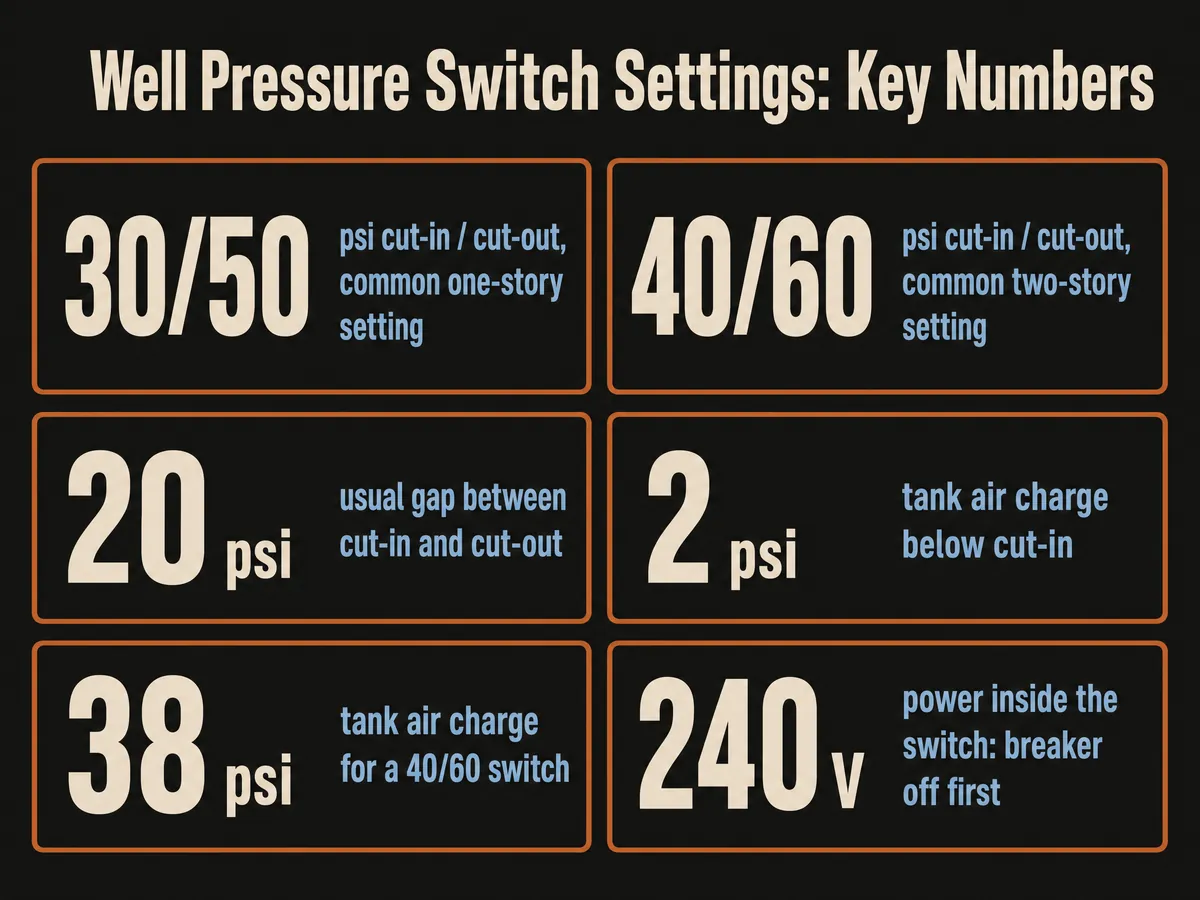
- The two common household settings are 30/50 and 40/60 psi, a 20 psi gap between pump-on (cut-in) and pump-off (cut-out) (PressureTankSizer).
- The large range nut moves cut-in and cut-out together; the small differential nut moves only cut-out (Schneider Electric).
- Set the tank's air charge 2 psi below cut-in: 28 psi for a 30/50 switch, 38 psi for a 40/60 (Water Systems Council).
- One full turn of the range nut changes pressure by about 2 to 3 psi, so a 30/50 to 40/60 change takes roughly three to five turns (RPS Water Pumps).
- The switch maker's instruction sheet says to adjust the range nut first, then the differential, to refit the cover before restoring power and to check operation several times (Telemecanique Sensors, Pumptrol 9013, Sept. 2025).
- A setting above what the pump can produce keeps the pump running without shutting off, which risks the motor (RPS Water Pumps).
- Replacing a bad switch typically costs $150 to $300 installed, per the figure in our pressure tank cost guide (HomeGuide, 2026).
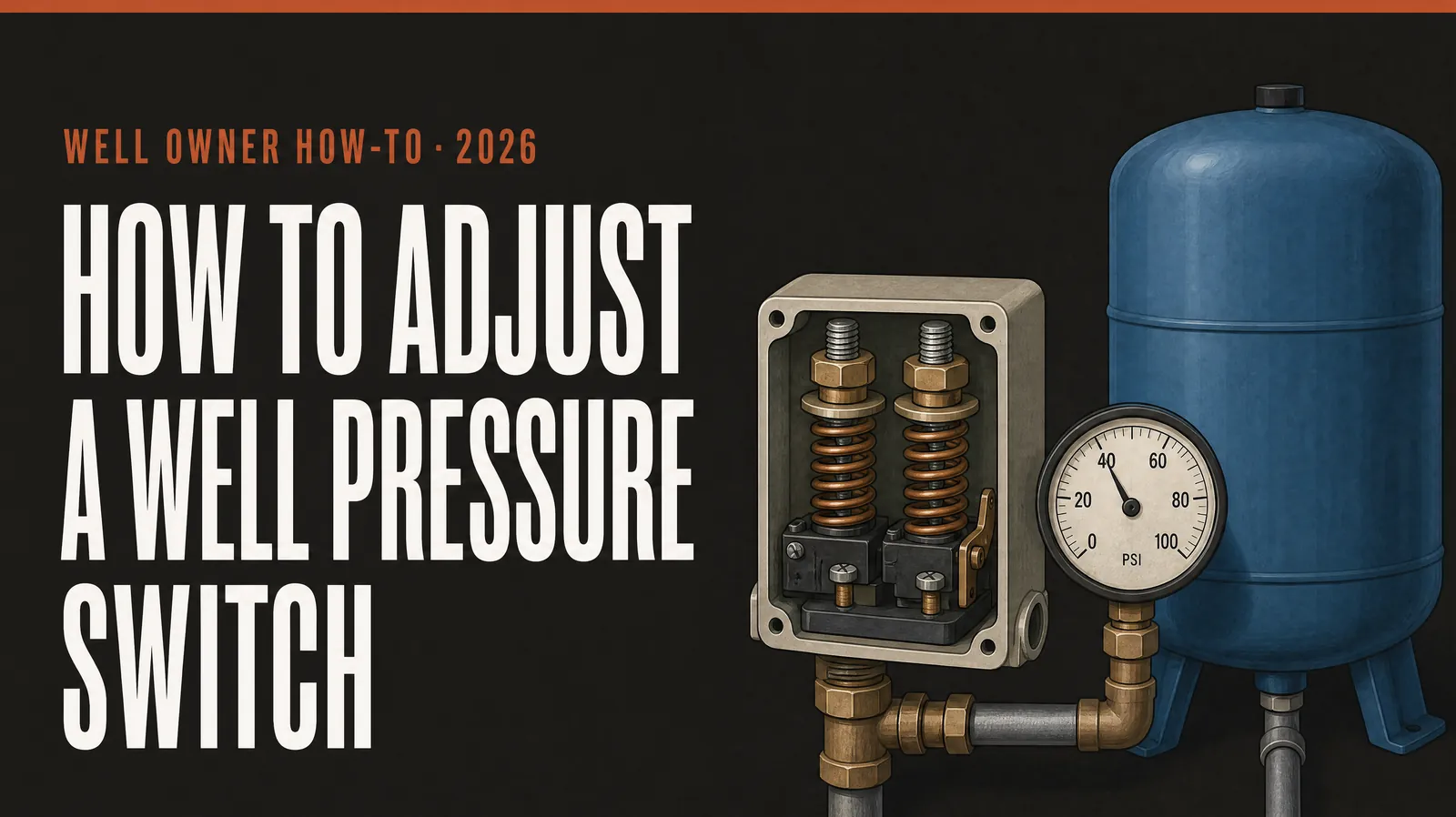
Water Well Drilling Weatherford answers a question many well owners ask when the shower feels weak: can the pressure switch just be turned up? Here is how to adjust a well pressure switch, what to check first, and where the job stops being a homeowner task. If you would rather have a person do it, our well pump repair team tests the switch, tank and pump together.
What does a well pressure switch actually control?
A pressure switch starts the well pump when pressure falls to the cut-in setting and stops it when pressure climbs to the cut-out setting. The gap between the two is the differential. A 30/50 switch starts the pump at 30 psi and stops it at 50 psi.
The tank between those two numbers holds the water you use between pump cycles. That is why the switch, the tank and the pump have to be changed as a set. Moving one without the others is how people end up with a pump that cycles every few seconds or never shuts off. Our guide to what size pressure tank you need covers the tank side.
What do you need before you adjust a well pressure switch?
You need a working pressure gauge, a tire-style air gauge, a nut driver or small wrench that fits the spring nuts, and a voltage tester. Before touching the switch, confirm the gauge is accurate and the tank is healthy.
- A trustworthy gauge. The gauge on the tank tee is often original equipment and can be off by several psi. Compare it with a second gauge if you can.
- A healthy tank. Press the air valve on the tank. If water comes out, the bladder has failed and no switch setting will fix it. See signs of a bad pressure tank.
- A pump that can reach the target. The pump’s rated pressure at your well’s depth sets the ceiling, not the switch.
- A reason. Weak pressure also comes from clogged filters, leaks and a falling water level. Our low water pressure guide rules those out first.
How do you adjust a well pressure switch, step by step?
To adjust a well pressure switch, kill the power, set the tank charge, remove the cover, turn the large nut in small steps and recheck the gauge. The order matters: the tank charge is set before the switch, not after.
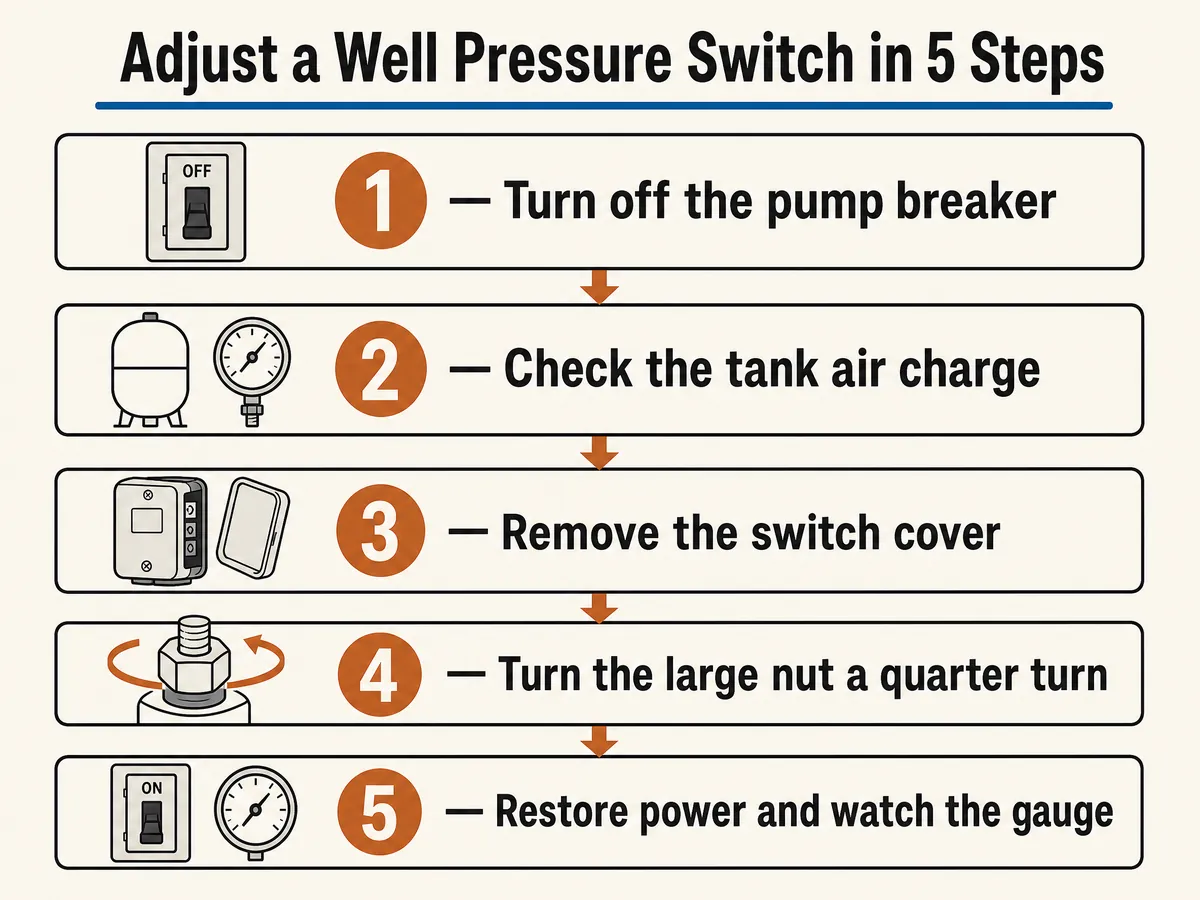
- Turn off the pump breaker. Confirm with a voltage tester. The switch carries 240 volts, and PressureTankSizer puts breaker-off first for the same reason.
- Drain the pressure and set the tank charge. Open a faucet until the gauge reads zero, then check the tank’s air valve. The Water Systems Council says the precharge belongs 2 psi below the cut-in: 28 psi for a 30/50 switch, 38 psi for a 40/60.
- Remove the switch cover. Find the two spring nuts. The large one is the range nut and the smaller one is the differential nut.
- Turn the range nut. The switch maker’s instruction sheet says to turn the range nut down (clockwise) for a higher cut-in and up (counterclockwise) for a lower one, and to set the range before touching the differential. Schneider Electric describes the same two nuts. RPS Water Pumps reports about 2 to 3 psi per full turn, so go a quarter turn at a time.
- Refit the cover, restore power and watch the gauge. The instruction sheet’s warning is to install and secure the cover before restoring power, so the cover goes back on for every test and the breaker goes off again before every further turn. Run water, note where the pump starts and stops, and repeat. Leave the differential nut alone unless you have a reason: the same RPS guide warns it is hard to return to the factory 20 psi gap.
Write the new settings and the tank charge on the tank with a marker so the next person sees them.
Should you use 30/50 or 40/60?
Use the lower setting unless the house needs more pressure. A 30/50 switch is the common choice for one-story homes and 40/60 for two stories, according to PressureTankSizer. Higher pressure also means more stress on the pump, the tank and every fixture. Our 30/50 vs 40/60 pressure switch comparison shows what the extra 10 psi does to tank drawdown, and our guide on how to increase well water pressure puts the switch in order with the filter and tank checks.
| Setting | Typical use | Tank air charge | Watch for |
|---|---|---|---|
| 30/50 psi | One-story home, short pipe runs | 28 psi | Weak showers upstairs |
| 40/60 psi | Two-story home, longer runs | 38 psi | Pump must reach 60 psi |
| 50/70 psi | Special cases only | 48 psi | Tank and pump ratings, and fixture limits |
The 50/70 row is arithmetic from the same 2 psi rule, not a recommendation. Residential tanks are typically rated near 100 psi working pressure (PressureTankSizer), but check your tank’s label.
How do you know the new setting is right?
The setting is right when the pump starts and stops at your target pressures several times in a row and runs at least one minute each time. The switch maker says to check operation several times after any adjustment, and Franklin Electric’s 2026 AIM manual sets one minute as the minimum motor run.
- Watch three full cycles. With one faucet running, note the gauge when the pump starts and when it stops. The numbers should repeat.
- Time the run. Close the faucet as the pump starts and time it to cut-out. Under a minute means the tank is too small for the new setting or its air charge is off. See well pump short cycling.
- Expect less water per cycle at higher pressure. Amtrol’s Well-X-Trol chart lists a 44-gallon tank at 13.6 gallons of drawdown on 30/50 and 11.8 gallons on 40/60, about 13% less (our arithmetic).
- Count the starts. The same Franklin manual caps single-phase motors of 1 to 5.5 hp at 100 starts per 24 hours, and smaller motors at 300.
If the pump passes at 30/50 and fails the one-minute test at 40/60, the fix is a larger tank, not another turn of the nut.
What is the lever on the side of some pressure switches?
It is a low-pressure cut-off, and it changes how the switch behaves after an adjustment or an outage. On Pumptrol switches with the M4 option, the contacts open when pressure falls roughly 10 psi below the cut-in setting (Square D specification sheet), which protects the pump when the well runs low or a pipe breaks.
The switch will not restart the pump by itself after that. The instruction sheet says to correct the fault first, then move the lever to Start and hold it until enough pressure builds to keep the contacts closed. Two things follow for an adjustment:
- After draining the system to set the tank charge, a lever-type switch needs the lever held at Start to refill. That is normal, not a fault.
- If it trips again in normal use, something is pulling pressure below the cut-off: a leak, a failed tank or a well that cannot keep up. See is my well going dry before raising any setting.
What goes wrong when you adjust a well pressure switch?
Four problems account for most failed adjustments: the pump will not shut off, the pump cycles too often, the pressure does not change, or the switch itself is worn.
- The pump runs and never shuts off. The cut-out is higher than the pump can produce. RPS Water Pumps warns that a setting beyond the pump’s maximum output leaves the pump on and risks damage. Breaker off, back the nut down, retest. If it still never stops, see well pump running constantly for the other causes.
- The pump starts every few seconds. The tank charge is wrong or the bladder has failed. Franklin Electric’s submersible motor manual is the reason to care: short run times shorten motor life.
- Nothing changed. The nut was turned the wrong way, or the gauge is wrong. Recheck against a second gauge.
- The switch chatters, clicks or will not close. Contacts burn over time and the sensing port clogs with sediment. Replace the switch. Our repair or replace a well pump guide explains how a technician tells a switch from a pump fault.
One public case shows how the pieces interact. In an April 2020 thread on the Terry Love Plumbing forum, a new homeowner reported a 16-year-old tank, a 38 to 70 psi swing and only 9 psi of air charge. Respondents pointed at that wide range and told the poster to check the pump’s maximum pressure before raising settings. The poster ordered a 50/70 switch, then found air escaping from the tank’s drain, which indicated a failed diaphragm. The tank, not the switch setting, was the real problem.
What does a pressure switch fix cost, and when should you call?
A new pressure switch typically costs $150 to $300 installed, according to the HomeGuide-sourced range in our pressure tank replacement cost guide. A pump that runs on after a small change can cost far more: submersible pump replacement at Parker County depths typically runs $1,800 to $4,500 (well pump replacement cost).
Call a well tech instead of turning the nut again if:
- the pump runs continuously at the old setting, or the breaker trips;
- air or water comes out of the tank’s air valve;
- the contacts inside the switch look burned, pitted or melted;
- you cannot confirm the power is off.
Near Weatherford, new wells finish with water about 110 ft down, and around Aledo it is closer to 176 ft (TWDB driller reports, per our low-pressure guide). A pump has to lift water that far before it adds any pressure at the house, so check the pump’s performance data before you set a higher cut-out. After hours, see emergency well pump repair. A frozen switch in a cold snap is a different fix; see how to protect a well pump from freezing.
Author’s take: what would I do with my own switch?
This section is the author’s analysis of the sources above, written by Chris Fugate, a water well driller with 24 years of experience. It draws conclusions from the cited evidence and does not describe any particular customer or job.
Leave the differential alone and move the range nut only if a gauge proves the need. Every source cited here agrees on the sequence: tank charge first, then the range nut, then a gauge check. Several warn about the same failure, a setting the pump cannot reach. The Terry Love thread shows the other failure: chasing a pressure complaint with a switch when the tank had already failed.
Treat the 240-volt switch as a call-the-pro item the moment anything is unclear. A $150 to $300 service visit is cheap beside a burned-out pump.
How was this guide researched?
This guide compares the switch maker’s instruction and specification sheets, a motor manufacturer’s manual, a tank manufacturer’s chart, a water-industry association’s sizing sheet, two retailer guides and one public forum thread. It contains no original measurements. The 50/70 tank charge and the three-to-five-turn estimate are arithmetic from the cited per-turn and 2 psi figures, not published values. Because this is an electrical-safety topic, anonymous forum anecdotes were used only to illustrate one failure, not to set any procedure. Texas licenses water well pump installers (TDLR); if your job goes beyond a settings change, such as replacing the pump, hire a licensed professional. The figures were checked in November 2026; the Schneider Electric and HomeGuide pages block automated checks, so the switch directions were re-read from the Telemecanique instruction sheet instead. For your own well, call a well tech now at the number below.
Frequently asked questions
Can a well pressure switch be adjusted?
Yes. Most switches have a large range nut that moves cut-in and cut-out together and a smaller differential nut that moves only cut-out. The pump must be able to reach the new cut-out pressure, and the tank air charge must be reset to match.
Can I adjust a 30/50 pressure switch to 40/60?
Often yes, with about three to five turns of the range nut and a new tank charge of 38 psi. It only works if the pump can build 60 psi at your well's depth and the tank is rated for it. A worn pump may not reach the higher cut-out.
Is 70 psi too high for water pressure on a well?
For most household systems, yes. Residential tanks are typically rated around 100 psi working pressure, and a 70 psi cut-out leaves little margin. A 40/60 or 50/70 switch is the usual ceiling, and only if the pump, tank and plumbing are all rated for it.
What should the pressure tank be set to?
Set the tank's air charge 2 psi below the switch's cut-in pressure, measured with the water pressure at zero. That is 28 psi for a 30/50 switch and 38 psi for a 40/60 switch.
Why does my well pump run but never shut off after I raised the pressure?
The new cut-out is higher than the pump can produce. Turn the pump breaker off, back the nut down a turn or two, and retest. If the pump still runs constantly at the old setting, the pump, a leak or the water level needs a technician.
How do I know if the pressure switch is bad instead of needing adjustment?
Burned or pitted contacts, a pump that chatters or will not start with the gauge below cut-in, and a clogged sensing port all point to a failing switch. Those are replacement jobs, usually $150 to $300 installed.
What is the lever on the side of my well pressure switch?
It is a low-pressure cut-off. On Pumptrol switches with the M4 option, the switch shuts the pump off when pressure falls roughly 10 psi below cut-in, as it does when a well runs low. After the cause is fixed, hold the lever at Start until pressure builds, then release it.
Is it safe to adjust a pressure switch myself?
Only with the breaker off. The switch carries 240 volts and the pump is the most expensive part of your system. If you are not sure the power is off, or the numbers do not behave, call a well tech.
Sources
- Telemecanique Sensors, Pumptrol 9013 FSG/FYG pressure switch instruction sheet 65013-005-39 (Sept. 2025)
- Square D 9013FSG2J21M4 specification sheet (low-pressure cut-off about 10 psig below cut-in), distributor-hosted copy
- Franklin Electric, AIM Manual, 60 Hz Submersible Systems, 2026 edition (one-minute minimum run, maximum starts per 24 hours)
- Amtrol, Well-X-Trol specifications and sizing chart, form MC 7025 (04/19), retailer-hosted copy
- Schneider Electric, adjusting the 9013FSG pressure switch (range nut and differential nut)
- Water Systems Council, wellcare: Sizing a Pressure Tank (precharge 2 psig below cut-in)
- RPS Water Pumps, 30/50 regular-action pressure switch adjustment
- PressureTankSizer, how to set a well pump pressure switch (30/50 vs 40/60)
- Terry Love Plumbing forum, Well Water System Poor Pressure (April 2020)
- Franklin Electric, Submersible Motors AIM manual (starts per hour, run time)
- HomeGuide, well pump repair cost (2026)
- Texas Department of Licensing and Regulation, Water Well Drillers & Pump Installers at a glance