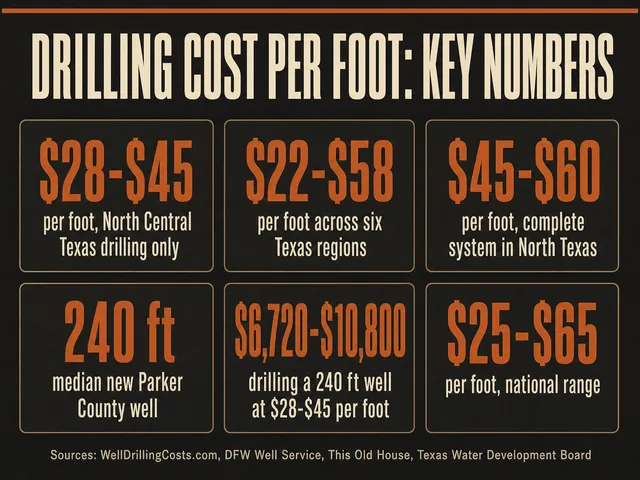
Water well drilling cost per foot in Texas runs about $22 to $58 in 2026, depending on region and rock. For North Central Texas, which includes Parker County, WellDrillingCosts.com publishes $28–$45 per foot for drilling only. A typical 240-ft Parker County well therefore costs roughly $6,700–$10,800 to drill, before the pump, tank and hookup.
Key takeaways
- North Central Texas drilling-only rates run $28–$45 per foot, against $35–$58 in the Hill Country and Trans-Pecos and $25–$38 on the High Plains (WellDrillingCosts.com, updated May 2026).
- A second Texas guide puts the Trinity Aquifer in north central Texas at $40–$55 per foot, so published rates for the same ground differ by about $12 per foot at the low end (WellDrillingCost.com, April 2026).
- A complete system, with casing, pump, tank and electrical, is quoted at $45–$60 per foot by one North Texas driller (DFW Well Service, June 2026).
- The median new household well in Parker County is 240 ft deep, and 52% of new wells fall between 200 and 249 ft (Texas Water Development Board driller reports, 2021–2026).
- At $28–$45 per foot, drilling a 240-ft well costs $6,720–$10,800 and a 375-ft well, deeper than about 90% of Parker County wells, costs $10,500–$16,875 (our arithmetic from the sources above).
- In a February 2007 North Texas forum thread, an owner was quoted $30–$40 per foot for about 800 ft, while a Wise County member said his well, drilled around 2001, cost $10 per foot plus pump and tank (TractorByNet).
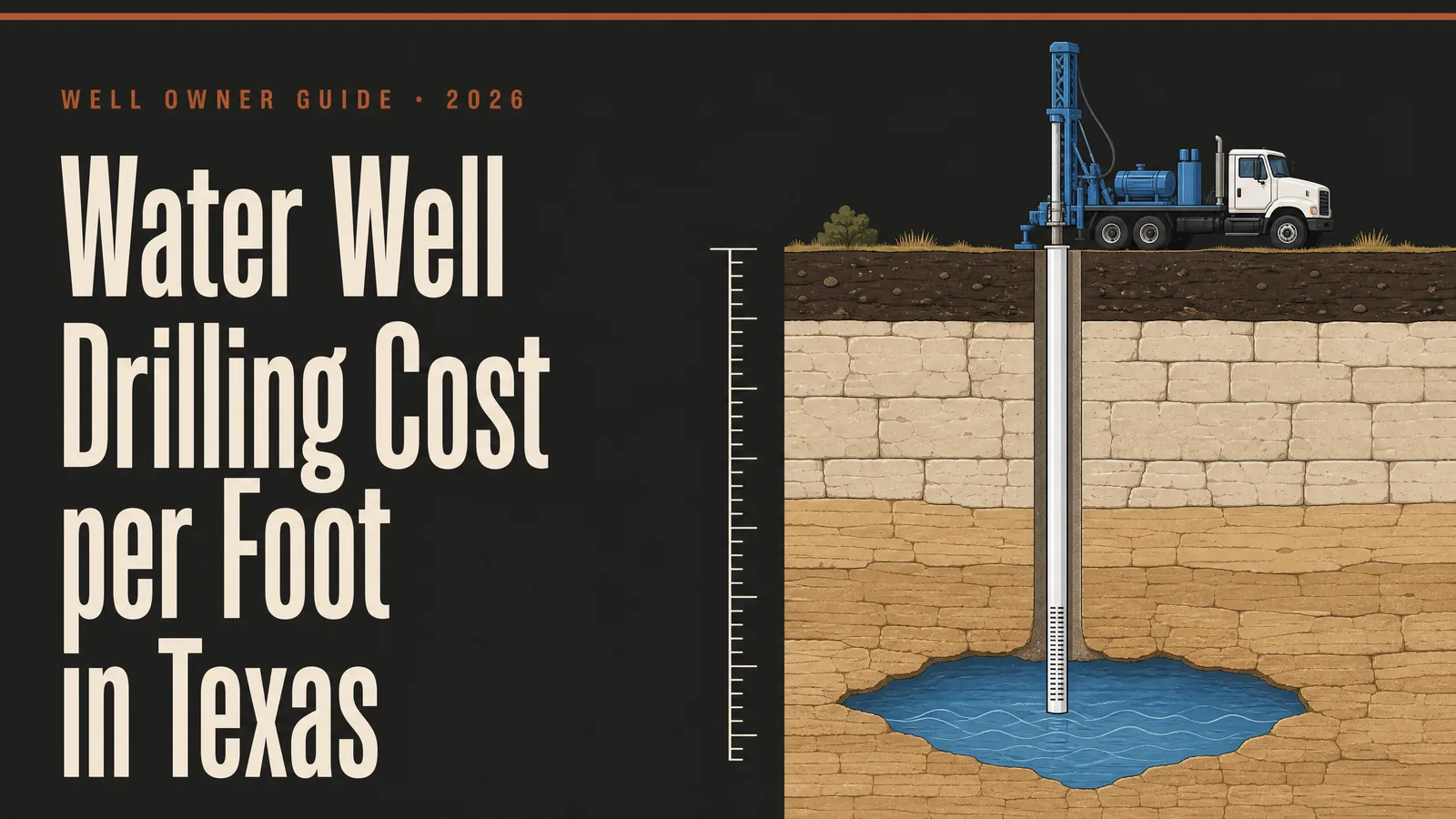
Water Well Drilling Weatherford gets asked for a price per foot before almost anything else, and the honest answer is that Texas has no official one. No agency tracks it, and the published numbers come from cost guides and contractor pages with no stated sample size. This page puts the 2026 figures side by side, shows where they disagree, and applies them to real Parker County depths. For the full line-by-line price of a Weatherford well, start with our water well drilling cost guide.
How much does water well drilling cost per foot in Texas?
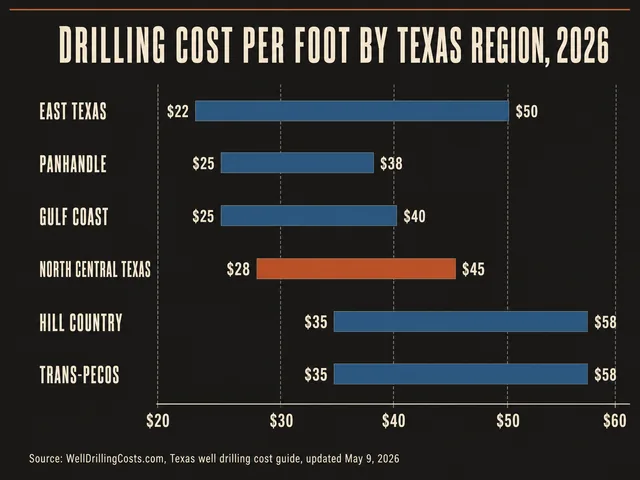
Drilling-only rates run about $22 to $58 per foot across Texas, and they follow the rock. WellDrillingCosts.com (published March 2026, updated May 9, 2026) gives six regional ranges, and the cheapest ground is soft sand and the most expensive is hard limestone and volcanic rock.
| Region | Drilling-only rate | Source |
|---|---|---|
| East Texas / Piney Woods | $22–$50 per foot | WellDrillingCosts.com, May 2026 |
| High Plains / Panhandle | $25–$38 per foot | WellDrillingCosts.com, May 2026 |
| Gulf Coastal Plain | $25–$40 per foot | WellDrillingCosts.com, May 2026 |
| North Central Texas / Cross Timbers (includes Parker County) | $28–$45 per foot | WellDrillingCosts.com, May 2026 |
| Edwards Plateau / Hill Country | $35–$58 per foot | WellDrillingCosts.com, May 2026 |
| Trans-Pecos / Far West Texas | $35–$58 per foot | WellDrillingCosts.com, May 2026 |
The same guide says soft Gulf Coast sand drills at $22–$30 per foot because it drills fast and barely wears the bit, while Edwards Plateau limestone is $40–$58 because a single bit can cost $1,800–$3,500. SC Well Service (July 2026) lists $25–$45 per foot for limestone and $35–$60 for hard rock, but does not name a primary source for those rates, so treat them as a rough cross-check only.
Why do published per-foot rates disagree?
They disagree because no source publishes how it collected its numbers. A second Texas guide, WellDrillingCost.com (verified April 2026), lists the Trinity Aquifer across the Hill Country and north central Texas at $40–$55 per foot. That is $12 per foot above the $28 low end quoted for the same area, and no guide explains the gap.
| Source and date | Rate | Scope |
|---|---|---|
| WellDrillingCosts.com, May 2026 | $28–$45 per foot | North Central Texas, drilling only |
| WellDrillingCost.com, April 2026 | $40–$55 per foot | Trinity Aquifer, Hill Country and north central Texas |
| DFW Well Service, June 2026 | $45–$60 per foot | Complete system in North Texas |
| This Old House, March 2026 | $25–$65 per foot | National range; residential wells average 300 ft |
| Leaf Home, August 2025 | $25–$50 shallow, $30–$70 deep | National range |
| Bob Vila, March 2023 | $30–$55 per foot | Texas statewide, older than the others |
The scope matters as much as the number. The $45–$60 figure from DFW Well Service covers drilling, casing, pump, pressure tank and electrical, so it should not be compared with a drilling-only rate. This Old House (March 2026) puts the national drilling range at $25–$65 per foot, and a 2024 California State Water Board model priced drilling alone at $65 per foot for a 500-ft well, per FindMyWellDriller. California is not Texas, but the figure shows how far rates can run above the Texas ranges.
What does a per-foot rate include?
A drilling-only rate covers the borehole and sometimes the casing, and the rest is priced separately. WellDrillingCosts.com lists PVC casing at $8–$14 per foot installed and steel at $18–$30. This Old House gives a wider national spread of $6–$10 for PVC and $30–$130 for steel, plus $50–$150 per foot for piping and electrical lines to the house.
The same North Texas driller says the pump, pressure tank and wiring add $3,000–$6,000 to a project. If a drilled well is out of reach, our cistern vs well comparison prices a rainwater system for the same household. Our pump replacement cost guide and pressure tank cost guide price those parts for Parker County, and the Upper Trinity district charges $600 plus a $100 refundable deposit to register a new well (UTGCD forms and fees).
How deep are Parker County wells, and what does that cost per well?
The median new household well in Parker County is 240 ft deep. Texas Water Development Board driller reports show 4,746 new domestic wells since January 2021, with a mean of 257 ft and a middle half of 200–300 ft (depth by town). That is slightly shallower than the 300-ft national average This Old House cites.
| Well depth (Parker County reports) | Share of new wells | Wells |
|---|---|---|
| Under 200 ft | 10.9% | 518 |
| 200–249 ft | 51.5% | 2,444 |
| 250–299 ft | 9.7% | 458 |
| 300–399 ft | 20.7% | 983 |
| 400–499 ft | 5.1% | 240 |
| 500 ft and deeper | 2.2% | 103 |
Source: Texas Water Development Board, Submitted Drillers Reports, extract dated September 25, 2026. About 26% of Parker County reports list exactly 200 ft.
Footage is the biggest lever on a quote, so here is what the North Central Texas rate of $28–$45 per foot means at each depth. These are our own multiplications, not quotes, and they cover drilling only.
| Depth | What it represents | Drilling-only cost at $28–$45 per foot |
|---|---|---|
| 200 ft | 25th percentile of Parker County wells | $5,600–$9,000 |
| 240 ft | Median Parker County well | $6,720–$10,800 |
| 300 ft | 75th percentile | $8,400–$13,500 |
| 320 ft | Median near Aledo | $8,960–$14,400 |
| 375 ft | 90th percentile | $10,500–$16,875 |
| 500 ft | Deepest 2% of wells | $14,000–$22,500 |
Two things sit outside this table. Our own cost guide rounds the Parker County low end up to $30 per foot, which moves the 240-ft figure to $7,200–$10,800, a difference of $480. And a well in Aledo, where the median depth is 320 ft, costs about $2,200–$3,600 more to drill than the county median.
Try your own depth
Enter a depth and a per-foot range to see the drilling-only cost. It uses the North Central Texas rate by default.
For the whole project, including pump, tank and trenching, use our well cost calculator.
What have Texas owners actually paid per foot?
Recent first-hand per-foot prices are hard to find, because owners usually post a total. The best traceable thread is old. On TractorByNet in February 2007, an owner in Prosper, north of Dallas, said local companies wanted $30–$40 per foot for an irrigation well of about 800 ft and that 13 neighbors wanted wells too (TractorByNet).
A Wise County member replied that Trinity water there sits at about 400 ft and that his well, drilled about six years earlier, had cost $10 per foot plus pump and tank. An East Texas driller in the same thread said he charged $14 per foot plus equipment and set-up, and credited the gap to formations and equipment: “I bet that the differences in equipment and formations are the main reasons for the price differences.” That is a driller’s explanation from 2007, not a measurement.
What the thread shows still holds. A rate of $10 per foot around 2001 and quotes of $30–$40 six years later, in a different county and for a deeper irrigation well, show how fast per-foot prices move, and how much rock and equipment change them. Today’s Parker County range sits well above $10, so a per-foot figure older than a couple of years is a history lesson, not a quote.
Author’s take: how I’d use a per-foot number
This section is the author’s analysis of the sources above, written by Chris Fugate, a water well driller with 24 years of experience. It draws conclusions from the cited evidence and does not describe any particular customer or job.
Use per-foot rates to sanity-check a quote, not to build one. If a Parker County quote prices drilling at far outside $28–$45 per foot, ask why. Harder rock, a longer casing string or a remote site can explain it, but the driller should say which.
Check the footage before the rate. Most of the cost swing in a Parker County well comes from depth, not the rate. A well that finishes at 200 ft and one that goes to 375 ft differ by several thousand dollars at the same price per foot. Ask what depth the quote assumes and what happens if the water is deeper. The state driller report data above shows what is normal near you.
Compare scope, then price. A $45–$60 per-foot complete-system figure and a $28–$45 drilling-only figure can describe the same job. Get the casing, grout, pump, tank and electrical listed line by line, and confirm the driller is licensed with our guide to checking a well driller’s license.
How was this guide researched?
This guide compares published cost sources opened in October 2026: six 2026 guides or driller pages, one 2025 guide, one 2023 guide, one 2007 forum thread and the Texas Water Development Board driller database. No Texas agency publishes a per-foot rate, and none of the cost sources states a sample size.
HomeGuide, Angi and Forbes returned access errors and Reddit blocked our requests, so none is used. The multiplication tables are our arithmetic on the cited ranges. Depth figures come from our extract of state driller reports. About 7% of Parker County wells reach 400 ft or deeper, so the high-footage end of the table applies to a minority of owners. Prices move, so we review this page quarterly. Rules matter before price, so read the 2026 groundwater rule changes before you buy a lot, and see why pump depth shapes the rest of the bill. When you are ready for a written quote, see our residential well drilling service or call a well tech at the number below.
Frequently asked questions
How much does it cost per foot to drill a water well in Texas?
Published 2026 drilling-only rates run about $22 to $58 per foot across six Texas regions, per WellDrillingCosts.com. North Central Texas is $28–$45, the Hill Country and Trans-Pecos $35–$58, and the High Plains $25–$38. A complete system with pump, tank and electrical is quoted higher, at $45–$60 per foot by one North Texas driller.
How much does it cost to drill a 200-ft well in Texas?
At North Central Texas rates of $28–$45 per foot, drilling 200 ft costs $5,600–$9,000 for the borehole, casing and seal. A complete system quoted at $45–$60 per foot would run $9,000–$12,000 at 200 ft. Pump, tank and hookup change the total, so ask for each line separately.
Why are Texas well drilling prices so different from one source to the next?
Sources use different regions, rock types and scopes, and none publishes a sample size. For north central Texas, WellDrillingCosts.com lists $28–$45 per foot while WellDrillingCost.com lists $40–$55 for the Trinity Aquifer. Bob Vila's 2023 Texas range was $30–$55. Treat each as a planning range and get written quotes.
Does the per-foot price include the pump and pressure tank?
Usually not. Drilling-only rates cover the borehole and often casing. A North Texas driller says the pump, pressure tank and wiring add $3,000–$6,000, and quotes $45–$60 per foot only for a complete system. Always ask whether a per-foot figure covers casing, grout, development, pump, tank and electrical.
How deep is a typical water well in Parker County?
The median new household well is 240 ft deep, and the middle half run 200–300 ft, from 4,746 Texas Water Development Board driller reports since 2021. About 7% of Parker County wells reach 400 ft or more, and Aledo's median is 320 ft, so footage and price run higher on the east side.
Sources
- WellDrillingCosts.com, Texas Well Drilling Cost: 5 Regions, 2026 (published March 14, updated May 9, 2026)
- WellDrillingCost.com, Texas Well Drilling Cost 2026 (last verified April 2026)
- DFW Well Service, How Much Does It Cost to Drill a Water Well in North Texas? (updated June 4, 2026)
- This Old House, Well Installation Cost (updated March 30, 2026)
- SC Well Service, Texas Well Statistics 2026 (last updated July 1, 2026)
- Leaf Home, How Much Does It Cost to Drill a Well? (August 26, 2025)
- Bob Vila, Well Drilling Cost (published March 30, 2023)
- FindMyWellDriller, How Much Does Well Drilling Cost? (February 3, 2026, citing the California State Water Board 2024 cost model)
- TractorByNet forum, Well Drilling - North Texas (thread started February 22, 2007)
- Texas Water Development Board, Submitted Drillers Reports (extract dated 2026-09-25)
- Upper Trinity Groundwater Conservation District, forms and fees