A well pump running constantly means it never reaches its shut-off pressure. The usual causes are water being used (a running toilet or leak), a failed pressure switch or tank, lost prime, a leak in the well piping, a low well or a worn pump. Closing the main valve at the tank tells you which side to check.
Key takeaways
- A well pump should fill the pressure tank and then shut off until water is used again; constant running signals a problem (Hunker, updated Jan. 7, 2022).
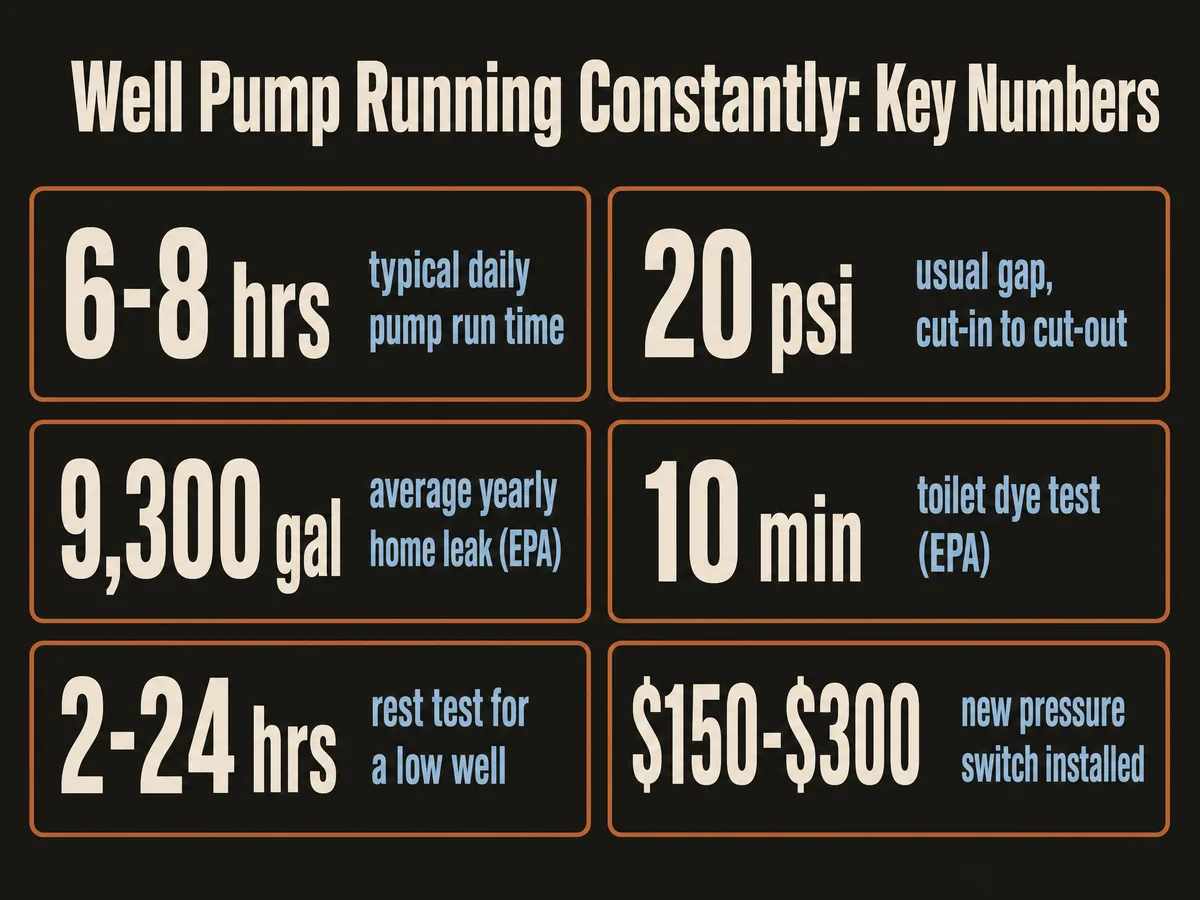
- One Maryland pump contractor puts normal run time at about 6 to 8 hours a day, sometimes up to 10, across all of a household's water use, so a pump that never stops is outside that (Tri-County Pumps, Dec. 2024).
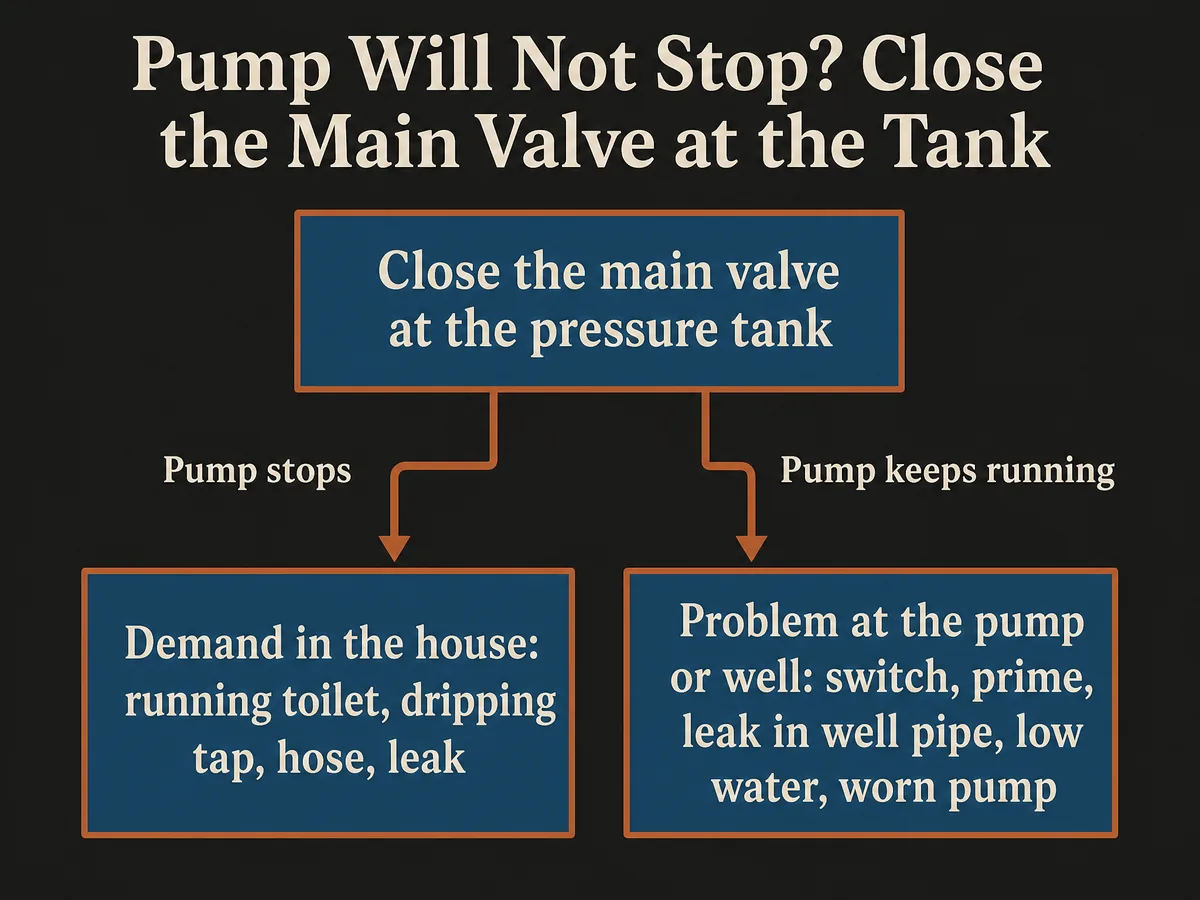
- The fastest split: close the main valve at the pressure tank. If the pump stops, the water is going out in the house; if it keeps running, look at the pump, switch or well (InspectApedia).
- The average U.S. home loses more than 9,300 gallons a year to leaks, and a toilet flapper leak can show up in a 10-minute dye test (EPA WaterSense).
- A switch cut-out set above what the pump can produce keeps it running; InspectApedia gives about 20 psi between cut-in and cut-out as typical (InspectApedia).
- If the well may be pumped down, switch the pump off and let it rest 2 to 24 hours to see whether it recovers (InspectApedia).
- A replacement pressure switch typically runs $150 to $300 installed (our pressure tank cost guide, from HomeGuide), far below a $1,800 to $4,500 pump replacement (our pump cost guide).
Water Well Drilling Weatherford gets this call when the pump has been humming for hours: a well pump running constantly. Most of the time the cause is one of seven things, and you can narrow it to one side of the system in a couple of minutes. Below are the checks, what each cause costs, and the point where a well pump repair visit is cheaper than another day of running. Line-item prices are in our well pump repair cost guide.
Is it normal for a well pump to run constantly?
No. A well pump should fill the pressure tank and then shut off until water is used again, and Hunker says constant running signals a problem with the water system. It also raises the power bill and can wear the pump out early. The opposite fault, a pump that starts every few seconds, is covered in well pump short cycling.
How long is too long? A Maryland pump contractor says a pump typically runs about 6 to 8 hours a day, sometimes up to 10, depending on household use (Tri-County Pumps). That is one contractor’s figure, not a manufacturer rating, and it is a total across many short runs. A pump that has not stopped for an hour while nobody is using water is outside any normal pattern.
Why is my well pump running constantly?
The pump runs until pressure reaches the switch’s cut-out setting. If it never gets there, either water is leaving the system as fast as the pump supplies it, or the pump or switch cannot do its job. The table groups the causes the sources agree on.
| Cause | Side of the system | How to check | Typical fix |
|---|---|---|---|
| Running toilet, dripping tap, hose or sprinkler | House | Pump stops when the main valve is closed | Repair or shut off the source |
| Leak in the line between well and house | Outside | Gauge falls with the pump off and valve closed; wet ground | Locate and repair the line |
| Failed or mis-set pressure switch | Pump controls | Compare gauge to cut-in and cut-out; look for burned contacts | Reset or replace the switch |
| Waterlogged or failed pressure tank | Pump controls | Tank sounds solid when tapped; water at the air valve | Recharge or replace the tank |
| Lost prime (above-ground jet pump) | Pump | Remove the priming plug and look for water | Re-prime; find the foot or check valve leak |
| Leaking check valve or broken drop pipe | Well | Pressure falls with nothing running | Replace the valve or pull the pump |
| Low water level or worn pump | Well or pump | Rest the pump 2 to 24 hours; pump can’t reach cut-out | Resize, deepen or replace |
Sources: InspectApedia, Hunker, Tri-County Pumps, Southern California Well Service.
How do you tell where the problem is?
Close the main valve at the pressure tank, the one that sends water to the house. InspectApedia gives this as the first test: if the pump stops, the leak or draw is downstream of the valve, in the house. If it keeps running, the problem is at the pump, the controls or the well.
If the pump is running dry at any point, with no water arriving and the tank not filling, InspectApedia says to cut power to the pump right away, because running dry can damage it.
What if the pump stops when the main valve is closed?
Then water is being used somewhere, and the pump is doing its job. Walk the house first: a running toilet, a dripping tap, an outdoor hose, an irrigation zone stuck on, a leaking water heater or softener line.
The toilet is the usual suspect. EPA WaterSense says a worn flapper can leak thousands of gallons a year without a sound, and the dye test is simple: put a few drops of food coloring in the tank, wait 10 minutes without flushing, and see whether color appears in the bowl. The same EPA page says the average home loses more than 9,300 gallons a year to leaks, and a faucet dripping once a second wastes over 3,000. On a well, that water is all pumped by your own pump and paid for in your own electricity.
What if the pump keeps running with the valve closed?
Work through the pump side in this order. The checks run from cheap to costly.
- The pressure switch and its setting. InspectApedia lists a cut-out set too high, clogged or leaking switch tubing and welded or burned contacts among the causes. It gives about 20 psi between cut-in and cut-out as typical, and says to confirm the gauge itself is accurate before blaming the pump. Our pressure switch guide covers the settings, including the failure where a setting above what the pump can produce leaves it running.
- The pressure tank. A waterlogged tank cannot hold pressure, so the pump has to run every time water is drawn. Our signs of a bad pressure tank guide has the tap test and the air-charge check.
- Prime, on an above-ground jet pump. If the pump has lost prime, it can run dry continuously. Check for water in the priming port and see how to prime a well pump. Most Parker County house wells use a submersible, which does not lose prime.
- The well piping. With the pump off and the main valve closed, a gauge that keeps falling points to a leak in the line or a leaking check valve. One well service says a drop of more than 5 psi in a minute or two with nothing running suggests a check valve problem (Southern California Well Service, Feb. 2026).
- The water level. A submersible must stay under water to work. InspectApedia says to turn the pump off for 2 to 24 hours and see whether the well recovers; another shop suggests 24 to 48. New wells near Weatherford finish with water about 110 ft down, and around Aledo about 176 ft (TWDB driller reports, per our low-pressure guide). Our is my well going dry guide covers the signs.
- The pump itself. A worn pump may stall below cut-out. One shop’s example is a pump that tops out at 42 psi when the switch is set to 50 (Southern California Well Service). Our how long a well pump lasts article gives the 8 to 15 year range for submersibles.
Franklin Electric’s manual describes its submersible motors as designed for a cooling flow of water over and around the motor (Franklin Electric, pp. 8-9). A pump that is running but not moving water through the well is not being cooled that way, which is why stopping it early matters.
What have other well owners reported?
Two public cases on InspectApedia show how fast this can turn serious. On July 4, 2017, a reader named Jim wrote that his switch was set to cut out at 50 psi but pressure climbed to 90 psi and the pump kept running. He had already swapped in a new 30/50 switch with no change. The editor called it dangerous and advised turning the pump off, opening faucets until pressure dropped to 30 psi or below, and setting the tank’s air charge to 28 psi. No outcome was reported.
On February 15, 2021, a reader named Janis wrote that a frozen well pump had thawed and started running continuously at very high pressure. The editor’s first advice was to turn the pump’s power off immediately, because the tank could burst (InspectApedia FAQs). Our guide to protecting a well pump from freezing covers the cold-weather side.
Both threads make the same point: when pressure rises past the switch’s cut-out, the pump is no longer being controlled, and the safe move is the breaker.
Author’s take: what would I check first?
This section is the author’s analysis of the sources above, written by Chris Fugate, a water well driller with 24 years of experience. It draws conclusions from the cited evidence and does not describe any particular customer or job.
Do the main-valve test and the toilet dye test before you call anyone. Both are free and take minutes, and between them they split the problem into “the house” and “the well.” The sources agree on this order, and it keeps you from paying for a pump visit to find a $20 flapper.
Treat rising pressure as an emergency and slow running as a diagnosis. A pump that runs steadily at normal pressure is wasting power; a pump that runs while the gauge climbs past cut-out is a risk to the tank and the plumbing. The 90 psi thread is the case to remember.
Don’t reset the switch higher to cure a pump that won’t shut off. If the pump cannot reach the new number, you have only moved the failure. Check the tank, the prime and the water level first.
What does it cost to fix a pump that won’t stop?
Cost depends on the cause, and the cheap causes are the most common. Our own guides put a replacement pressure switch at $150 to $300 installed (pressure tank cost guide, from HomeGuide), a replacement tank at $800 to $1,800, and a submersible pump replacement at Parker County depths at $1,800 to $4,500 (pump replacement cost).
Southern California Well Service lists $50 to $500 for most household leaks, $200 to $400 for a check valve at the well head and $800 to $1,500 for one downhole, and $500 to $2,000 or more for a broken drop pipe, because the pump has to be pulled (Feb. 2026, California pricing, so use it as a guide to relative cost). Our repair or replace guide explains how a technician decides.
Call a licensed pro if:
- the pump keeps running with the main valve closed and the switch and tank check out;
- pressure climbs past the cut-out setting;
- the pump runs but no water arrives, or the breaker trips;
- you find burned switch contacts or cannot confirm the power is off.
Texas requires a license to install or repair a pump on a water well (TDLR). If the house has no water at all, use emergency well pump repair or work through our no water from well guide. If the tank is the culprit, see well pressure tank replacement.
How was this guide researched?
This guide draws on one InspectApedia reference page and its reader FAQ, two contractor guides, one lifestyle-site explainer, the EPA’s leak guidance, one manufacturer manual and TWDB and TDLR records. It contains no original measurements or field tests, and the 6 to 8 hour run time is one contractor’s figure with no manufacturer source found. The cost figures from Southern California Well Service are California pricing, and we left out its percentage-of-cases estimates because it gives no source for them. Reddit threads on this topic exist but our fetch tool could not read them, so none are quoted.
Frequently asked questions
Why is my well pump running constantly?
It is not reaching its shut-off pressure, or something keeps calling for water. The usual causes are a running toilet or leak, a failed or mis-set pressure switch, a waterlogged tank, lost prime on a jet pump, a leak in the well piping, a low water level or a worn pump. Close the main valve at the tank to see which side the problem is on.
Is it normal for a well pump to run all the time?
No. Hunker says a well pump should fill the pressure tank and then shut off until more water is needed. One pump contractor puts normal total run time at about 6 to 8 hours a day, spread across many short cycles, so a pump that never shuts off needs attention.
How long can a well pump run continuously?
The sources we read give no safe limit, and it depends on the pump and on water flowing past the motor to cool it. Franklin Electric's manual describes its submersible motors as designed for a cooling flow of water along the motor. If the pump runs without delivering water, turn it off at the breaker straight away.
Can a running toilet make a well pump run constantly?
Yes. Any steady demand keeps the pressure from reaching cut-out. A toilet fill valve or flapper leak is a common one. The EPA says a few drops of food coloring in the tank that show up in the bowl within 10 minutes mean a leak.
Why does my well pump run but no water comes out?
A jet pump may have lost prime, the well level may have dropped below the pump intake, or there may be a break in the drop pipe. Turn the pump off, because running dry can overheat and damage it. See our guide on how to prime a well pump if you have an above-ground jet pump.
Why is my well pressure going past 60 psi and the pump won't shut off?
That points to a switch that is not opening, such as welded contacts, or to wiring or tank trouble. A reader on InspectApedia reported pressure climbing to 90 psi on a switch set to cut out at 50. The site's editor called it dangerous and advised turning the pump off at the breaker.
Should I turn off my well pump if it keeps running?
Yes, if it runs without delivering water, if pressure climbs well above the cut-out setting, or if you hear or smell anything unusual. Turn off the breaker, then work through the checks in this guide. In Texas, repairing or replacing a pump on a water well is licensed work.
Sources
- InspectApedia, Why won't our water pump turn off? (Daniel Friedman)
- InspectApedia, FAQs on a water pump that won't stop running (reader questions)
- Hunker, Should a Well Pump Run Constantly? (Julie Bawden-Davis, updated Jan. 7, 2022)
- Tri-County Pumps, Why a Well Pump Runs Constantly: Causes and Fixes (Dec. 26, 2024)
- Southern California Well Service, Well Pump Running Constantly (updated Feb. 2026)
- EPA WaterSense, Fix a Leak Week
- Franklin Electric, Submersible Motors Application, Installation and Maintenance Manual (pp. 8-9, cooling flow)
- Texas Department of Licensing and Regulation, Water Well Drillers and Pump Installers at a Glance
- Texas Water Development Board, Submitted Drillers Reports