30/50 vs 40/60 pressure switch: which should you use? Use 30/50 for a one-story home and 40/60 when fixtures sit on two or more levels. The pump starts at 30 or 40 psi and stops at 50 or 60 psi. The higher setting adds 10 psi but cuts tank drawdown about 13%, and the pump must reach 60 psi.
Key takeaways
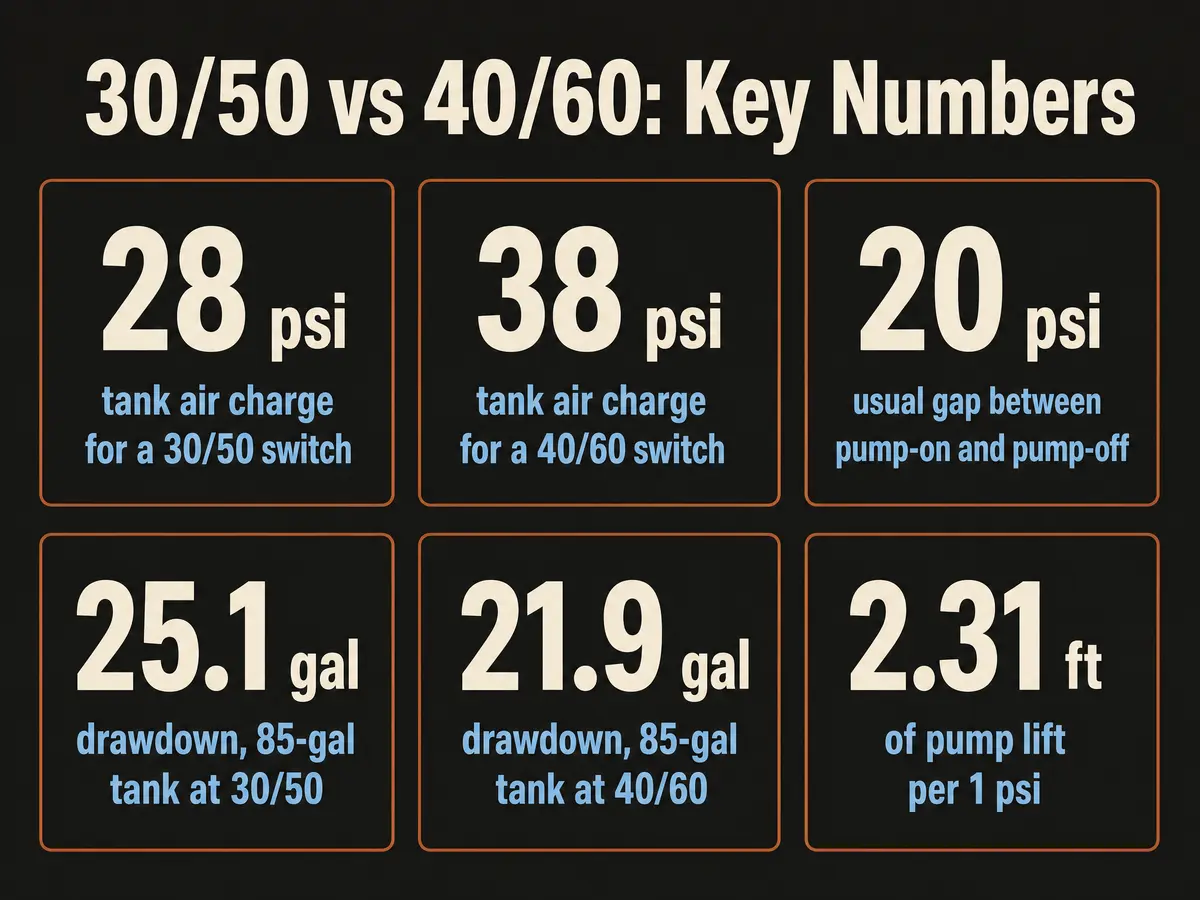
- A 30/50 switch starts the pump at 30 psi and stops it at 50 psi; a 40/60 switch starts at 40 psi and stops at 60 psi. Both keep the usual 20 psi gap (PressureTankSizer).
- Set the tank air charge 2 psi below cut-in: 28 psi for 30/50 and 38 psi for 40/60 (Water Systems Council).
- In a worked example for an 85-gallon tank, 30/50 delivers 25.1 gallons per cycle and 40/60 delivers 21.9 gallons, about 13% less (Bob Pelikan, The Driller, 2006).
- A retailer's guide says 30/50 can be enough for a one-story home and 40/60 is worth considering when two or more levels have fixtures (R.C. Worst, Feb. 2018).
- Every 1 psi equals about 2.31 ft of water head, so 40/60 asks the pump for about 23 ft more lift at cut-out than 30/50 (BCcampus, Math for Trades; our arithmetic).
- Parker County's new household wells have a median depth of 240 ft, so the extra 23 ft is a small share of the pump's total lift; check its curve and rating before you change anything (our depth guide).
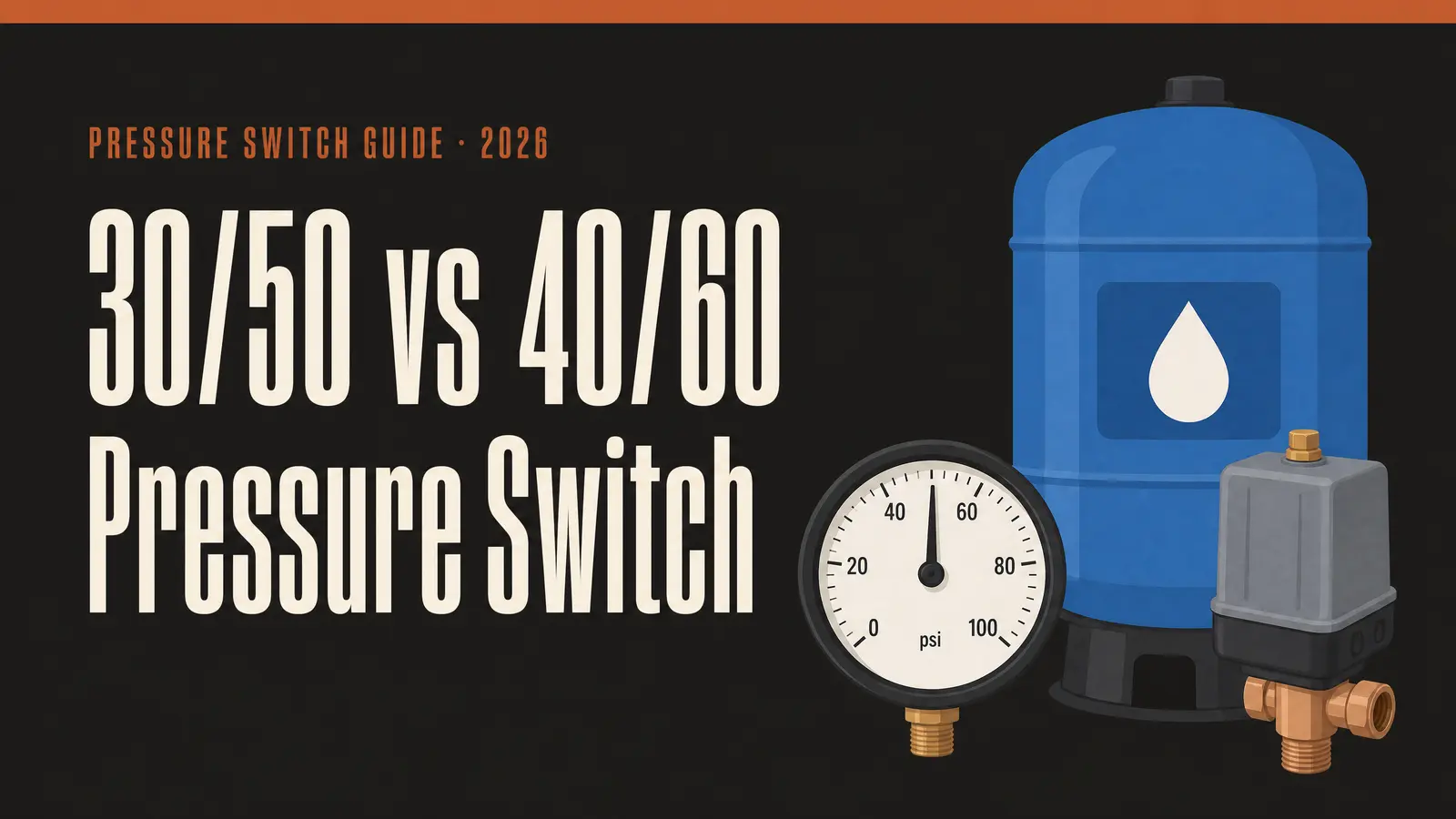
Water Well Drilling Weatherford covers the 30/50 vs 40/60 pressure switch choice that well owners run into when pressure fades as the pump kicks in or an upstairs bath feels weak. The two numbers are the psi where the pump turns on and where it turns off. This guide covers what each setting does to pressure, tank water and the pump, and which one to pick. Our well pressure tank replacement page covers the tank side.
What is the difference between a 30/50 and a 40/60 pressure switch?
A 30/50 switch starts the pump when pressure falls to 30 psi and stops it at 50 psi. A 40/60 switch starts at 40 psi and stops at 60 psi. Both keep the same 20 psi gap between cut-in and cut-out, which PressureTankSizer lists as the two common household settings.
The switch itself is often the same hardware. On a Square D 9013FSG, the large range nut moves cut-in, and the smaller differential nut moves cut-out and the gap between them (Schneider Electric). Our how to adjust a well pressure switch guide walks through the nuts step by step.
How do 30/50 and 40/60 compare side by side?
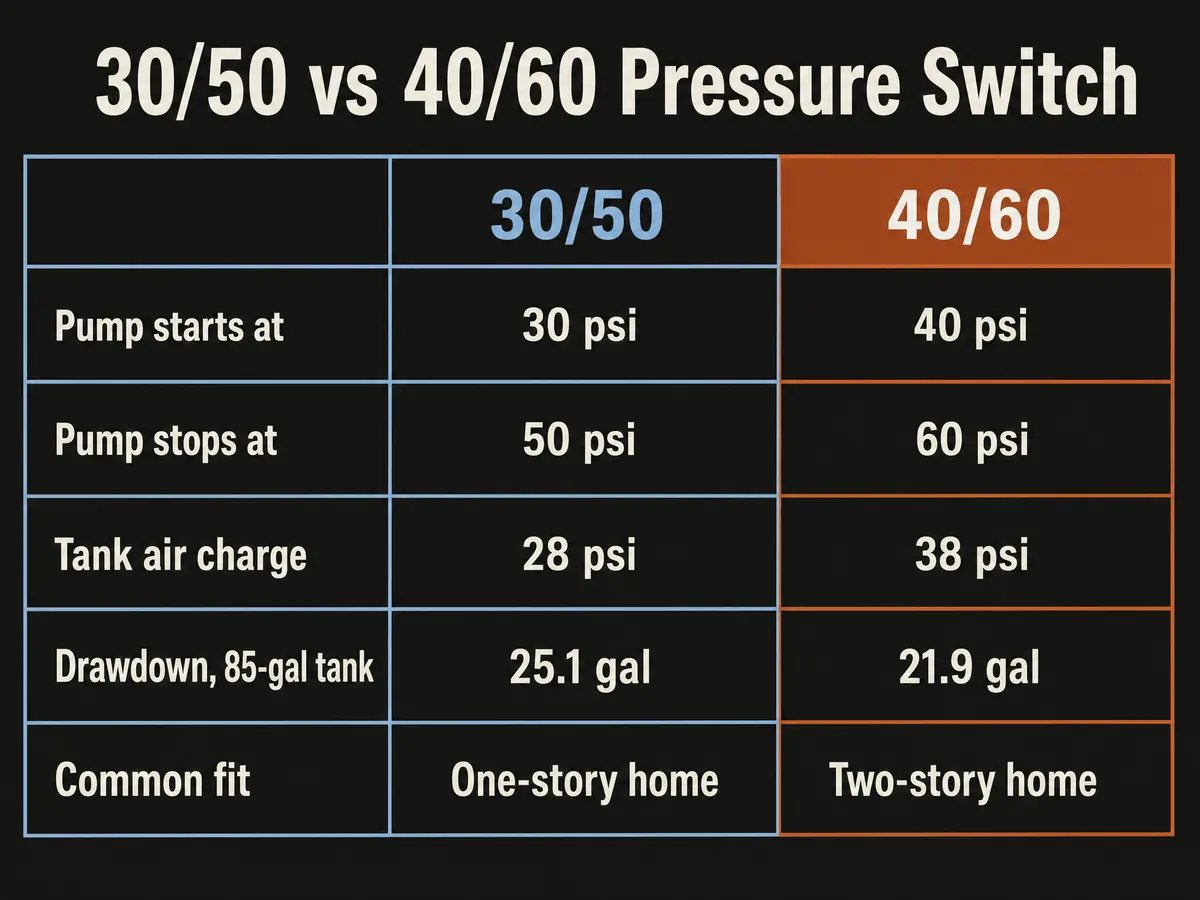
The settings differ in five practical ways: where the pump starts and stops, the tank air charge, the water each cycle delivers, the load on the pump, and the kind of house each suits. The table below puts the sourced numbers in one place.
| 30/50 | 40/60 | |
|---|---|---|
| Pump starts (cut-in) | 30 psi | 40 psi |
| Pump stops (cut-out) | 50 psi | 60 psi |
| Tank air charge | 28 psi | 38 psi |
| Drawdown, 85-gal tank | 25.1 gal | 21.9 gal |
| Extra pump lift at cut-out | baseline | about 23 ft more |
| Common fit | One-story home | Fixtures on two or more levels |
Sources: Water Systems Council for the air charge; The Driller for drawdown; R.C. Worst for the fit. The 23 ft is our arithmetic from 10 psi at 2.31 ft per psi.
Which one should you choose for your house?
Choose 30/50 unless the house needs more pressure. R.C. Worst’s guide says 30/50 may be sufficient for a one-story home, or a two-story home with no fixtures upstairs, and that 40/60 is worth considering when two or more levels have fixtures. It adds that lower pressures are easier for the pump and gentler on old plumbing (R.C. Worst, Feb. 12, 2018).
The source calls the choice personal preference. Low pressure at one far fixture is not always a switch problem, so work through our low water pressure on a well diagnosis before you raise the setting.
Does 40/60 give you less water per pump cycle?
Yes. Raising the pressure compresses the air in the tank more, so the tank holds less usable water between cut-in and cut-out. In Bob Pelikan’s worked example in The Driller, an 85-gallon tank with a 28 psi charge on a 30/50 switch delivers 25.1 gallons per cycle; the same tank on a 40/60 switch with a 38 psi charge delivers 21.9 gallons (The Driller, Feb. 1, 2006).
That is 12.7% less water per cycle. For the same water use, the pump starts about 15% more often, because 25.1 divided by 21.9 is 1.15. That is our arithmetic, not a measured result. The article’s drawdown formula uses absolute pressures, so it adds 14.7 psi to each gauge reading at sea level.
Why does cycling matter? Franklin Electric’s submersible motor manual says excessive cycling shortens the life of switches, starters, relays and capacitors, and sets a limit of 100 starts per 24 hours for single-phase motors from 1 to 5.5 hp (Franklin Electric manual, Table 1). If your pump already cycles, read our well pump running constantly causes first. A larger tank offsets the loss; our pressure tank sizing guide shows how.
Can your pump and tank handle 40/60?
Only if the pump can build the cut-out pressure and the tank is rated above it. A pump that cannot reach 60 psi runs without stopping. A forum reply on the Terry Love Plumbing forum put it plainly: confirm the pump can actually reach the chosen cut-out first (Terry Love forum, March 2025).
Pump type decides the limit. A 1 HP deep-well jet pump from Flotec is rated to a maximum lift of 70 ft and a 70 psi shut-off (Pentair Flotec FP4210), so a jet near its limit may stall at 60 psi. Our submersible vs jet pump comparison covers the difference. Pentair’s switch instructions also say never to set cut-off above 60 psi, and our guide on how to increase well water pressure covers the checks to make first.
In Parker County, new household wells have a median depth of 240 ft and water about 110 ft down (our depth guide). A submersible set that deep already lifts water 110 ft or more before pressure is added. Each psi equals about 2.31 ft of head (BCcampus), so 60 psi adds about 139 ft and 50 psi about 116 ft. On a 240 ft well that is a small share of the total lift, but a worn or undersized pump may still not reach 60 psi, so the pump curve should be checked first. Our well pump lifespan article covers how age changes output.
What do well owners and plumbers say about these settings?
Forum threads show the same trade-offs in practice. A homeowner on the Terry Love forum asked in March 2025 whether a 30/50 switch could be changed to 30/60 so the tank would hold more water. One reply warned that a 30/60 setting may overstretch the diaphragm unless the tank has an internal dome limiter. Another said tank diaphragms are typically designed for about a 20 psi differential, so a 30 psi swing would be excessive for many tanks (Terry Love forum, March 24-25, 2025). The replies shown did not settle on a single answer or report a result from the poster.
A different thread shows what a high setting can hide. In April 2020 a new owner of a 3,600 square foot house reported a 16-year-old tank with a 38 to 70 psi swing and only 9 psi of air in it. Respondents said the wide range, not a restriction, was the problem. The poster ordered a 50/70 switch and then found air coming out of the tank drain, a failed diaphragm, so the tank needed replacing (Terry Love forum, April 16, 2020). The lesson is that a bad tank charge can look like a switch problem; our signs of a bad pressure tank page lists the symptoms.
What goes wrong when you change the setting?
Four things go wrong most often, based on the sources above:
- The tank charge is not reset. Changing the switch without moving the charge to 2 psi below the new cut-in cuts drawdown and speeds up cycling (Water Systems Council).
- The pump cannot reach cut-out. It runs without stopping. Turn the breaker off and back the setting down.
- The gap is stretched. A 30 psi swing may overstretch a diaphragm, per the Terry Love replies above.
- A bad tank is blamed on the switch. Air at the tank drain means the diaphragm has failed.
A new switch is a small repair. We list a pressure switch at $150 to $300 installed in our pressure tank replacement cost guide, citing HomeGuide (2026).
Our take: what I would set on a typical Parker County well
This section is the author’s analysis of the sources above, written by Chris Fugate, a water well driller with 24 years of experience. It draws conclusions from the cited evidence and does not describe any particular customer or job.
Start at 30/50 and move up only for a reason. The sources agree that 30/50 is the gentler setting for the pump, the plumbing and the tank, and it gives the most water per cycle. If the pressure you have is enough at the farthest fixture, there is nothing to fix.
Go to 40/60 for fixtures on two levels, and treat the tank as part of the change. The extra 10 psi costs about 13% of your drawdown, so a 40/60 system on a small tank will cycle more. If the tank is the original and 15 years old, replacing it is a better use of money than moving the nuts.
Do not stretch the gap. The forum replies about 30/60 line up with what the tank makers design for. If you want a longer run time, buy a larger tank rather than widening the swing.
Check the pump before the switch. On a 240 ft well the extra 23 ft of lift is a small share of the total, but a tired pump may still not shut off. If it runs constantly after the change, return the setting and have the pump tested.
When should you call a well technician?
Call if the pump runs constantly after a change, if the gauge falls to zero between cycles, if air spits from the faucets or the tank drain, or if you are unsure the breaker is off. The switch carries 240 volts, and the pump is the most expensive part of the system.
Our well problem checker helps sort out the symptom first, and well pump repair covers what we diagnose in Parker County. If you want the pump, tank and switch matched properly, you can request a site visit and we will check the pump curve, the tank charge and the switch together.
How was this guide researched?
This guide draws on a 2006 trade-magazine drawdown calculation, a 2018 retailer guide, two Terry Love Plumbing forum threads, a Schneider Electric support page, a Franklin Electric motor manual, a Pentair pump specification, a Water Systems Council sheet and a BCcampus textbook. The drawdown figures come from The Driller’s worked example for one 85-gallon tank, not from a test of our own. The percentage changes and the 23 ft figure are our arithmetic. We could not fetch several Reddit, Facebook and retail pages that appeared in search, so none are used. No Parker County pump or tank was tested for this guide.
Frequently asked questions
What is the difference between a 30/50 and a 40/60 pressure switch?
A 30/50 switch turns the pump on at 30 psi and off at 50 psi. A 40/60 switch turns it on at 40 psi and off at 60 psi. Both keep a 20 psi gap, so the 40/60 simply runs the whole system 10 psi higher and needs a 38 psi tank charge instead of 28 psi.
Is 40/60 better than 30/50 for a well?
It is better only if the house needs the extra pressure. R.C. Worst says 30/50 may be enough for a one-story home and 40/60 is worth considering with fixtures on two or more levels. The higher setting also means a smaller drawdown per cycle and more load on the pump.
Can I change a 30/50 switch to 40/60 myself?
Often yes, but with the breaker off and in steps. Turn the large range nut clockwise to raise both settings, then reset the tank air charge to 38 psi. First confirm the pump can build 60 psi and the tank is rated above it. Our adjustment guide has the steps.
Does 40/60 make the pump cycle more often?
Slightly. The Driller's worked example gives 21.9 gallons per cycle at 40/60 against 25.1 gallons at 30/50 for the same 85-gallon tank. That is about 15% more starts for the same water use, so a 40/60 setting with a small tank cycles noticeably more.
What tank air charge goes with a 40/60 pressure switch?
Set the air charge to 38 psi, 2 psi below the 40 psi cut-in, measured with the tank drained of water pressure. A 30/50 switch pairs with 28 psi. A wrong charge cuts the usable drawdown and is a common reason a tank short-cycles.
Can a worn pump handle a 40/60 setting?
It might not. If the pump cannot build the cut-out pressure it runs without shutting off. Chucky_ott on the Terry Love forum advised confirming the pump can actually reach a new cut-out first. Back the setting down and call a technician if it keeps running.
Is 30/60 a good setting to get more water from the tank?
Forum plumbers advise against it. On the Terry Love forum, one reply said tank diaphragms are designed for about a 20 psi swing and a 30 psi swing would be excessive for many tanks. Another said a diaphragm can be overstretched unless the tank has an internal dome limiter.
Sources
- PressureTankSizer, how to set a well pump pressure switch (30/50 vs 40/60)
- Water Systems Council, wellcare: Sizing a Pressure Tank (precharge 2 psig below cut-in)
- Bob Pelikan, The Driller, How to Calculate and Control Pressure Tank Drawdown (Feb. 1, 2006)
- R.C. Worst & Company, 30/50 or 40/60 PSI: What Pressure to Set Your System To (Chris Worst, Feb. 12, 2018)
- Terry Love Plumbing forum, Pressure switch 30/60? Why 20 PSI range (March 24-25, 2025)
- Terry Love Plumbing forum, Well Water System Poor Pressure (April 16, 2020)
- Schneider Electric, adjusting the 9013FSG pressure switch (range nut and differential nut)
- Franklin Electric, Submersible Motors Application, Installation, Maintenance manual (2023), Table 1 starts per 24 hours
- Pentair Flotec, FP4210 1 HP deep-well jet pump (maximum lift 70 ft)
- BCcampus, Math for Trades: Understanding and Working with Units (2.31 ft of water per psi)